
Zando acquires Tin House Books
Zando, established in 2020 by a former Penguin Random House editor/publisher, is acquiring the Tin House trademark and their entire catalog of more than 200 titles.

Zando, established in 2020 by a former Penguin Random House editor/publisher, is acquiring the Tin House trademark and their entire catalog of more than 200 titles.
Author Rob Osler discusses what contributed to his novel landing on the USA Today bestseller list.
The advance review copy service, used primarily by traditional publishers, is launching a consumer marketing website.
The Spoken World podcast launched last week and will provide in-depth coverage of the global audiobook market.
Author Insider is a weekly Substack newsletter that will focus on interviews and online education featuring industry insiders.
The publisher, best known right now for the Rebecca Yarros series, will expand in a partnership with the Penguin Michael Joseph division.
Three Wishes expects to publish 15 to 20 concepts a year across novelty board books, personalized journals, arts and crafts, and sound books.
The imprint will publish science fiction, fantasy, crossover stories, speculative romance, horror, and mythological retellings.
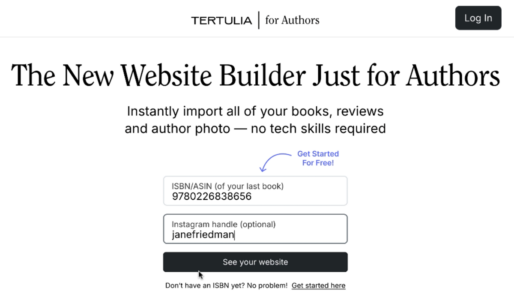
Unlike its competitors, the service requires only an ISBN and template choice to create a site in under a minute.
Sudowrite, the leading generative AI platform for creative writing, has launched a new tool called Muse. They’re calling it the “first AI made for fiction.”
Najafi has sold Author Solutions to Center Street Ventures, described as “a private investment firm focused on publishing, media, and marketing services.”
As organic search traffic declines due to AI use, will AI tools generate any meaningful traffic back to sites it uses to generate responses?
On March 4, the Trump administration’s tariffs went into effect for Canada, Mexico, and China.
The imprint is called Outsider Editions; it will focus on underappreciated literary work of all genres.
Auteur is a series of books that combine film criticism and personal narrative. Each title will examine a single movie.
Atria Australia will publish across multiple fiction genres.
The first title to be signed to the nonfiction imprint is How to Disagree Better by Julia Minson, a Harvard professor.
Crazy Maple Studio, creator of the streaming platform ReelShort, is launching a publishing division for books inspired by short videos.
The publisher will focus on underrepresented voices in fiction and nonfiction, with Ingram distributing and RBmedia as its audiobook partner.
David Moldawer has joined to represent nonfiction authors. He previously held editorial positions at Amazon Publishing and Portfolio.
A Romania-based publisher has quietly built a successful business selling specialized nonfiction books directly to consumers.
Amulet publishes fiction, essays, and poetry on the theme of spirituality.
There’s already more to read than anyone has time to consume. Do generative AI tools really make the problem any worse than it is?
Gotham Ghostwriters and the Association of Ghostwriters will host their second annual Gathering of the Ghosts in New York City in November.
Digital audio now beats ebooks in terms of dollars earned for AAP-reporting publishers.
BeRead is headed up by two people with backgrounds in the publishing industry. Both have worked in marketing positions for the big houses.
The latest in traditional publishing, magazines, marketing & promotion, children’s publishing, romance, media, AI, and libraries.
If you’re publishing a nonfiction book of any kind, it’s become part of your journey now to discover the first AI-generated knockoff.
Grand Central Publishing, a division of Hachette, is launching the Cardinal imprint this fall, which will publish fiction and nonfiction.
After fizzling out in the mid-2010s, the new-adult category is receiving renewed attention from traditional publishers.
Storytide will publish fiction for middle-grade and teenage readers.
Submissions management is one area where AI assistance might stand to improve things, but its use remains controversial.
Penguin Random House Canada is launching Swift Water Books that will publish widely across all age groups and include graphic novels.
Da Capo Press was once an independent publisher in Boston; it was acquired by Hachette in 2016.
The imprint is a partnership with the founder and producer of 12:01 Films and Emily Bestler Books.
The two companies will look for books that have “cinematic roots” and partner on film and TV adaptations.
The home of Rebecca Yarros has announced Mischief Books and Mayhem Books.
The platform enables Substack writers who want to collaborate on creating themed collected writings in a more polished print or ebook form.
Jason Rekulak is the author of Hidden Pictures, a national bestseller and winner of a Goodreads Choice Award.
The latest in traditional publishing, bookselling, marketing & promotion, culture & politics, and AI.
They’ve just launched ElevenReader Publishing, where authors can create and sell AI-narrated audiobooks for free through their app.
This change is a reminder that you don’t actually own most ebooks you purchase—they are licensed.
Hoopla says it will revise its “collection development policy to ensure we adhere to and evolve with industry best practices.”
Recently, two new collectives of independent publishers were announced: The Stable Book Group and the Publishers Cooperative.
On the rise: romance sales in Canada, sales at Hachette, and subscription figures at Storytel.
Ingram said Amazon is not suppressing pre-orders to their knowledge.
The mission: “publish books that illuminate and elucidate the central questions and fundamental ideas of modern science for readers.”
Independent publisher Grove Atlantic has launched Atlantic Crime, a new imprint that will release 18–24 titles per year.