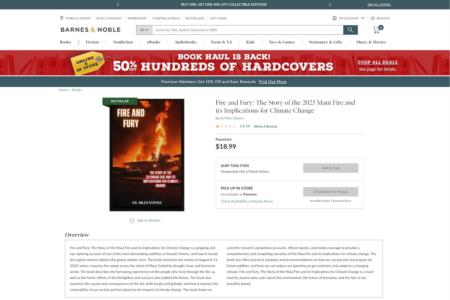
If you’re publishing a nonfiction book of any kind, it’s become part of your journey now to discover the first AI-generated knockoff. CBC (Canada) recently wrote about the problem, pointing to how it affects biographies and memoir in particular. As soon as one dupe is taken down, another takes its place.
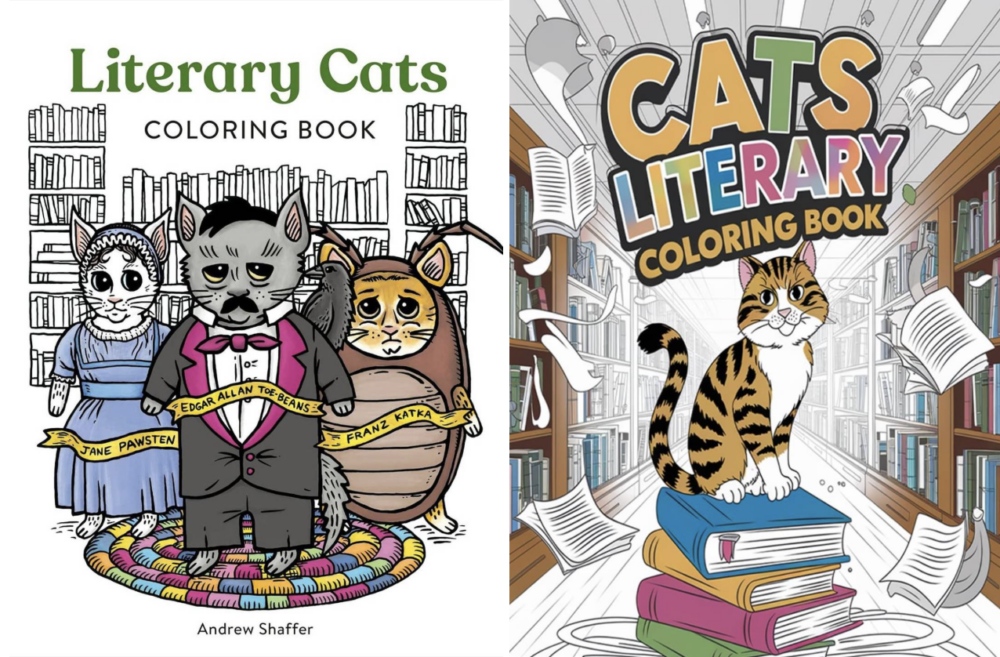
I recently heard more about this problem from author Andrew Shaffer, who wrote and illustrated a coloring book showcasing literary cats, published by Running Press (Hachette) on Feb 11. An AI knockoff with nearly the same title was published on Feb. 5, before his book’s official release date. AI copycats appear to target upcoming titles in the hopes of skimming off sales in the early days of publication, when publicity and visibility may be at its highest.
Shaffer wrote, “[It’s] a terrible knockoff that misses the mark by a mile, but it’s only a matter of time before these knockoffs get closer to being halfway decent. I almost think I should create my own knockoffs before the scammers do.”
- What can authors do? If you have a publisher, tell them. If you’re a member of the Authors Guild, you can try inquiring with their legal department for guidance, or consult with the Alliance of Independent Authors if you’re a member. If you’re self-published, you can try contacting Amazon and mention whether there’s a clear violation of their content guidelines, which say “We do not allow companion books based on copyrighted works (e.g., summaries, study guides, etc.) to be published outside the US without written permission from the copyright holder” and also “Books for sale on Amazon should provide a positive customer experience. We do not allow descriptive content meant to mislead customers or that doesn’t accurately represent the content of the book. We also do not allow content that’s typically disappointing to customers.”

Jane Friedman has spent her entire career working in the publishing industry, with a focus on business reporting and author education. Established in 2015, her newsletter The Bottom Line provides nuanced market intelligence to thousands of authors and industry professionals; in 2023, she was named Publishing Commentator of the Year by Digital Book World.
Jane’s expertise regularly features in major media outlets such as The New York Times, The Atlantic, NPR, The Today Show, Wired, The Guardian, Fox News, and BBC. Her book, The Business of Being a Writer, Second Edition (The University of Chicago Press), is used as a classroom text by many writing and publishing degree programs. She reaches thousands through speaking engagements and workshops at diverse venues worldwide, including NYU’s Advanced Publishing Institute, Frankfurt Book Fair, and numerous MFA programs.