
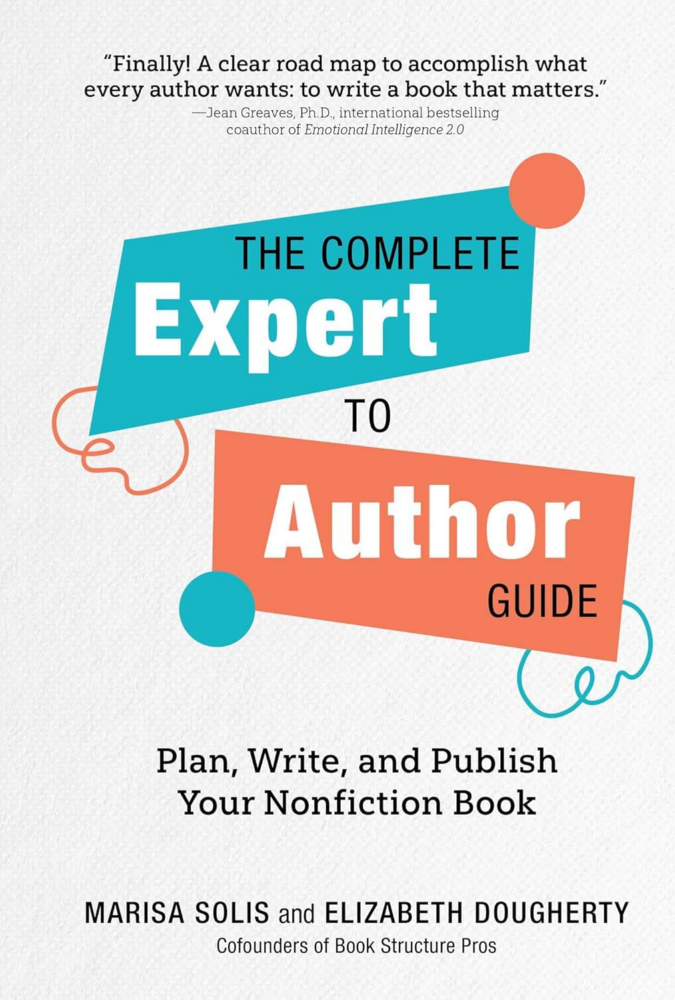
Today’s guest post is excerpted from The Complete Expert-to-Author Guide: How to Plan, Write, and Publish Your Nonfiction Book by Marisa Solis and Elizabeth Dougherty, published by The Collective Book Studio.
Like many experts, you may be very practical and methodical about the purpose of your book: There is a fairly obvious problem with a satisfying handful of proven solutions. The end.
However, a foundational step at this stage involves addressing the human component—and the main character of your book—including the emotions fueling the reader’s need for this book. As you know, the reader is the hero. The reader’s emotions matter. They won’t buy a book if they don’t feel validated from the first page.
So not only must you validate the reader’s problem and offer solutions, you must also share the promise you’re making to the reader. Because it’s in this promise that they can picture their improved life in whatever domain you’re writing about.
Initially, some of our clients gently decline to make any such guarantee. As one author declared, “I don’t feel comfortable making a promise to my reader. I simply can’t promise what their outcome will be.” We get that. In certain professional fields, a license could be at stake when you give professional advice. But you can include a disclaimer at the start of your book that protects you by stating the scope and limitations of your advice, and you, as an expert, likely know how to stay within the guidelines of your profession.
Put another way, you need to consider potential effects on the reader from your solutions, because your reader sure as heck is going to be considering them before deciding to buy your book.
Draw upon design thinking
There’s an emotive component that you must tap into when conceptualizing your book—it’s what makes the material feel relatable and relevant to the person considering buying it. The reader wants to be heard, seen, and understood. For instance, Devorah Heitner’s books Growing Up in Public and Screenwise about the challenges of parenting in the digital age (the problem) aren’t just about strategies such as managing privacy settings and talking about cyberbullying (the solutions). They’re about the profound feelings of relief, security, and confidence that come from learning how to protect your kids (the promise).
In other words, readers don’t have just functional needs, they have emotional ones too. Empathizing with people and collecting their feedback in order to deeply understand, prioritize, and effectively meet their needs—before trying to solve their problems—are important steps in design thinking. This human-centered design approach to solving problems is most commonly applied to product development, most famously by IDEO Design. Since cognitive scientist and Nobel laureate Herbert Simon first suggested design as a way of thinking in his seminal 1969 AI book The Sciences of the Artificial, design thinking has evolved into a discipline in its own right. The Hasso Plattner Institute of Design (aka “d.school”) at Stanford University is the mecca of current design thinking research and applications.
Tapping into design thinking while developing your book, aka your product, can help you remain reader-centric and find compassion for your audience. Addressing both the problem and the resulting emotions, as well as being open to new ideas, can lead to bold innovations rather than simply incremental improvements of the status quo.
Getting curious about a reader’s pain points will help you formulate solutions that address the emotions underlying their challenges. For example, when we surveyed our target audience, we learned that they felt excited to write a manuscript, worried about it being good enough, and frustrated when they stalled. This insight informed our overarching promise: to get readers unstuck and armed with the know-how to finish a high-quality book with more confidence and efficiency, and less stress.
Adopting a human-centered approach can make you a more relatable writer; if you can chart a reader’s emotional journey throughout the book, while providing practical advice, meaningful change is more likely to happen. Explain what the reader will be able to do and how they will feel different. For instance, a book about transitioning careers may make the reader feel more confident about changing jobs. Promising how your reader will be different by the time they finish your book will resonate with their pleasure points.
Imagine a different future
Readers of advice-based nonfiction are interested in some type of personal gain; they are looking to your book for guidance. One direct way to appeal to them is to offer a picture of their transformed future self—whether that self has a stronger body, greater entrepreneurial acumen, or more effective ways to cope with a breakup after they read your book.
As you consider the promise you are willing to make, ask yourself:
- How can the reader expect to be different?
- How will the reader’s life have changed?
- How will they feel if they implement your solution?
- How will their relationships, work life, personal growth, and other dynamics have shifted?
- What will their habits look like in six months and in six years if they implement the solutions?
You can also flip this line of questioning to ask: If the reader doesn’t follow the advice in your book, in what ways will their lives stay the same, or worsen, preventing them from progressing?
To be clear, we aren’t supporting creating inflated or overly optimistic claims. Whatever promise you make, it should be something that, by the end of the book, the reader can accomplish.
Exercise: The Promise My Book Is Making
- Create a document titled “The Promise My Book Is Making,” or download the free template here.
- On the first line of text, type “Ten words to describe how the reader will feel after reading my book,” then follow that prompt with ten adjectives or terms.
- Insert a one-column table with at least fifteen rows.
- List at least fifteen promises. Use the questions under “Imagine a Different Future” (above) to help you home in on tangible, realistic guarantees. If you need more lines, add them.
Here’s a shortened version of what your table can look like, with two examples:
The Promise My Book Is Making
Ten words to describe how the reader will feel after reading my book: calm, empowered, clear-headed, confident, resilient, present, peaceful, capable, liberated, courageous.
| Readers will be able to set and reach SMART goals with confidence and ease, which will reduce their frustration. |
| Readers will be able to ground themselves in the present moment, creating calm and a sense of safety. |
- Give yourself a few days or up to a week. Have any other promises come to mind? As you’ve thought about your promises, have any more problems or solutions come to mind? If so, add them to the table.
- Review the list of promises. Look for themes and other similarities. Are the promises realistic? Do they speak to the reader’s emotions? Take time to identify a thread that all the promises have in common.
- At the top of the document, above the ten words, add one sentence that states the overarching promise you’re making to the reader. Refer to the ten words to help you set the tone and inspire your writing.
Longtime book coaches and developmental editors Marisa Solis and Elizabeth Dougherty coauthored The Complete Expert-to-Author Guide: Plan, Write, and Publish Your Nonfiction Book (The Collective Book Studio). They believe that there are experts who can transform lives by writing a book. The Complete Expert-to-Author Guide gives them the tools to succeed.
Marisa and Elizabeth cofounded Book Structure Pros, a boutique editorial services company that specializes in helping subject matter experts become book authors. Services include book coaching, developmental editing, manuscript assessments, and book proposal development. They also offer customized workshops, webinars, and speaking events.
Marisa’s start in publishing came in 1996, when she was disabused of the idea that her dream job was writing travel guidebooks and instead took a job editing one for Random House. Since then, Marisa has worked on more than 500 books in many nonfiction genres, from cooking and crafts to feminism and Buddhism. Her sweet spot now is self-help, wellness, and personal growth. She has a reputation for working magic with first-time authors.
Elizabeth has been a developmental editor since 1988, working in books, magazines, and online media. As executive editor at Weldon Owen, she ran book programs for brands such as Gymboree, Pottery Barn Kids, and Hallmark. Her topical super-specialties are parenting, health and wellness, and women’s leadership. She holds a master’s degree from the Medill School of Journalism at Northwestern University.