Update: In March 2026, Tertulia launched Tertulia Pro for authors who want to sell ebooks and audiobooks directly and send email campaigns to readers. See a comparison of the two plans.
Also: Shortly after I published this piece in 2025, BookBub announced a similar website building service. See a comparison. This has not been updated, however, to take into account Tertulia Pro or how BookBub’s service has also evolved.
During the life cycle of any business that touches authors, someone will recognize that authors have a lot of trouble building and maintaining websites, and there’s a business opportunity in addressing this challenge. Consequently I’ve seen many efforts over the years, but few have really mattered in the end. The most prominent options remain:
- The Authors Guild’s Sitebuilder ($12/month), revamped in 2018
- Pub Site ($20/month), launched by John and Fauzia Burke of FSB Associates, a marketing and publicity firm, in 2018.
For the most part, authors still tend to use Wix, Weebly, WordPress, or Squarespace. Even Substack has been serving in this role when authors start a Substack newsletter but have no website.
Just last week I heard from an author wondering if he should take my website class for authors. He wrote, “In recent weeks, I ceased association with Wix because despite my inquiries, I was not able to grasp the mechanics and moved on. To Squarespace. Same thing. So, I moved to Substack, which looked simple. It wasn’t for me, either. And this is where I stand now, unable to find a program I can operate. Will taking this webinar be the charm?”
Unfortunately, I had to tell him no. But I’m going to send him to the new Tertulia author website building service.
Back up: What’s Tertulia? Tertulia is a book discovery app and co-op bookstore that launched in 2022. (I covered it in June 2022.) Ingram fulfills orders placed through the app and is an investor. Authors can promote their book through Tertulia using a discount code provided by Tertulia as part of a pre-order campaign, at no cost to them. (Learn more.)
Frankly, Tertulia has not been on my list of companies that interface regularly with authors in a meaningful way. But in my conversation with two Tertulia founders last week, co-founder Sebastian Cwilich said, “We’ve just learned a ton from working with authors. Authors have been an important, arguably the largest, driver of Tertulia’s growth, as we’ve done hundreds of author campaigns.” Moreover, Tertulia has seen the importance of “author-owned properties” in driving book sales, namely an email newsletter list and an author website. Even a modest-sized email list, Cwilich said, outperforms giant social media followings. In that, Tertulia and I perfectly agree about what’s important and meaningful for an author’s long-term business.
Here’s a look at how Tertulia’s site-building service works.
- You input an ISBN for one of your books. If you have an Instagram handle, you add that as well.
- You choose a theme or template.
- Your author website is drafted and ready for further customizations.

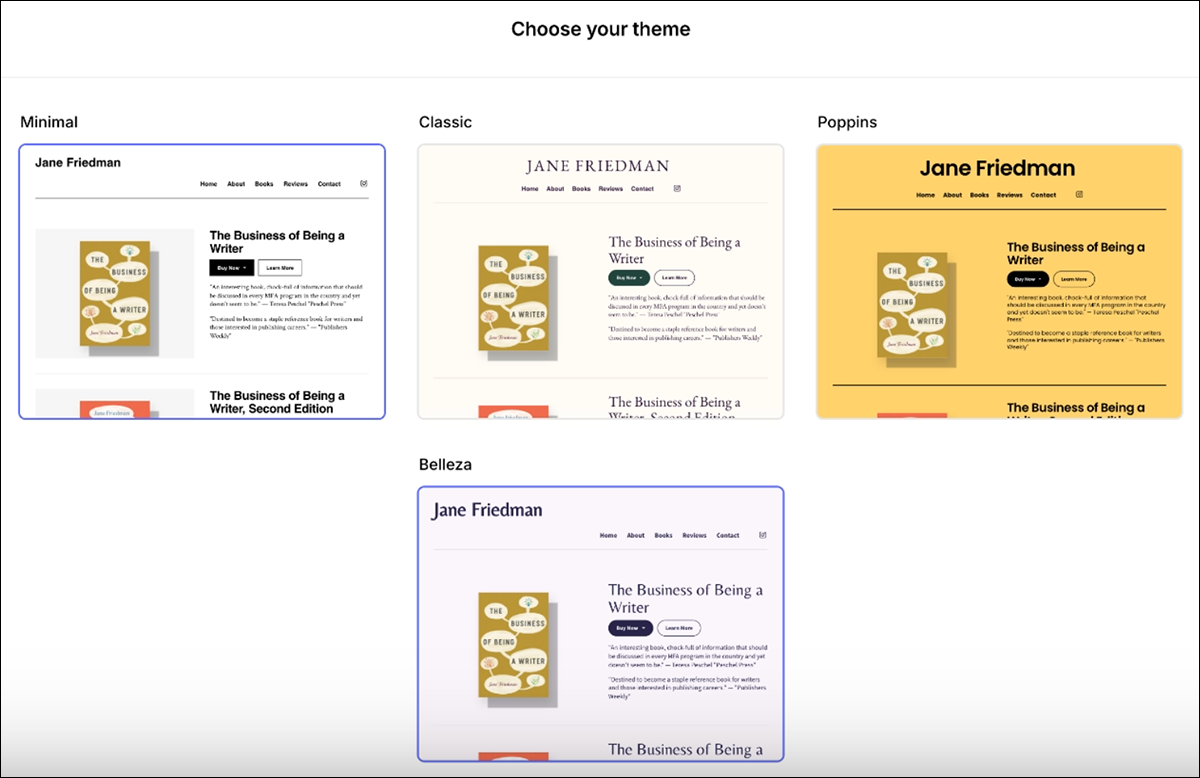
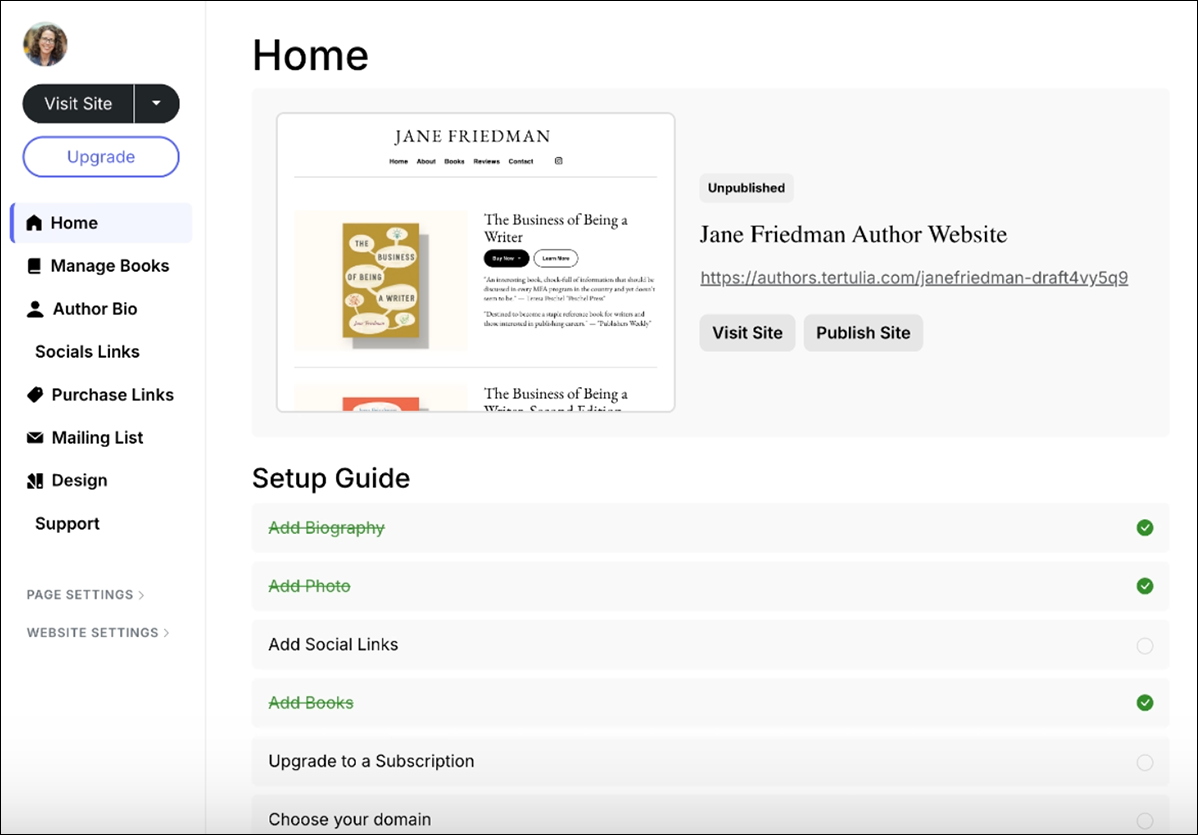
On my first time through the process, I did a screen recording so you can see what it’s like. It took me less than 1 minute. You don’t have to sign up for an account first, input your credit card, or learn a new system. I have never seen an easier process for site building. Cwilich told me they did a lot of testing with authors on the user experience and interface, and it shows. “Ease of use is our north star,” he said.
If you don’t have a published book yet, you can still create a site using Tertulia. You’ll be asked if you have a title or cover yet for your book. If not, it will focus on your bio instead.
How is a meaningful site produced so quickly? Tertulia pulls from existing assets for your book based on the ISBN number. My site draft already had marketing copy for my books, including blurbs and reviews, which I could reorder, add, delete, or otherwise modify. Same for purchase or retailer links. If Tertulia doesn’t pull in all the books you want to showcase—e.g., it won’t pull in anthologies you’ve contributed to, nor did it pull in my out-of-print titles—you can manually add books as well as re-order them on the page or delete them.
Other current features include:
- Mailing list sign-up. You can have the site collect emails, then export a CSV file that you can import into your preferred email marketing provider. That’s not ideal, but they do offer integration with Mailchimp as of today and are working on adding other popular providers, such as MailerLite.
- Social media links & other links. You can add links to wherever you’re active online, including social media, Substack, other blogs, etc.
- Simple design customizations. There aren’t many themes to choose from at the moment, but Cwilich says they’re working on more. Aside from theme selection, you can customize the color palette and fonts.
While Tertulia’s design options are currently limited, I consider that a feature and not a bug. The kind of author who chooses this solution isn’t someone who wants to spend money hiring a designer or developer for a custom site. They want a nice-looking site that works without the time and trouble of learning a tech platform—or dealing with the numerous changes such platforms roll out every week or month. In some ways, this tool also ensures the website follows best practices in the publishing industry—the kinds of practices I teach in my classes. Authors using Tertulia can’t make bad decisions about their site content and design unless they try very, very hard.
What functionality is missing? Right now, there’s no blogging functionality, nor is it possible to sell direct from a Tertulia author website. (You could always link to some other site, of course, to sell direct; you just can’t facilitate the sale through this site.) Tertulia is working on incorporating such features, as well as events page functionality and the ability to add other pages. Cwilich and co-founder Lynda Hammes told me they will build out the service based on authors’ feedback and to support authors’ businesses.
What about pricing and customer service? Tertulia is starting with highly competitive pricing: $9.99 per month or $7.99 per month if you pay annually. For those who pay annually, Tertulia throws in the first year of domain registration for free if you don’t already have your own domain. Customer service is handled primarily via email, but they emphasized to me they will get on the phone or use Zoom with customers who have trouble. It’s hard for me to imagine what that trouble would be, but of course skill levels vary tremendously.
Bottom line: When Tertulia first reached out to me about this service via email, I was not enthusiastic. My default attitude: Must we have another do-it-for-you site service that creates mediocre author websites? While it’s still early days and some key functionality has yet to be added, I’m impressed by the service and have already started recommending it to writers like the one who contacted me last week. This is an area of real struggle, and countless authors do not need (and can’t afford) a bespoke author website. Tertulia is not a tool I would ever use for myself (my entire business is nothing if not my website), but I expect many authors who have been frustrated with their existing platforms and have straightforward needs will move over to Tertulia. Writers who have delayed building a site should give Tertulia a try. It costs you nothing for the first 14 days, and you won’t even be asked for a payment method.
One author’s experience using Tertulia
I reached out to Jaycee Andreas to ask about his experience using Tertulia to build his website. He has 17 books published in English and Spanish, spanning nonfiction and nonfiction, with upcoming releases as well.
- On whether he had a website prior to finding Tertulia: “I had been considering an author website for a while but found most platforms too complicated, expensive, or not tailored for authors. Tertulia made the process effortless, allowing me to finally build a site that showcases my books beautifully in a way that feels intuitive and professional.”
- On what he appreciates about Tertulia: “The ease of setup is the first thing I’d mention to other authors. In just a few steps, I had a fully functional, professional-looking website that showcases my books beautifully. … On top of all that, the Tertulia team has been incredibly supportive, making the process even smoother.”

Jane Friedman has spent her entire career working in the publishing industry, with a focus on business reporting and author education. Established in 2015, her newsletter The Bottom Line provides nuanced market intelligence to thousands of authors and industry professionals; in 2023, she was named Publishing Commentator of the Year by Digital Book World.
Jane’s expertise regularly features in major media outlets such as The New York Times, The Atlantic, NPR, The Today Show, Wired, The Guardian, Fox News, and BBC. Her book, The Business of Being a Writer, Second Edition (The University of Chicago Press), is used as a classroom text by many writing and publishing degree programs. She reaches thousands through speaking engagements and workshops at diverse venues worldwide, including NYU’s Advanced Publishing Institute, Frankfurt Book Fair, and numerous MFA programs.