Today’s post is by Elizabeth Held, who publishes the newsletter What To Read If on Substack.
When I mentioned to Christine Larson, author of Love in the Time of Self-Publishing, that more than a dozen romance writers had donated to an auction to help my neighborhood bookstore make repairs from flood damage, she immediately lit up.
Larson asked if I had heard of a similar auction, Romancing the Vote, a 2020 fundraiser for Georgia voter organizations. The 2020 fundraiser, organized by authors Alyssa Cole, Courtney Milan and Kit Rocha, ultimately raised more than $400,000 and is a prime example of the kind of solidarity and collective support that defines the community of romance authors and readers, known as Romancelandia.
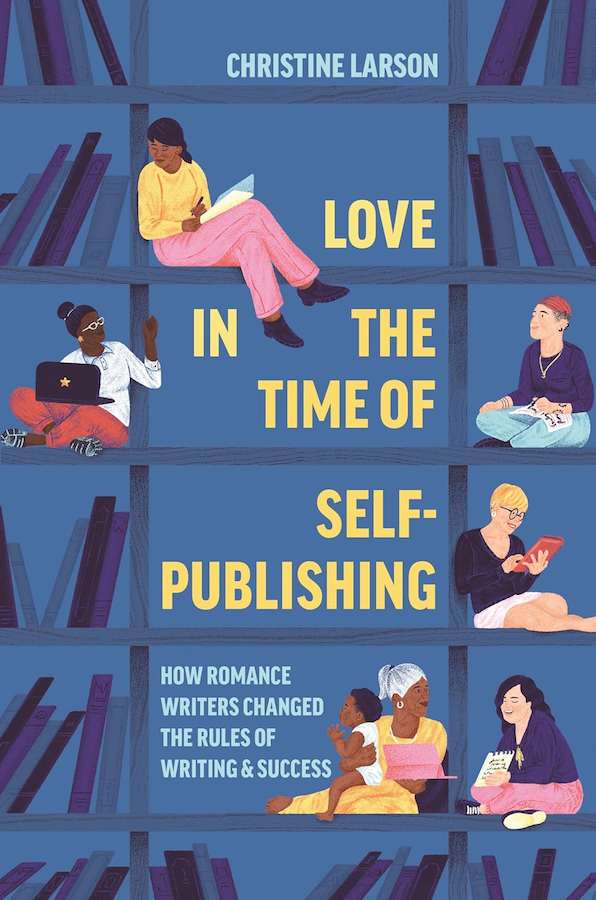
Larson, a journalism professor at the University of Colorado, Boulder, spent nearly a decade examining how the unique aspects of Romancelandia led romance writers to thrive in the self-publishing era. A survey Larson conducted found the genre’s authors saw their median income surge 73% between 2009 and 2014, while the median income of all authors fell 42%. In the same period, the median income of romance authors of color increased 150%, compared to 63% for white writers.
I spoke with Lawson over Zoom about the genre’s struggle with racism and efforts to make it more diverse, as well as how self-published romance writers make a living.
Elizabeth Held: You’ve called Love in the Time of Self-Publishing a labor history of romance authors. What drew you to the topic?
Christine Larson: The short answer is I didn’t know that it was a labor history when I started. All I knew was that romance writers were making a lot of money and doing things differently in self-publishing than any other authors.
Doing interviews with romance authors made me feel so much better when I was going through a divorce. One person led to another person for years, and it became a labor history. I realized the answer to the question about why romance writers were doing so well dated back 40 years. So, as I was trying to unroll that mystery, the labor history unfolded organically.
In the book, you argue that the Romance Writers of America, the genre’s organization for writers, created formalized structures, such as mentoring programs, that helped some authors succeed while failing to provide the right support to authors of color. Its commitment to collective support only went so far. In 2020, the RWA collapsed after years of racist actions. What was it like for you to write this book as the dissolution process was ongoing?
When I finished my dissertation in 2017, I thought, “Oh, this is great. It’s a happy ending.” But as I was reporting in 2015 and 2016, I saw more and more of the We Need Diverse Romance campaign.
I’m white and it took me longer than it should have to say, ‘This is a deeper problem. This isn’t something that can be solved with ‘We need diverse romance’ buttons.’ Fortunately, I had done many interviews and had generous authors of color who helped explain the deeper dynamics of the publishing industry.
So, I became more aware of the issues in 2017, and I was writing about them, but things looked good at the time. There was a lot of push for change in the industry and for the RWA to get involved. I thought my book would end with Kennedy Ryan being the first Black author to win the RITA [the RWA’s award for best romance].
I sent out my book proposal and was talking with editors, and one of the editors asked me on Twitter in December 2019, “How will the book deal with the meltdown in romance land?” It took me another couple of years to wrap my head around that and watch what happened.
Editorial houses have made some progress in publishing more diverse romances, in part because they saw self-published romances featuring non-white and queer succeed. Is this is an example of the market working?
I think it is the market working because digital self-publishing allowed a certain democratization of publishing to take place. Traditional publishers vastly underestimated the appetite of readers for romance of all kinds, of all subgenres, for diverse characters, for a wider variety of tropes and more. There was just so much freedom in self-publishing.
When I started doing my research, I thought I would see a change in the superstar structure of publishing, but I did not see that. Superstar economics say that, for a bunch of reasons, in any entertainment industry, you have a few superstars who earn 99% of the money, and then the rest of the world earns what’s left. So, many people earn almost nothing. I found this still to be true.
In my analysis of the income of romance writers, it was a little bit better. In self-publishing, there are a handful of people—more than a handful—who make millions of dollars. But, the real story to me was how many authors were making $100,000—a living.
I was struck by a line in your book—“Perhaps more than any other group, romance authors take to heart Virginia Woolf’s admonition: ‘A woman must have money and a room of her own if she is to write fiction.’” I regularly hear romance authors refer to themselves as businesswomen, something I’ve never heard from writers in other genres.
It struck me in my initial interviews that these are such savvy people. I was a business reporter. I love to follow the money, and so did all my interviewees. That lit the fire for me. But when I got to the RWA’s archives, I saw that every edition of its magazine for its first 20 years talked about these writers as businesswomen, as professionals. I love that.
Going way back in history, a lot of writers we still know today, such as Nora Roberts, started writing because they were in financial difficulties. Words were a way they could write their way out, to steal a line from Hamilton.
My academic critics kept saying, “You’re focusing too much on money. What about all the other reasons for writing?” And I had to say again, “They go hand in glove. If you are a committed professional writer, you have to be thinking about how do I keep the gas in the tank? How do I make a financially viable career?”
What can authors and other creatives learn from the financial success of romance writers compared to other genres?
The main thing I hope people take away from the book is that if you are a creative or independent worker, you need a community if to be treated fairly. But if you want community, you and your group have to treat everyone in it fairly. That’s what we saw with the collapse and bankruptcy of the Romance Writers of America. They didn’t adapt quickly enough to changing times and the needs of their historically underrepresented members. It’s sad that that community went away. But that doesn’t have to be the end of the story for other groups of creators.
With the collapse of the RWA, how optimistic are you right now about the future of the genre?
The future of the genre has never been brighter. Women have dominated The New York Times Top 10 for the last year. Most of that is driven by romance writers. This is unusual and I think it’s a sign that romance is coming into its own.
Romance is where sci-fi was 20 or 30 years ago. When people first started writing sci-fi, it was often a disrespected genre. Then, the public began to realize that speculative fiction is the place where we can explore different worlds, realities and what-ifs. People began taking it seriously, and then we saw Margaret Atwood and Octavia Butler saying important things in that genre.
We’re seeing people realize romance can be a place for that same kind of speculation—asking, what would it take to make the world better? Romance does it, or can do it, in a playful, joyful way. I think that’s fantastic.
Even if romance didn’t have this transformative ability, it’s still a time when we need joy, happiness and happily ever afters.

Elizabeth Held is a writer and romance reader in Washington, D.C. She writes a weekly book recommendation newsletter and runs East City Bookshop’s romance book club.