
Concern about the children’s market has been reaching new heights with imprint closures, such as Dial Books for Young Readers and Roaring Brook, plus continued reports of literacy and reading declines in the US and UK. Recent articles across the writing and publishing community discuss the challenges of the middle-grade market and what to do when all the news is bad. And Michael Cader of Publishers Lunch recently reported that first-quarter deals for all children’s categories are down 18 percent year over year (sub required).
While the children’s market as a whole rebounded in 2025 in terms of sales, recent commentary by Circana BookScan analyst Brenna Connor has offered limited comfort for middle-grade authors. When I reached out to her last month, she wrote me that “middle-grade readers (roughly ages 9–12) are the most challenged segment in the kids’ book market, with book sales for this segment continuing to decline year over year since 2021.” She believes that there is a decline in reading for pleasure among middle-grade readers in the US and that parents are buying activity-based formats (games, sticker books, workbooks, logic and brain teasers, puzzles) rather than narrative fiction. The data suggests that parents are trying “to keep kids engaged with books at all, competing against screens by choosing products that feel less like ‘traditional reading.’”
While there is reason for concern—which we’ll dig into—it’s not accurate to say the consumer market is dramatically worse than it was before. Much depends on your perspective and framing, because the BookScan sales data that I’ve analyzed (see below) suggests a return to pre-pandemic normalcy. However, sales are increasingly concentrated among certain types of titles, and for years now it’s been tough for new books and authors to break out. The children’s market is dominated more by backlist sales, approaching 80 percent backlist, according to presentations I’ve attended by BookScan analyst Kristen McLean. (For the adult market, it’s in the 60 to 70 percent range.) In 2023, Connor told the Children’s Institute that “frontlist is driving more than half the losses and declining at four times the rate of backlist paperback” for middle grade.
All children’s categories, across all ages, can present challenges to debuts and emerging authors because licensing—everything from Disney to Dr. Seuss to Paw Patrol—can be as much as one-third of consumer sales. And series also account for a significant proportion of sales, about two of every three kids’ books sold, according to BookScan.
What about Barnes & Noble’s role in all this? Some authors continue to be upset at Barnes & Noble’s buying practices for middle-grade work: They all but stopped stocking frontlist hardcovers around 2022. But when I recently spoke with children’s industry veteran Harold Underdown about it, he was unambiguous about whether this is a real factor in the market downturn: He called it “bullshit.” Most of those books, he said, would be returned within months. As my reporting (and others) have made clear, ever since CEO James Daunt stepped in to lead the chain, his more data-driven approach has made a point of reducing returns, including the elimination of pay-to-play placement. All books now need to justify their shelf presence. This may hurt some authors, but there’s no question it was a correction to a largely inefficient practice. Learn more in my 2022 article.
Conditions in schools and libraries, including book bans and shadow bans, make the sales environment worse and more risk averse. I spoke with three agents—Vicky Weber of Creative Media Agency, Eric Smith of Neighborhood Literary, and Kate McKean of Howard Morhaim Literary Agency—about what they’re seeing across the market, not just consumer sales. In addition to speaking with Underdown, who has held a variety of positions inside traditional publishing going back decades, I spoke with middle-grade author Lauren Magaziner, who has been writing and publishing books full-time since 2014.
“It’s not the consumer, I think, that’s causing this,” says Underdown in describing the broader market downturn. BookScan figures don’t include school or library sales, and that market, Underdown says, has been in a downturn for over a year and is largely invisible to outside observers. The clearest signal is the pattern of who is getting hurt. “It’s the small companies who have a big dependence on the school and library market, or it’s been the imprints at the big publishers that have a dependence on the school and library market.”
McKean says that declining school and library sales, book bans, and education troubles are all related and affect the market slightly differently. “Book bans have a trickle-down effect, I think, into school and library sales.” It’s not about specific state bans so much as “the kind of squeamishness that might be happening at the buyer’s level.” Ultimately, it amounts to self-censorship. Smith says, “You get the librarian who says, ‘Oh, you know what? I’m not going to order these books because I know these parents are going to make a big fuss,’ or ‘the local district is going to make a big fuss.’ And that’s the quiet consequences that we don’t see, that are sort of impossible to track.”
Magaziner confirms this in her experience with school visits. “I’ve talked to a lot of librarians, I’ve talked to a lot of educators, and what they’re telling me is that they have to be careful in what they bring onto their bookshelves,” she says. “I totally understand that there are people out there that do not want to lose their jobs over a fight about a book that isn’t theirs. And at the same time, it’s really tough on the author end if you are writing inclusively.”
There are also broader educational problems that affect middle-grade reading. Before becoming a literary agent, Weber spent six years as a classroom teacher. She believes part of the problem is that schools in many districts no longer hold students back, which means classrooms now span reading levels from kindergarten to sixth or seventh grade simultaneously, and the support system meant to address that gap is chronically undermined. Kids who fall behind become embarrassed, and it is hard to recover. “There’s a lot of those kids who then became parents and then had kids,” Weber said, “and reading wasn’t important to them or was hard for them, so they might not know how to help their child who’s struggling. It all snowballs downhill real fast.” When those parents can’t or don’t step in, the fallback—the school librarian—is increasingly absent. “Some schools don’t even have librarians anymore,” Weber said. “That means that they’re only getting the books that their parents purchase, and not all parents purchase books.” And, of course, the pandemic complicated matters. McKean specifically flagged the cohort of kids who were ages 7–12 during the pandemic as having particular literacy and attention span challenges.
The bright spot: graphic novels and manga. Kids’ graphic novel sales were up 5 percent through September 2025, according to BookScan; bookstores like Books-A-Million and Barnes & Noble have reported graphic novels and manga as some of their strongest growth areas. Both Weber and McKean see it as meeting kids where they are. Smith says, “Sometimes I hear this nonsense about reading graphic novels and reading comics isn’t reading. But it is.”
McKean notes that graphic novels have been growing as their own distinct thing without necessarily cannibalizing other children’s fiction, though Underdown suggests that as publishers increase graphic novel output alongside a weak prose middle-grade market, they may increasingly make tradeoff decisions. Also, it’s more expensive to produce graphic novels, and their costs have gone up.
Magaziner, who has been tempted herself to move into the graphic novel space, worries that market may itself be heading for oversaturation, since publishers have been acquiring heavily (see deal report analysis below). And for prose authors who want to move into graphic novels without being illustrators, the road is significantly harder than commonly acknowledged. It requires producing a script, a skillset prose writers may not have, and some editors won’t even look at a script unless the author is also the artist.
Weber believes Scholastic most clearly understands what the children’s market requires, and it isn’t leading with graphic novels per se. Weber points to Scholastic’s Branches and Acorns imprints, which occupy a format space most publishers have left uncontested. “All of their books are super highly illustrated. They’re not quite graphic novel level, but it’s the space between a picture book and a graphic novel.” The text on each page is limited, but the characters have a ton of personality, something like Dog Man or Captain Underpants. “Other publishers do have some books here and there, but they’re not leaning into it and putting their foot on the gas the way Scholastic is.” She believes the company’s deep presence in schools—and specifically their book fairs—may give it a more accurate read on actual child preferences.
What should a middle-grade author do for now? The advice is consistent: Write shorter. “We just can’t expect them to read 80,000 words,” says Weber. Magaziner has been told to aim for 50,000 words, “which is really short,” she says, with “quick, snappy chapters.” She has also been advised to prioritize accessibility in language without sacrificing complexity of thought. Smith says the projects he’s been able to sell have been on the short end, as low as 20,000 words. Most editors don’t want a book that exceeds 50,000 words, he says. Notably, Underdown pointed out that when he started working in traditional publishing, a middle-grade novel had to be under 160 pages, but the Harry Potter phenomenon changed all that. He’s not sure shorter books will solve anything, but for now, shorter works, along with illustrated works and graphic novels, are in a better position to sell.
While imprint closures hurt, it’s important not to forget new efforts. In 2026 so far, manga publisher TokyoPop has launched TokyoPop Kids for young readers up to age 12, which will include chapter books and middle-grade novels. In a licensing partnership with Lego, DK has launched a line of children’s books that include middle-grade work packaged with exclusive Lego bricks. Hachette UK has launched Starboard for middle-grade fiction. Editor Alvina Ling has a new imprint at Little, Brown. And 2025 saw the launch of Sarah Barley Books at Simon & Schuster, Ten Speed Young Readers at Penguin Random House, HarperCollins’s Storytide, DK flip, and Stonefruit Studio at Sourcebooks.
Bottom line: Publisher staff cuts and imprint closures are downstream effects of sales pressure, and publishers are also retreating to the familiar: repackaging backlist, releasing special editions, producing graphic novel adaptations of already-successful prose titles. Magaziner mentions this explicitly: “Everybody’s looking to their backlist, or what is currently bestselling on their frontlist, and being like, ‘Well, that works. How can we give this sprayed edges? How can we make a special edition?’” Underdown points out that any time there’s even a 5 percent decline in sales, that has a big impact on publishers’ planning. Addressing the dynamics that have produced the downturn will take time. Weber says, “I think it’s a little bit like when you have a sinking ship and there’s holes everywhere, and you’re just like, ‘Which ones do I plug up?’ But there’s already water in the boat.” She says, “Where the focus really should be, I think it needs to start in schools and improving the support that kids have and access.”
Middle-grade book sales trends, 2019–2025
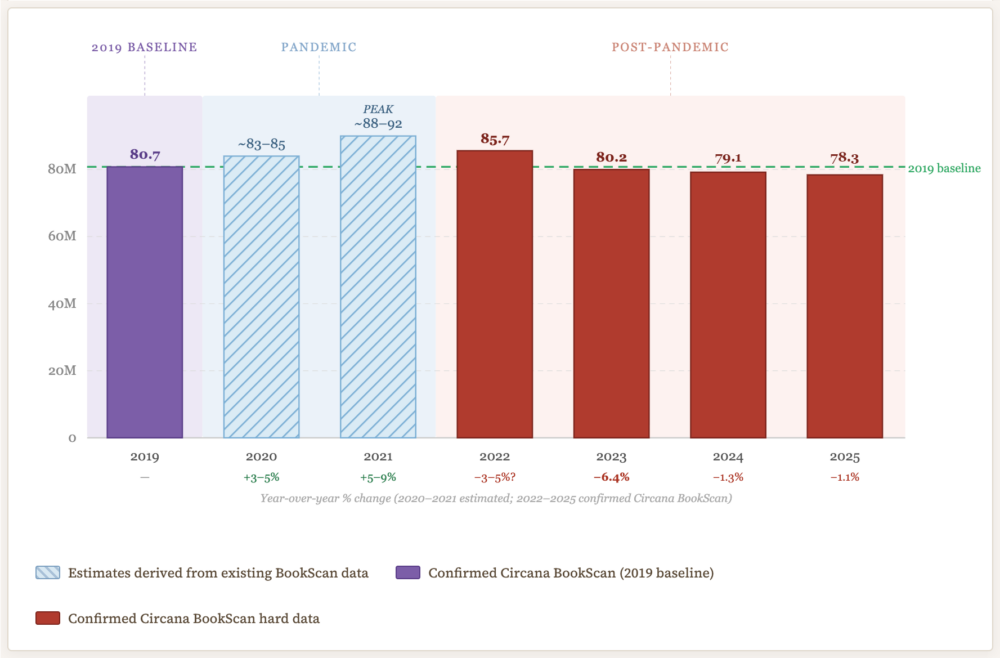
Brenna Connor at BookScan shared with me print unit sales figures for children’s middle-grade from 2022 to 2025. Prior to 2022, I’ve used Publishers Weekly reporting of BookScan figures as well as my own reporting. (See sources listed below.)
Key takeaway: A few years ago, Circana analyst Kristen McLean commented that the decline in the overall children’s market is really a return to 2019 sales levels, but middle grade sales have continued to decline year on year. 2025 print unit sales were 3 percent below the 2019 pre-pandemic baseline.
Sources and Analysis
- Middle-Grade Sales Continue to Slip (Publishers Weekly, July 2024)
- Winter Institute 2024: Booksellers Assess a Changing Tween Scene (Publishers Weekly, February 2024)
- The Shifting Middle-Grade Market (Publishers Weekly, June 2023)
- NPD Gauges the Children’s and YA Market (July 2022)
- American Book Producers Association (ABPA) presentation by BookScan’s Brenna Connor (October 2021)
The 2020 and 2021 estimates are based on figures cited from the ABPA presentation: 64 million print units through October 2021, described as the best year-to-date performance since BookScan started tracking in 2004; and 59 million units through October 2020. The 2019 figure is confirmed by information reported by Publishers Weekly in February 2024.
Middle-grade deal trends, 2024–2026
Dealmaking in children’s middle-grade is up by 5 percent, but growth is driven entirely by graphic novels. So far in 2026, dealmaking runs 4 percent below 2025 overall, but graphic novels are up 4 percent. Source: Publishers Marketplace deals database.
| Category | 2024 | 2025 | Change |
|---|---|---|---|
| MG Fiction | 239 | 237 | −2 (−1%) |
| MG Nonfiction | 48 | 45 | −3 (−6%) |
| Graphic Novels | 138 | 165 | +27 (+20%) |
| Total | 425 | 447 | +22 (+5%) |

Jane Friedman has spent her entire career working in the publishing industry, with a focus on business reporting and author education. Established in 2015, her newsletter The Bottom Line provides nuanced market intelligence to thousands of authors and industry professionals; in 2023, she was named Publishing Commentator of the Year by Digital Book World.
Jane’s expertise regularly features in major media outlets such as The New York Times, The Atlantic, NPR, The Today Show, Wired, The Guardian, Fox News, and BBC. Her book, The Business of Being a Writer, Second Edition (The University of Chicago Press), is used as a classroom text by many writing and publishing degree programs. She reaches thousands through speaking engagements and workshops at diverse venues worldwide, including NYU’s Advanced Publishing Institute, Frankfurt Book Fair, and numerous MFA programs.


I’m a public school teacher (4th grade in a charter school) and a librarian. However, my library skills are used within my classroom and in influencing other classrooms, because our K12 school doesn’t have a library yet. A library is in the planning stages! The “advancing children even though they are not grade-ready” is a problem with the reading focus in the classroom, because some of the most active, influential, and popular kids are non- or very low level readers. Chapter books were my legacy from previous 4th grade teachers.
However, I started to flood (and I mean FLOOD) the classroom with reading materials for every type of interest last year. Motocross magazines, UTV magazines, popular science, National Geographic Kids, Ranger Rick, the entire Animal VS Animal (Who Will Win?) series, dog/cat/horse breed books, western riding (barrel racing, rodeo), science experiment books, books on snakes, dinosaurs, fish, birds, reptiles, fossils, rocks, flowers, gardens, buildings, cars, travel… from Scholastic Book Fairs, Marvel comics for kids (Ms Marvel), and the usual Dog Man, Diary of a Wimpy Kid, the I Survived graphic novels, the Wings of Fire graphic novels, Warrior Cats graphic novels, Babysitter Club graphic novels… and on and on.
I lay the books and magazines out every morning all over the classroom, and I have a designated area with stackable foam blocks from RIWI and bookcases full of more books. The school now supports all this overabundance of reading material, and we have a “wish list” and student “order form” at the front office. Any child who requests a book, gets it. We try to encourage them to donate the book back to their classsroom, but as of now, we are not tracking it. We want them wanting books…hungry for books.
I use Thriftbooks, Scholastic, Barnes & Noble …and Amazon, if the child wants it super quick. It’s slowly infiltrating the psychology and culture of the classroom and the school. My lowest level reader told me she wants to be able to read (she didn’t care before), and another low level reader found a Warrior Cats laying around, went to the reading area, and asked if he could skip one of the academic periods to read more of the book. I told him if he loved that book he could stay reading the rest of the morning! He got so excited he finished the book… and then wanted the first two in the series (he had read #3). That’s when Amazon comes in handy. I order the books right in front of the kids and let them know what day they are coming. The two Warrior Cat books came in two days… and he will have them Monday morning!
Classroom teachers must be given a generous budget to buy outside the curriculum and stock their classroom libraries – especially if there is no school library! Kids need to be seeing books and magazines all over the place. The kids who started looking through the motocross magazines, asked a couple of weeks ago if there were motocross books. Thanks to Thriftbooks, those kids now have four motocross-related books in their classroom.
Our Principal is totally supportive of all this investment in “outside curriculum” books, and I have been able to convince friends to help me subsidize my book-buying (along with Scholastic Book Fair’s generous contributions from Book Fair sales). Teachers are now requesting books and book sets, and the plan is to have the interest in books infiltrate the culture of the families. That’s why we let the kids take a book home when they ask—without qualification.
Thanks so much for sharing this detail, Margaret. Kids are lucky to have you!
🙂 I’m the lucky one to have them! They keep me young. And to have YOU. You keep me on my publishing toes.