

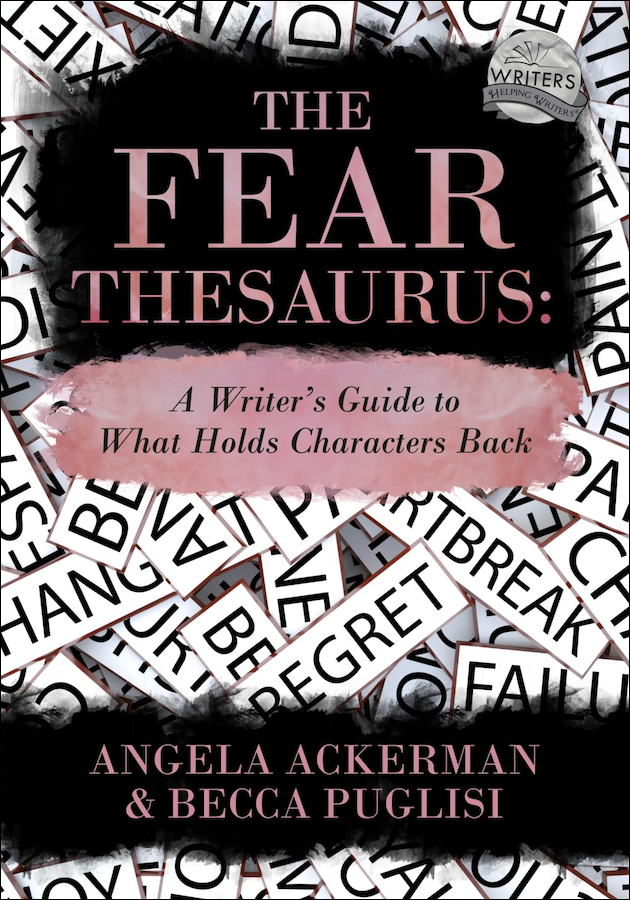
Today’s guest post is by Angela Ackerman, co-author of the new book The Fear Thesaurus: A Writer’s Guide to What Holds Characters Back.
Fear is much more than an emotion—it is one of the biggest influencers of human behavior. Whenever we encounter a situation with unknowns, fear kicks in. Even if we do not yet know what is triggering our unease, our senses heighten, our blood pressure rises, and we go on high alert, searching for possible threats.
This response is pure human instinct, with fear being the self-preservation mechanism that alerts us to potential danger. It keeps us vigilant, helps us manage risk, and steers us away from people and situations that threaten our physical our well-being.
But fear also has a dark side, limiting a person’s ability to apply reason and logic, hijacking their decision-making processes, and leading to all sorts of flawed choices and behavior. And while this can be bad for us in real life, it’s story gold in fiction. All those bad decisions juice the story with conflict and tension and draw readers in, because they can’t help but be reminded of their own fear-driven behavior and the repercussions that usually follow.
To write realistic in-the-moment reactions, let’s look at fear’s calling cards.
Distorted perception
When fear takes hold, it distorts perception. Characters become hyperaware of their surroundings, and possible threats are magnified. Shadows appear menacing, angles are sharper, and other people become potential sources of conflict. And—this is important—anything in their environment that reminds them of a negative experience or awakens personal anxieties can make them believe they’re in danger (even when they are not).
For example, imagine a character who feels uneasy around dogs because they were attacked by one as a child. Out for a walk, they spot a stray and their brain immediately zooms in on certain details—the animal’s lips pulled back to expose its teeth, how its muscles are quivering, how it’s pointed at them as if to leap. Your character becomes certain an attack is coming, yet they pass the dog without issue. The dog is merely panting from the heat, and was never a threat.
Takeaway: Fear acts as an early warning system, but it doesn’t frame every situation accurately. When fear is active, your character isn’t as objective, and they can misread neutral signals, seeing danger where there is none. (To take full advantage of distorted perception, try using a suspense device.)
Disrupted logic and irrational thinking
Fear often short-circuits logic and rational thought, too, bypassing right to fight, flight, or freeze responses. When there’s real danger, this can help. But if the character has misjudged the threat, this can lead to overreactions and rash decisions.
Say our character, Adam, spots a stranger speaking to his daughter in the ice cream line at the beach. He charges in, shoves the man, and demands to know what he’s doing. Only then does Adam learn that the two were chatting because she has the same fuzzy backpack as the man’s daughter.
Takeaway: Fear causes characters to misread situations, make assumptions, and jump to conclusions. When they act impulsively, it can take a situation from bad to worse.
Split-second flawed choices
The presence of fear can drive characters into making split-second decisions that aren’t always good ones. Convinced they’re faced with a threat, they misread cues, overestimate the risk, and often overreact in the moment. This might mean lashing out at a friend (whose well-meaning advice awakened reminders of the character’s always-critical parents), drawing a weapon and escalating the likelihood of violence, or firing off an angry message to the boss instead of keeping it in draft.
Takeaway: Fear clouds thinking and drives emotional decisions, and these two don’t mix well. Reactive characters are prone to short-sightedness which usually leads to fallout. Maybe they lash out at a sibling, accuse a co-worker of wrongdoing, or throw their wedding ring in the lake during an argument. Suffering the consequences of one’s own actions is painful, adds complication, and generates conflict. But, mistakes can also become teachable moments, making them opportunities for the character to experience an epiphany about how they are letting fear steer the ship.
Avoidance
When fear enters the chat, it can be so overwhelming that your character immediately retreats. Often when we think about fight-or-flight, we imagine something dire, but it happens in quieter situations, too: asking for help, or saying yes to an opportunity, opening up to someone. Depending on a character’s difficult past experiences, when they feel emotionally vulnerable, their knee-jerk reaction in the moment can be to run.
Takeaway: Avoidance (flight) also can happen over small things, not just in-your-face danger. Procrastinating, caving to pressure, and avoiding decisions all alleviate the momentary discomfort of fear (but often leave behind guilt and self-blame). You can use it to show growth, too. Early in the story, show your character’s pattern of avoidance. Then later, show them begin to tackle things head on.
Damaged relationships
People are hardwired to hide or mask their fear, and so when this feeling is triggered, they get defensive and sometimes take it out on others. Accusations, yelling, projecting and other defense mechanisms…it can feel good to vent fear through anger or frustration, but it also causes relationship friction.
Takeaway: Fearful characters unleash on handy targets, but no one likes to be a punching bag. Showing strain in a relationship due to the character’s behavior is a great way to show how fear is affecting them.
Inner sabotage
Even when a character has good intentions and wants to tackle a problem or take on a challenge, fear can stop them. The closer they get to vulnerability, the louder their inner voice of doubt gets: Don’t do that, you’ll only get hurt. Tell the truth and it’ll go badly. This inner sabotage can unravel the character’s determination, and suddenly they’re walking back a decision, delaying an action, or finding an excuse that will give them an out.
Takeaway: Characters often know the right thing to do but fear stops them from following through. This causes them to beat themselves up, lowing their self-esteem. But what can hurt them can also be the launching point of growth. Challenging this inner voice is the key to confidence and empowerment.
Parting thoughts
Showing your character’s fear in real time—through distorted perception and thinking, poor choices, avoidance, and fallout—brings readers into important story moments and keeps the tension high.
If you’re looking for more ideas on how fear shapes character behavior and choices, The Fear Thesaurus: A Writer’s Guide to What Holds Characters Back explores 80 human fears, from betrayal and heartbreak to powerlessness and death, and shows how each one can create meaningful inner struggles in a story.





Thanks for having me here, Jane!