

Today’s post is by Jennie Case.
When my essay, A Political Pregnancy, came out in The Rumpus, I was so frozen I spent most of the day stiff in a chair, the room swirling. It took a good week for me to unthaw, and nearly a year for me to share the piece publicly on social media. To be sure: I was proud of the essay, which explored my painful, conflicted responses to an unintended pregnancy during the 2016 election. I was also confident that the piece rang true. Yet the thought of people I knew (especially my mother and Catholic family) reading it and judging me, or knowing how complicated that period of my life had been, was a psychological whirlwind I could not easily travel through.
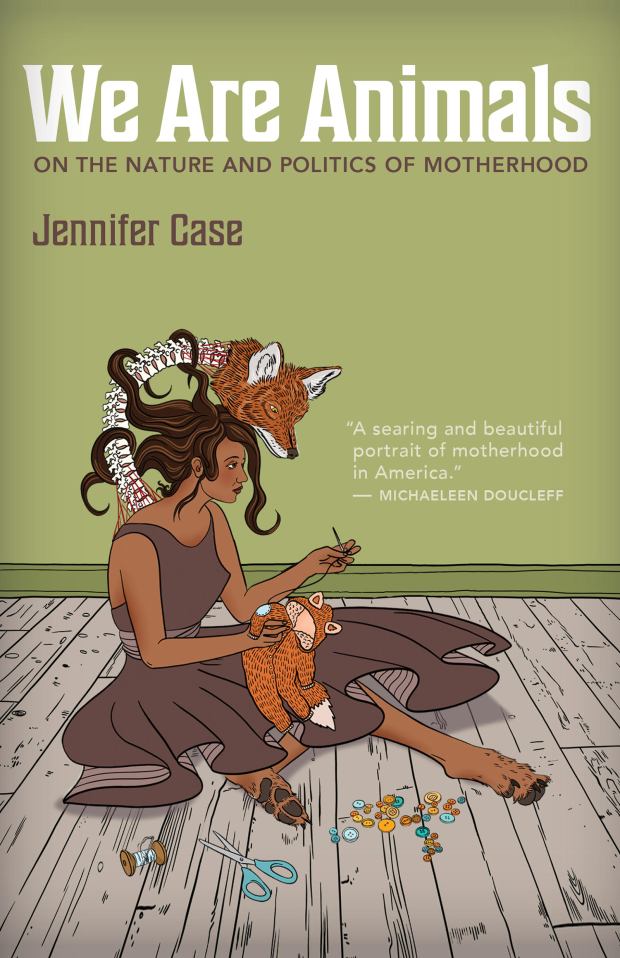
I’ve been thinking about this a lot lately as I gear up to publish We Are Animals: On the Nature and Politics of Motherhood, a collection of essays that includes that Rumpus piece. Amongst the book’s broader exploration of feminism and evolutionary biology, it addresses unplanned pregnancies, reproductive justice, maternal mental health, and my own complicated reactions to early motherhood. I am proud of these essays, and I hope they help shift the conversation on reproductive justice or offer insight and comfort to readers. Yet part of me is also terrified: that there is some flaw in the manuscript—or flaw in me—that the book will reveal, and that at some point I’m not going to look at it with pride, but with embarrassment and shame.
Shame, evolutionary biologists tell us, has a purpose. When we act in a manner that threatens our relationships with others, shame pressures us to apologize and repair the connection. Despite our current culture’s valorization of individualism and hyper-independence, human survival has long depended on community cooperation. Expulsion from a family or group thus threatens survival, so human emotions that prevent expulsion have a critical purpose.
Yet, there is also something such as “toxic” or “chronic” shame—the kind that often starts at a young age and becomes so ingrained that the person believes they, themselves, are bad. Such a child will grow up to minimize and silence themselves—to hide themselves from the world in order to protect familial connections. This, I can sometimes recognize in myself, as well as in the creative writing students I teach. Although I give my students free rein to write about whatever they’d like, many choose to explore fraught family relationships or moments when their lives came in conflict with social norms. The drafts they turn in are beautiful, moving, and fruitful, yet it isn’t uncommon for me to receive a panicked email right before class workshop, as the student quakes from vulnerability and suddenly questions their subject matter (much as I quake before my book’s launch). When we make ourselves visible or push against social dictates—especially when we come from rigid family backgrounds where certain stories aren’t allowed—there can be an eviscerating psychological toll.
Lately, I’ve become interested in how writers navigate such shame—and grateful for the writers who’ve spoken openly. Stephanie Clare Smith, author of the beautiful memoir on childhood neglect, Everywhere the Undrowned, has acknowledged that the publication process was at times excruciating. “Most [press and readers] just expected me to be overjoyed, healed, and ‘feeling the love,’” she said. In reality, the lead-up to her launch pained her “on an intense cellular level,” requiring her to better care for and reassure her younger self.
Novelist and writing coach Sarah Stone has described the phenomena in a similar way, and her words resonate with me. “When we publish our books, we go out naked into the world,” she says. “It’s one of the reasons that [supportive writing groups are] so important. Who else understands just how vulnerable we are, how all kinds of childhood selves emerge just at the moment when we need to be more grown-up than ever? But overall, it can be very nurturing, and the hard parts illuminating. With every book, when we stay open, we make wonderful new friends. I think that’s the best part, no matter what does or doesn’t happen in a worldly way.”
I am no expert—on human emotions or psychology—but I find comfort in Smith’s and Stone’s words, and their insistence that pre- and post-publication shame doesn’t mean our work is actually shameful—or that the emergence of childhood selves means we shouldn’t have published it. On the contrary, publication can help us soften and grow.
I also find comfort witnessing the practices of my students. When I see my students working on their essays—trying to find meaning and art in complex realities—what I see is beauty. Their essays don’t have to be fully processed for me to admire them. Their conclusions don’t have to be perfect. It is the act of writing, and the act of reaching for understanding that appeals to me most, both in the students I teach and the published works I read.
This is what I will try to remember this fall, during those inevitable moments when a poor review or critical response (or no response at all) triggers my own childhood shame, and I begin to think it would have been better for me to stay silent and small. Art has meaning, I will remind myself. What we do is meaningful. When it comes to our humanity, there is nothing to be ashamed of.

Jennifer Case is the author of We Are Animals: On the Nature and Politics of Motherhood (Trinity University Press, 2024) and Sawbill: A Search for Place (University of New Mexico Press, 2018). Her essays have appeared in journals such as The Rumpus, Orion, Ecotone, Literary Mama, and North American Review, while her scholarship can be found in the Journal of Creative Writing Studies and Assay. She teaches at the University of Central Arkansas and serves as an assistant nonfiction editor at Terrain.org. You can find her at www.jenniferlcase.com.



Thank you for this piece. I was happy to see that second form of shame mentioned, the one that keeps often sensitive but articulate people silent. These are exactly the people whom we value when they do speak up, but the forces holding them back, often unprocessed childhood trauma, keep them silent until they somehow realize the importance of what they are saying, and perhaps even more powerfully, the importance of having the courage to say it. The world is full of people with little to say but who babble all day long. We could use more formerly shamed talkers.
Oh, my gosh, you are speaking to me. This is why I resist finishing my memoir after years of hard work: a fear that it, and I, will be found unworthy. That my flaws will be revealed.
Thank you for your words this morning! And your courage in writing your own stories. I wish you all the best.
It’s frustrating for me, having spent 15 years in therapy, to still encounter shame as I’m writing my memoir. Thanks for addressing this issue.
Wow! I needed to hear this. I had only heard of toxic shame a few years ago. When I had first encountered it, I thought I was being blamed for all the hurts and wounds I had endured as a child. I write fiction, and I feel so exhausted putting this veiled part of myself out there that it’s hard to deal with people after things are published. It’s good to know that many other writers deal with this too.
I’m facing toxic shame as I write my memoir about having an abortion when I was young. It’s a powerful antagonist.
This was meaningful to me as my book about my mother’s hoarding and our relationship is coming out in January. I have written about the situation before, but the questions about why my sister and I didn’t do anything which is at the heart of the narrative can still stir up old shame and sadness. I’m a clinical psychologist and struggled with this. I’ve shared your piece. Thanks for writing about it.
Thanks for a beautiful essay on an important topic. My fear that embarrassing errors would be uncovered after publication led to hyper-vigilant proofing that was furiously reinforcing because I kept finding errors. I finally moved forward but held my breath for the initial reviews. Thank you for reminding us that the journey is difficult but predictable.
Thank you for this piece. It’s powerful and timely. I very recently published my first piece, an interview in Medium and Authority, about my journey as a rape and gun violence survivor. I’m positive I won’t share it on social media for the same reason that it would scandalize those in my family who are unaware of it! It will eventually serve as the cornerstone of my author platform. I can’t thank you enough for writing about your experience and acknowledging the associated shame of writing about society’s impolite, taboo topics. Imagining (or trying not to imagine) what other people are thinking and imagining about our work is work itself!
Thank you for your remarkable piece. Reading it felt like looking into a mirror and seeing my experience reflected back to me. I can’t tell you how helpful it is to feel a kinship with another writer who can so beautifully share that excruciating experience of being sent naked out in the world when your book is published. My memoir, A Tree with My Name on It: Finding a Way Home has been out for just over two weeks and I am encouraged by the insights about shame that you shared.. how it can soften us.