Last year, self-help author Keila Shaheen signed a seven-figure deal with Simon & Schuster after she sold more than a million copies of her self-published book, The Shadow Work Journal. About 700,000 copies were sold directly through TikTok Shop, many by influencers who earned a 15 percent commission on every sale.
That success caught the attention of authors and publishers alike. On a TikTok panel at the 2025 US Book Show, Charlotte Bryla, director of advertising and social commerce at Hachette Book Group, discussed how the publisher started selling direct through TikTok Shop last year and how much their affiliate strategy has supported sales. (Anyone who runs a TikTok Shop can choose to pay a commission—one that they determine—to TikTok creators who spur purchases through the Shop.) Bryla said Hachette has seen strong sales that they wouldn’t ordinarily expect for their deep backlist—a lot of practical nonfiction and non-book product, such as How to Build Small Barns & Outbuildings by Monte Burch, released in 1992.
Selling through TikTok Shop can be challenging for an indie author, however, due to logistics. TikTok Shop requires fast shipping, with little tolerance for delays. Author Sacha Black told me that you can easily receive violations over minor rule breaches. Some authors have considered outsourcing fulfillment to third-party services just to meet TikTok’s turnaround demands. Even Hachette’s Bryla flagged this problem in another form: Viral spikes for a title (like the outbuilding book) can cause inventory shortages faster than supply chains can respond. And some authors can become victims of their own success. The more sales you generate, the more affiliate requests you receive, the more direct messages you have to handle, and the more runs to the post office that are required—often necessitating personal assistants to help coordinate.
I recently spoke to two authors who have been able to make the system work for them: A.P Beswick and Z.S. Diamanti.
- Beswick, based in the UK, began self-publishing his fantasy novels in late 2019. He started posting on TikTok in January 2022 as part of an accountability challenge with another author: He had to post on TikTok every single day for five days. “I couldn’t think of anything worse,” he told me, but it quickly became addictive because people were actually engaging with him and asking questions about his book. By the end of January 2022, he had made £100 without spending a penny on ads, up from what he characterized as no earnings. He was one of the first authors to start selling direct on TikTok Shop that year and began working full-time as an author in early 2023. Today, he reposts his TikTok content on Instagram, Facebook, and YouTube, and he sells direct through his Shopify-powered site.
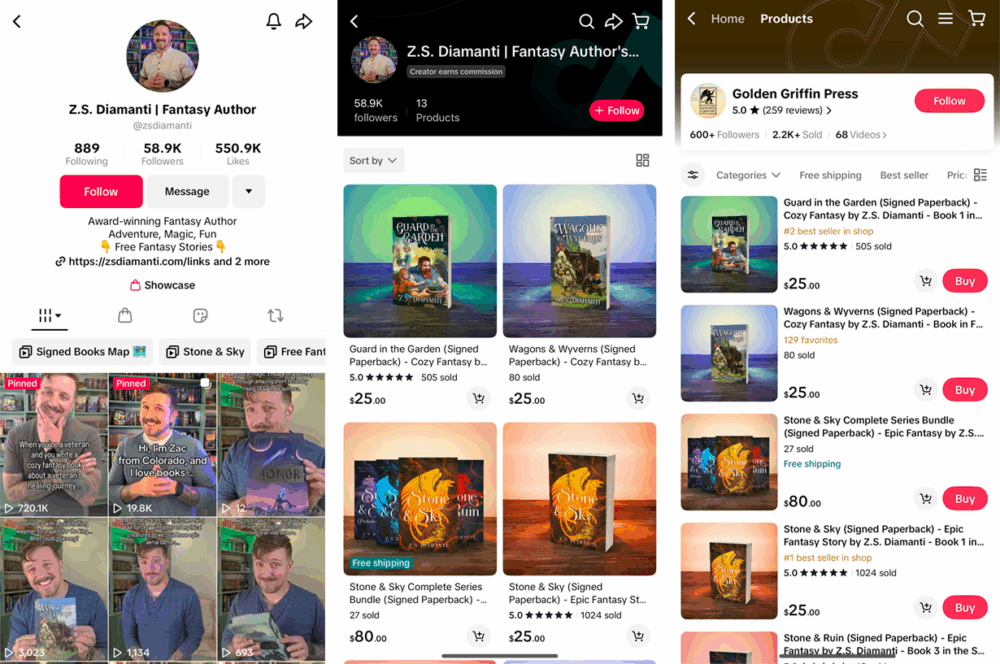
- Diamanti, based in the US, began as a short-story writer and later transitioned to fantasy novels. After leaving his job during the pandemic, he devoted a year to finishing and launching his debut novel, Stone & Sky, in 2023. He built his readership from zero by studying and using TikTok strategically, growing to tens of thousands of followers before release. Currently he publishes about three books a year, using Kickstarter to support audiobooks and special editions. He uses TikTok and Instagram along with TikTok Shop and his own Shopify-powered website for direct sales.
Visibility and discoverability on TikTok comes first, not the Shop itself. Most authors start with consistent, authentic, short-form content that builds a reader base, with a focus on entertainment and community building. To that end, one of Diamanti’s suggestions is to separate your TikTok content from your TikTok Shop. He has a personal author account (@zsdiamanti) for community growth and a separate business account for the Shop itself (Golden Griffin Press). The author account can then become an affiliate of your Shop, allowing you to link to products without losing access to tools such as trending audio. (Business accounts can’t use trending audio, which Diamanti says limits organic reach.)
Before Diamanti released his first book, he spent months on his author account, talking about nostalgic fantasy classics (e.g., Dragonlance, Redwall, Eragon). This created associative branding; readers already trusted his taste, and his first novel fit naturally into that space.
Beswick has had considerable success using TikTok Live to host live shopping events for his books. He started doing live events as a way to pack orders while chatting with viewers, and people started placing additional orders just to see him pack them live. Over time, the Friday Lives became a recurring event that steadily increased his weekly sales. (As he was describing it to me, I envisioned an appeal that’s rather like QVC or Home Shopping Network.) Beswick will do Lives to showcase new stock or special editions, with exclusive offers for viewers; the books can be purchased immediately without leaving the stream. He says the events perform well because they humanize the sale. TikTok Lives also trigger the platform’s internal promotion: TikTok pushes live sessions to more users when engagement is high. I happened to talk to Beswick on a day when he’d done a livestream, and he said he generated about £2,000 in sales in four hours.
TikTok’s built-in affiliate network—creators who earn commissions for featuring and selling products—is a powerful lever. It’s essentially influencer marketing run through TikTok’s own tools. Any account can potentially be an affiliate once they reach 5,000 followers. Beswick told me he has hundreds and hundreds of people who have signed up to be an affiliate for his shop; each receives a 10 percent cut of the sale. Beswick told me, “Every now and again, I’ll have someone make a video and tag a product that’ll take off and generate an influx of sales. A good way of scaling is if you can send your books out for free to people as an affiliate and they post the content for you. That looks even more organic.” However, he said you need to make sure you have enough inventory on hand as your affiliates grow, because it’s easy to get caught short on stock if an affiliate’s video takes off.
There are two types of affiliate collaborations on TikTok: open and targeted. Open collaboration is where anyone who is a TikTok affiliate can select your product and add it to their showcase on their profile or request a free copy. (Beswick said TikTok does monitor such requests to stop people from requesting free products if they’re never reviewing or mentioning those products in their videos.) You can also do targeted collaborations, where you approach specific TikTok creators with a custom deal, possibly offering a higher affiliate cut or making specific requests, such as posting on a particular day.
Only a tiny percentage of Beswick’s overall sales are through affiliates, as it’s not a focus area for him. But when I spoke to Bryla at Hachette, she considered affiliate strategy the most important part of TikTok Shop; they have thousands of affiliates through open collaboration, in addition to targeted collaborations that Hachette pursues with specific influencers. (Bryla declined to say what percentage they pay affiliates.)
Authors still run ads to keep the sales engine humming. In the last couple months, Diamanti says he’s been taking advantage of TikTok’s GMV Max ads, which are a way for TikTok Shop accounts to run ads using content that affiliates have posted—meaning you are paying to boost your affiliates’ videos. He also runs some Facebook ads but outsourced their management because he no longer has time for it. Beswick runs Facebook and Instagram ads to strategically retarget audiences and supplement his organic performance.
One more warning about logistics: I felt stressed out just listening to Diamanti and Beswick talk about the demands of fulfilling orders every day. Beswick invested in a big office outside his home. He, his wife, and his father-in-law use it to help pack and ship orders. Meanwhile, Diamanti continues to fulfill orders from his home, and he said that constant packing is what burns out many authors. “I’ve got 11 half-built boxes of books upstairs right now. Then I know we’ve got another 10 orders at least we have to pack today.” He recommends setting clear daily packing windows, and for him, that’s in the evening between school and dinner time. He has three kids at home, and they all chip in, so it’s a family lifestyle. But then those orders have to be shipped out. “My wife is so wonderful. She’ll ask me one question: ‘Hey, so I noticed you haven’t posted in the last couple days.’ And I’m like, ‘I know.’ [laughs] And she’s like, ‘Just gonna ask—do you want to sell books?’ And I’m like, ‘Dang it, yes. I’m going, I’m going.’ … You gotta go post.”
Bottom line: While powerful, TikTok Shop is just one part of indie authors’ overall sales and marketing effort. It does not replace having a website, selling direct through that website, or having an email newsletter. Authors should still drive fans and readers to places where they can control presentation and pricing and obtain customer data—as demonstrated by both Diamanti and Beswick having Shopify-powered stores where their fans continue to buy. (TikTok Shop does not share customer email addresses.)
Even before Shop emerged, TikTok boosted the discoverability of books to a wide and diverse audience, and many readers prefer to shop at other online retailers or through brick-and-mortar stores. (Barnes & Noble’s current health has been partly tied to TikTok fervor.) Diamanti told me that after he posts a high-performing video on TikTok, he sees sales spike across platforms. That’s good to hear, since unquestionably TikTok’s policies, algorithms, and seller tools will continue to evolve, and creators always have to be ready to adapt to a changing marketplace.
Readers respond
Bethany Kelly at Publishing Partner writes in, “Regarding the TikTok shop article, I found it very interesting. Have you heard of Acutrack? They are a book printing and fulfillment service that specializes in BookTok sales. They played a role helping Keila Shaheen and her Shadow Work Journal. They also collaborated with the I Want To Hear Your Story series, a very popular series that is independently published and fulfilled by Acutrack. They have helped hundreds of self-publishers on TikTok, and their biggest strength is scalability, as they are agile and can print books and deliver them on time fast enough to keep up with any virality. They are able to take care of high volume and handle all of the shipping, taking this off of the author. I am not an affiliate with them, but I have worked with them on a few projects and I recommend them as a resource for anyone who is needing fulfillment services for an independently published book that has sales volume. They would be a good fit if an author is selling 50 or more copies of their book a month.” Learn more about Acutrack.

Jane Friedman has spent her entire career working in the publishing industry, with a focus on business reporting and author education. Established in 2015, her newsletter The Bottom Line provides nuanced market intelligence to thousands of authors and industry professionals; in 2023, she was named Publishing Commentator of the Year by Digital Book World.
Jane’s expertise regularly features in major media outlets such as The New York Times, The Atlantic, NPR, The Today Show, Wired, The Guardian, Fox News, and BBC. Her book, The Business of Being a Writer, Second Edition (The University of Chicago Press), is used as a classroom text by many writing and publishing degree programs. She reaches thousands through speaking engagements and workshops at diverse venues worldwide, including NYU’s Advanced Publishing Institute, Frankfurt Book Fair, and numerous MFA programs.