
Today’s guest post is by coach, author, and speaker Anne Marina Pellicciotto.
I’d labored over my memoir for more than a decade when, last January—after two rounds of beta reads, a professional developmental edit, and years of critique sessions with my beloved writing group—I finally completed my seventh (and final) draft. My book was done; it was time to put it out into the world.
I’d even gotten as far as to pitch my book at a couple virtual pitch-the-agent events, and received a single response of interest. What’s more, I had an inside connection with an author-heroine who’d graciously read my entire manuscript and liked it. She then offered to refer me to her agent—if I could please send her an itty bitty three-page summary.
Then I hit a wall.
I toiled for a month. I forced myself to remain at the desk for five straight days, yanking out gray hairs until I’d boiled-down my 350-page masterpiece to 10 ugly pages. Pure torture. Jane Friedman, publishing industry expert, agrees: “It’s probably the single most despised document you might be asked to prepare: the synopsis.”
Though, turns out, the resistance wasn’t to the writing assignment per se.
Reliving my dark, dramatic coming of age story all over again—in a kind of high-speed time-lapse—got my scoliosis spine all flared up. Knots in my lumbar and hips made it excruciating to walk, much less sit in my chair any longer.
So, for the sake of my health, I shelved it. That’s just what I told my writers group one recent Monday over Zoom, when they asked, out of the blue: “What’s happening with the memoir?”
I’d moved on to a new book project, I explained—one more present and prescient and rosy than the story that kept me trapped in my transgressive past.
“But, Anne,” they pushed back. “You’re sabotaging yourself. We’ve all been there.”
“Promise I’ll come back to it.” I sounded upbeat, though tears glossed my eyes as I stared back at them in their Zoom squares. I’d worked with these women for years, receiving their poignant and loving critiques. They helped me write the darn book. They wanted to see it out in the world. But something inside me was making sure it never got out there.
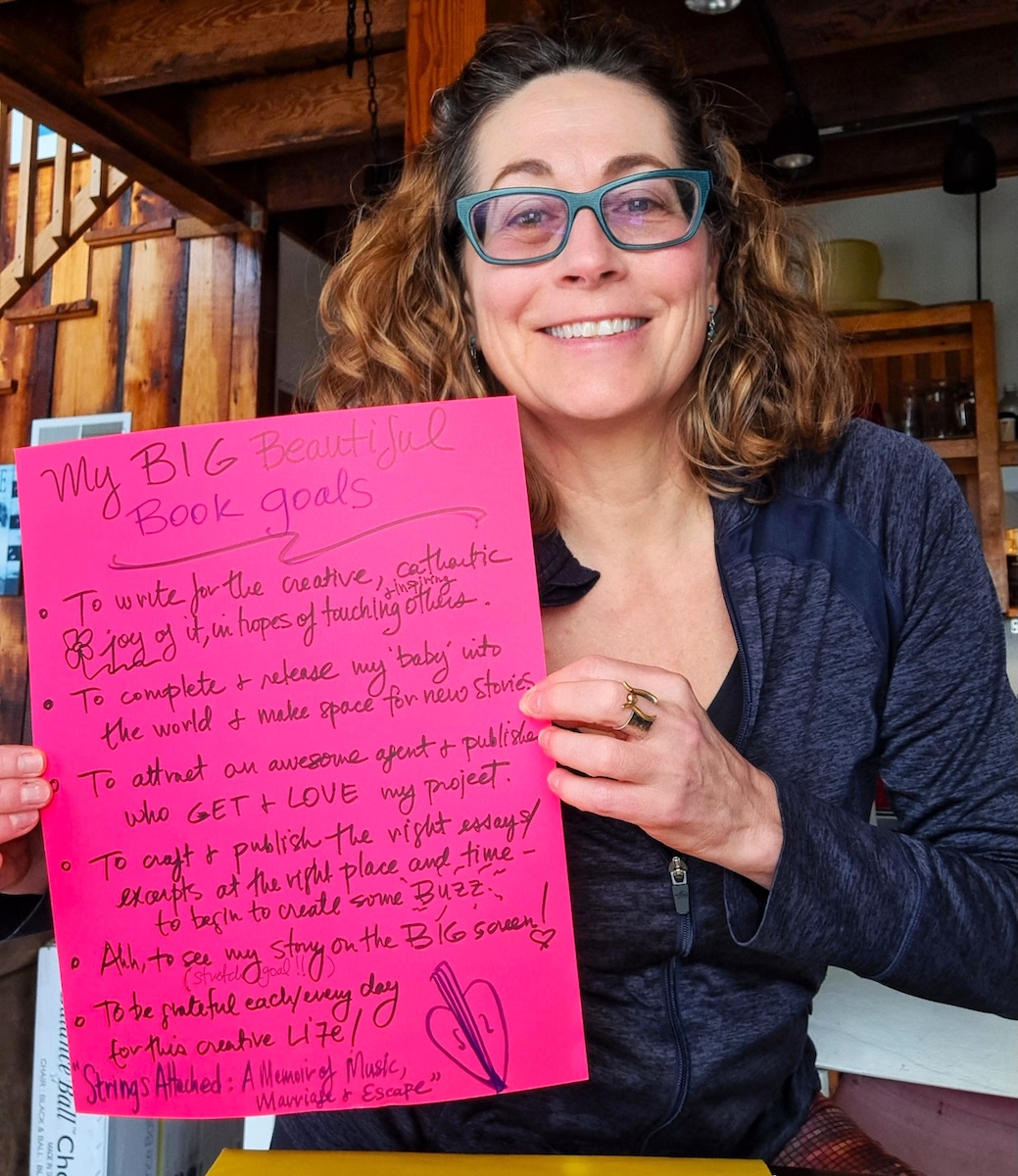
The next morning, when I showed up at my desk, dread infusing me, I caught a glimpse of My Big Beautiful Book Goals posted in neon on my office wall. Number 1 on the list of faded magic marker dreams: “To write for the creative, cathartic joy of it in hopes of touching and inspiring others.”
How could I touch or inspire anyone if the story remained trapped in computer files?
It was time to reach out to my therapist for an emergency session. She’d been with me through the protracted completion of the manuscript. The challenges were obviously not over.
“Of course not; you’re scared—not just of the rejection; what if it’s accepted?”
“I’ll have to keep reliving it—every pitch, every query—over and over. And a book tour?” I felt my chest tighten with panic at the thought.
“Who’s talking?” the therapist asked.
I understood what she was referring to. Based on our year together doing parts work—a therapeutic approach that recognizes we all have different inner selves with distinct voices and needs—she’d helped me address unresolved conflicts between my various parts, especially the ones wounded and unseen from childhood.
I shut my eyes and repeated my words: I’ll have to keep reliving it. The voice was teen me, the character who’d lived through the abuse and eventually escaped. The heroine of the story. She needed acknowledgment—she’d given me the story. She needed to feel safe. Could she trust me to protect her through the publishing process?
The writer me just wanted the book out in the world after decades of labor—completely understandable.
“What if they call me a liar—a drama queen? What if they criticize the writing—and me?”
It wasn’t safe to speak truth back then, the therapist reminded me. But I’m older and wiser now. That hindsight narrator—my true Self—the one who has painstakingly healed, in part through the writing—she could lead with curiosity and compassion. She could listen to the scared one when fears arise, reassure her that it’s safe now. This Self knows: birthing the book into the world won’t keep us trapped in the past—it will free us, all the parts unified.
With this new sense of clarity—with the triumvirate of Selves behind me—plus the nudge from my writing group—I felt ready to face the synopsis again.
As a creative writer, memoirist at that, it goes without saying: I am staunchly against employing AI to generate anything original. But a task like this, where analytical dispassion was needed—and, when it came to my delicate story, I had none—this felt like a job for Claude. So, with some trepidation, I began to test the waters.
I had various artifacts at my disposal: the horrible 10-page draft, some relevant excerpts I’d included in essays, a one-page agent pitch. All my own words, my own story—I just needed help seeing the shape of it. Within seconds, the bot spat out a terrible but intact 1500-word attempt. Everything was out of order. The bot had missed key beats, including the turning point death of my father. But the plot-driven just the facts, ma’am blueprint was a place to begin.
At the end of one long day at the desk, writer self focused and determined—character self allowing and curious—wise self-encouraging—I had taken the AI sow’s ear and spun it into a silk purse: an accurate and what seemed like a compelling synopsis ready to share with the writing group.
I was nervous, adrenaline coursing as I gazed back at the screen of friendly faces. I cleared my throat. Within a paragraph or two, as I read the summary aloud for the first time, I could hear the power in my voice. I registered more than mild surprise at how dramatic, how cohesive, how poignant this story sounded. In this compressed version of events—and perhaps after the backburner time away—it seemed like a story somewhat separate from me. In a positive—not dissociative way.
Excitement bubbled. The young one in me, hovering behind the scene, wasn’t ashamed, but the slightest bit proud, remembering: this is a heroine’s story with a happy ending. This was an important shift.
The group’s silence, at first, alarmed me. But it turned out they were concentrating. Like me, none of them had ever seen the story laid-out fully. They were taking it all in.
“Wow, Anne, great job,” one member eventually piped up.
Their feedback was poignant and encouraging. “You got it; you did it. Every woman has been through a version of this abuse. They need this story.”
Relief swirled with elation. Yes, there were edits to make, more trimming and nuance to be added. Most certainly, a long, laborious process of outreach stretched before me—one replete, no doubt, with rejection.
But there was momentum.

Anne Marina Pellicciotto is a three-time DC Arts and Humanities Fellow for Literature and Pushcart-nominated essayist whose work has appeared in HuffPost, The Independent, and various literary magazines. As founder of SeeChange, she coaches clients through their own creative and healing journeys. Her memoir, Strings Attached, is out on submission; her essay “Sweet Sixty,” drawn from the memoir, is forthcoming in The Rumpus. Find her at seechangeconsulting.com.


I appreciate you having the insight to name this strange, artistic crisis, which I viscerally relate to. After my first two novels were published, I confidently gave my email list the news that the next book would be out in the next year. That was in 2022, a month before our house was destroyed by storm waters and mold. The house is still uninhabitable. I still haven’t completed the draft. It’s achingly close but I also know how much solid work is still ahead. Who knew that it could get scarier for the third book than for the first?
How old is the frightened part of me? She’s probably a teenager, too. Who needs a hug.
And maybe an adult who needs a house.
Thanks, Anne. I look forward to Strings Attached.
Dear Mika. Many thanks for reading – and relating. Wow, book THREE. That’s inspiring. And yet, I’m sorry you are hitting roadblocks. Storm waters and mold – that’s tough. I lived through Hurricane Helene – and I was just writing about that today – The Power of Creative Destruction. Sometimes we need these wake-up calls – the pauses – and then we build back better. Wish you the best – yes, give that kid a lot of care. She deserves it. PS You can read that latest piece about Kali’s dark forces on my website blog if you wish to.
I love this: “This Self knows: birthing the book into the world won’t keep us trapped in the past—it will free us, all the parts unified.” I appreciate the nudge, as I’m in that last 10% of revising my book before sending to an editor. Q for you tho: I was in a publishing course where some top agents were saying if they sniff out AI even in the query letter, they will not continue to read. Wondering about that…what are your thoughts?
Go, Cynthia. You’re so close you’re basically there. It’s so satisfying. Celebrate when you’re done – take yourself on a date, drink champagne! Re AI I have a lot of thoughts – AI is a tool – just as social media is – so many things rely on in our ‘modern’ world. It’s ubiquitous – Google forces you to use it for searches. I don’t think we can be in denial. But we cannot be hostage to it – we have to employ it well – carefully and thoughtfully. Use the AI to support you – not put words in your mouth. I primarily use it to CUT words – I can be verbose. And that is especially important in a query letter. Create a draft – instruct it – see what you get back. Rewrite it. Never submit anything that isn’t your thoughts and words. Good luck!
Anne, I wanted to comment on this eloquently written piece that gives us the reasoning behind us freezing as writers, precisely when the time is just right for us to do the exact opposite. I’ve had this happen this week, maybe even in this moment. When I ask myself what’s wrong, the answer comes back swiftly. What if I’m accepted? I’m an introvert. I don’t even know if I like people anymore. And what about the book launch. And the tour? And I’d have to speak….!
So, who’s talking? For me it’s the four- year- old girl whose mother told her she was a mistake. It’s the part of me that was once voiceless and still won’t let go. You said, “it’s time to put my story into the world.” You also said, “I’d have to relive it.” I can sense you know trauma too.
It takes courage to write memoir. Not any more courage than we had to muster up as children right?
Your story is “a heroine’s story with a happy ending.” I believe that. Sounds like you had courage.
Today I’ll query two more agents after a 2-week freeze. Thank you for giving me what I needed at just the right time.
Melanie Marloe
Hi Melanie. Did you get those queries out? Sometimes a break can be divine intervention – we come back to it with renewed conviction to get our voice into the world. It matters. You matter. Our stories matter. What’s yours callled? Keep me posted. Find me on substack. https://open.substack.com/pub/annesmuse?utm_source=share&utm_medium=android&r=eo9v
Wow, I’m going to have to do some thinking about why I’m stuck in my book, I’ve had a theory for a while but never took the initiative to do some soul searching about why I was scared to finish it. I had started writing it when I was being very irrisponsible and got stuck writing at the tail end of it. I know I still feel guilty about it, but what I’m afraid of is letting go of that guilt, accepting that I did what I did, and it doesn’t help that my muse is the reason for my guilt. Perhaps shifting my associations with the characters would help, I would just need a new muse. 3 months, 500+ pages, and I’m stuck 2/3rds of the way through haha
Guilt is a terrible thing to hold onto. I think in part we write to see the truth for ourselves in black and white and forgive ourselves. Release your muse – and open the space to complete. 500 pages…what will be particularly cathartic is to cut cut cut the darlings and see the true essence reveal itself and let yourself be surprised. Then the muse can have fun!
I am learning a lot about memoirs here! In fiction, it is easier to hide behind our characters but sharing very personal stuff for everyone to read, knowing it is about the author, sounds a bit scary. But it’s awesome that you’re in control of the situation now and can use your voice. Good luck with everything. let us know how it goes.
This is priceless: “taken the AI sow’s ear and spun it into a silk purse.”
Memoirists make it real! Try it. Play with a memory – maybe something particularly humiliating – and see how freeing it can be to release it. No one need read it but you. But you may find you want to share. Like I said above…let your muse have fune! Oh…I got 4 bites on my memoir after a full day Pitchorama online pitchfest. Told my trauma 7 times over 5 hours and it got better each time. Just today I sent those agents my pages. Fingers crossed I find my match! Thank goodness I wrote that dang synopsis!