

Today’s guest post is by author, coach and educator Courtney Maum, author of Alan Opts Out.
Although I am a woman, I’ve always written most comfortably as a man. The more different a character is from me, the easier I find it to fictionalize them. I’ve never been a man, so when I delineate a hometown, family, and profession for a male character, I reach for answers that make sense for that particular arc and narrative instead of compromising the character’s development with my own micro traumas.
On the flipside, when I write a female character, my own mother pushes her way into the room, and then there is the absence of my father, the issues with my brother, I can’t get away from any of it. The woman’s profession? She’s a writer! My agent begs me not to make my character a writer. I make her a journalist.
I write nonfiction in addition to fiction, and I’m a feminist who believes that womens’ experiences, thoughts and fears hold tremendous value in our culture, and should be prioritized. Accordingly, there’s no world in which I only write male characters just because I find it easier. I have to push myself.
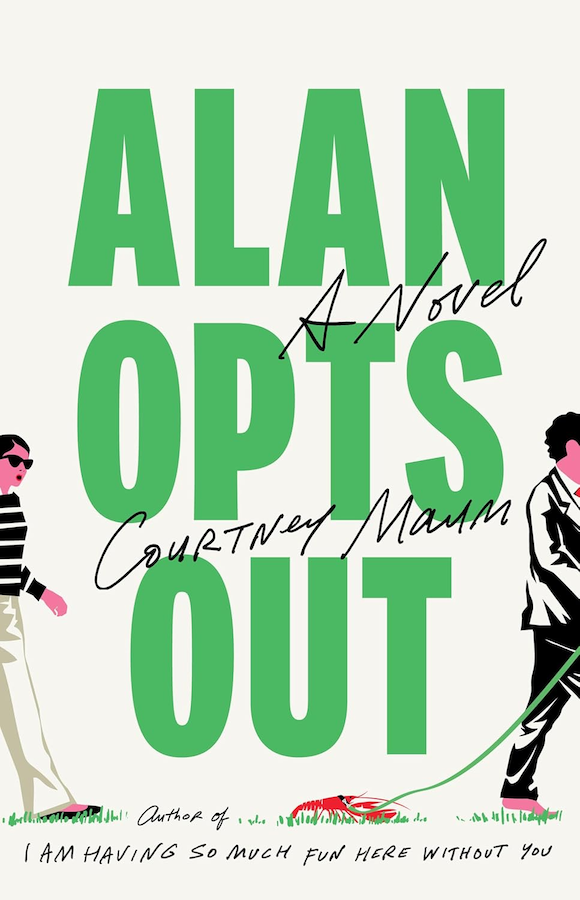
Fictionalizing the female narrator in my second novel Touch put hair on my chest, but I got it right. But when it came time to write Vivian Anderson, the woman character and second perspective in my forthcoming novel, Alan Opts Out, I was in trouble from the get-go. It’s hard to get a character to work in the first drafts, but that wasn’t my problem. I couldn’t get this character not to go to work. Readers would be shocked by the Vivian I started out with—an entrepreneur, a steamroller, a person who’s always on the move; and the Vivian who will meet readers on June 2—an insecure social climber, conflicted mother, someone whose central identity isn’t clear to even her, someone who’s always home. In short, because I have a job, and I love to work, I kept giving this character a capital “J” Job. I literally couldn’t get this woman to stay home with her children, even though it’s entirely in my purview and my power as a writer to make my characters do invented stuff.
By way of example, here’s the opening of Vivian’s first chapter (who was named Helen at the time) from my original drafts:
Back in her Denali after a style audit on a friend’s guest house that had somehow survived the last decade with wall-to-wall carpeting, Helen consulted the MenoPro application on her phone. 2:30 p.m. Her temperature was slightly elevated, but her ten-year risk of stroke had gone down two percentage points from the day before. Probably because she hadn’t had wine with dinner the previous evening, a milestone she’d shared with her cellphone. “Good job, Helen!” her phone had cheered her, with a yellow thumbs-up sign. Helen had teared up for some reason staring at this message. It had been a long time since someone told her that she was doing a good job. She didn’t seem to be doing a good job with Susannah—their youngest daughter’s latest report card had featured the word “underwhelming” twice, used by two different teachers—and Bailey was in her second program for “alternative learners” at a Montessori high school where—Helen knew that she wasn’t supposed to be judgmental about this—one of Bailey’s classmates identified as a cat.
In my first drafts, Helen was a fledgling stager desperate to nab all the local luxury real estate listings. (Stagers choose furniture, décor and general design schemes to help a property attract a certain kind of buyer.) Her entire arc was about her career ambitions, and the disappointments in her life that made her want a house to look a certain way. There’s nothing wrong with this. That’s a solid arc. Problem was, the set-up for my novel is that after botching a major account bid, Vivian’s advertising executive husband decides to opt out of capitalism and move into a playhouse in the Andersons’ backyard. The couple has two daughters. They live in a gated community with an HOA. My novel reckons with capitalism and hustle culture, so if Vivian was out working while her husband was playing Henry David Thoreau in their backyard, the book’s message flopped.
I’m embarrassed to admit how many drafts it took me to fictionalize Vivian correctly. To give myself the grace necessary to create the character the novel needed, someone who is not at all like me, whose values I disagree with. Vivian was a stager for seventeen drafts. It wasn’t until draft twenty-three that I started to get her right.
Here’s how the book opens now:
Vivian Anderson pushed the beauty products inundating her bathroom counter into an eddy by the outlet. Centered in her mirror and encased in flesh-toned shapewear, she resumed listening to Strive or Die, the motivational podcast she looked forward to every day. “A match point mentality isn’t a negotiable,” the host declared from her phone’s speaker. “I need my listeners to be waking up every goddamn day thinking—no, knowing—that they are gonna win. This isn’t manifestation. This isn’t vision boards. This is military battle. Women can lift cars that have fallen on their babies. Manipulate actual stallions with their inner thighs. These outcomes happen from just one place of thinking: I win, or I will die.”
First, I’m gonna win the fight against this shapewear, Vivian pledged, tugging at the control shorts cutting off circulation below her gut, and then I’ll win the Annes.
If you find yourself in a situation where, like me, you’re struggling to separate from your own experience to fictionalize your characters, here are some tips to help you imagine the impossible.
Convert your choices
On a large sheet of paper (if you follow my Substack, you know how much I love me some giant pieces of paper!), create two columns. On the left side, write everything that’s true about your character. When you’re done with that column, work line by line to create the polar opposite of the characters’ truths on the right side. For example, this exercise might have looked like this for me:
Vivian is a home stager → Vivian has never had a job
Vivian is active, always on the go → Vivian has agoraphobia
Vivian always wanted a large family → Vivian never wanted kids
Vivian is resentful of her husband → Vivian is proud of her husband
The idea here is to engage with comfort on the left side, and then to create extreme discomfort on the right side in hopes that the exercise will break you out of a rut and force you to see where you can put more fiction into your story.
Create outlandish wants
Grab another piece of paper. Same thing: divide the sheet into two columns. On the left side, list everything your character wants. It’s okay if these desires are internal or cerebral (“She wants to be liked,” “She wants a promotion”), just write out everything you know the character wants. Then, on the right side, illustrate tangible objects that the character might lust for. Tangible things only, and illustrations only: don’t use words at all. (A puppy, a designer purse, a flowering tree, a house, a wheel of cheese…)
Keep drawing until you land on an object that has some power to it. (For my character, Vivian, it was a swimming pool.)
As you go forward with your week, try to write to the most essential, solid thing your character wants, instead of the brainy, emotional desires. It’s the tangible objects that will lead to plot.
Write a letter of complaint from your character’s perspective to you, their creator
Imagine that your character is writing a letter to HR to complain about you, their creator. In the letter, your character should express what they deserve, how they’re not being treated fairly, not getting what they want. They’re upset with you, their boss. You’ve gotten something wrong about them. What have you gotten wrong?

Courtney Maum is the author of six books including the groundbreaking publishing guide and Substack of the same name, Before and After the Book Deal. Signed copies of her latest novel Alan Opts Out can be ordered through OblongBooks.com. Courtney’s website offers a variety of online writing classes, as well as information on her 2027 writing workshop in the south of Spain.




Thank you for this guest post!
I like the idea of creating the polar opposite of my character!
Indeed, people are a combination of consistency and inconsistency, liberal and conservative, logical and irrational.
It is so easy to think of all the virtues and Ideals, and we turn our character into a Mary Sue.
I’m going to try it.
“I’m embarrassed to admit how many drafts it took me to fictionalize Vivian correctly.” – oh my God, yes! I believe they call that… Writing.
I just made myself into a character in my most recent novel and had too much fun doing it. Now, I plan to continue the series with myself as the detective. I changed a few things, but not too many. And goodness, my mother always finds a way to sneak into my books, sometimes as the villainess 🙂