

As of 2025, most of my income arises from three types of work:
- My own speaking and teaching engagements (online and in-person)
- Hosting other people’s online classes
- Paid writing (newsletters, articles, books) and indirect income from free writing (advertising and affiliate income through my website and newsletter)
Since I started full-time freelancing in 2015, these categories have always remained central, although the mix and character of the work shifts. Here’s a look at how my income has developed and changed over the last decade.
What my top-line income looked like in 2016

Here’s what was happening in each of these categories.
- Online teaching (26%): This includes (1) multi-week workshops I was offering directly, (2) multi-week workshops I was offering by guest instructors (I kept a cut of registration fees), and (3) webinars I taught for other companies, such as Writer’s Digest. While it looks like a healthy percentage of my income, my profit margin was low on courses taught by others.
- Query-synopsis editing (24%): In 2016, I started attracting a steady stream of clients who were seeking help with their queries and synopses for submission to agents and editors.
- Consulting (17%): I once offered two types of consulting: book proposal consulting and one-on-one consulting. It was done on an hourly, flat-fee basis, trading money for time.
- Paid newsletter (12%): In late 2015, I launched a paid email newsletter with Porter Anderson. This was the first year we had a full year of subscription income, which we split down the middle after expenses. The profit margin was excellent, about 90 percent. This newsletter still exists today as The Bottom Line; I now fully own it.
- Freelance writing (7%): This included varied opportunities, including features for Writer’s Digest magazine. I also initially counted The Great Courses income under this, because it literally required me to write 100,000 words in three months. (I had to write the script for the course, then deliver on camera.)
- Affiliate income (6%): I’m an Amazon affiliate and also started affiliate arrangements around 2016 with Teachable and Bluehost, which I’ve since ended. I don’t work for this money; it’s passive income.
- Book sales (5%): This is all income from Publishing 101, which I self-published in late 2015.
- Conference speaking (3%): Some people think I get paid the big bucks for speaking. I do not. It represented the smallest piece of income in 2016. But speaking (especially in person) is important for visibility and trust. It’s also critical for me to remain in touch with real writers’ everyday concerns, plus I get to hear and learn from other experts in the community.
What my top-line income looked like in 2020
You’ll notice one big change here.

Here’s what was happening in each of these categories. And note that 2020 was the first full year that my husband joined the business as a full-time employee.
- Online teaching (48%): In fall 2019, I began hosting my own webinars because I now had someone who could help with post-production and customer service. Some webinars I teach myself and others feature guest instructors. This move proved fortunate when the pandemic rolled around. I keep 50 percent of the net for webinars taught by guest instructors. I still continue to teach for a range of organizations and companies, so that’s still included here as well.
- Query-synopsis editing (12%): I stopped taking on this work in the middle of 2020 to open up more room in my schedule for writing work. I still offer a query letter master class, though—that income now falls under online teaching.
- Consulting (16%): In 2020, I was still accepting one-on-one consulting clients and book proposal clients. In 2021, I accepted only book proposal clients in an ongoing effort to pull back some of my time for writing (or at least make consulting time more profitable).
- Paid newsletter (16%): I became the full owner of my paid newsletter. While this percentage doesn’t look much increased despite me taking 100% of the net, it’s not because the subscriber base didn’t grow. Rather, it’s a reflection of how much the other areas of my business grew—namely online teaching. Also, if this were a profits chart, not a top-line revenue chart, the paid newsletter would represent a bigger proportion of the pie.
- Book sales (3%): This is income from Publishing 101, my Great Course, and The Business of Being a Writer.
- Conference speaking (3%): This includes some virtual conferences and would’ve been more had it not been for the pandemic. (I’m not complaining, though! I needed to get off the travel wagon for a while.)
- Advertising (2%): I started accepting advertisers in Electric Speed, my free newsletter.
- Affiliate income (1%): Amazon has reduced its affiliate marketing payouts over time, and I’m more often linking to Bookshop—which simply doesn’t bring in as much income. (But one feels better linking to it.) I’ve stopped actively engaging in or seeking affiliate marketing, not because I’m against it, but frankly I have a lot of other things I’d rather do.
What my profits looked like in 2024
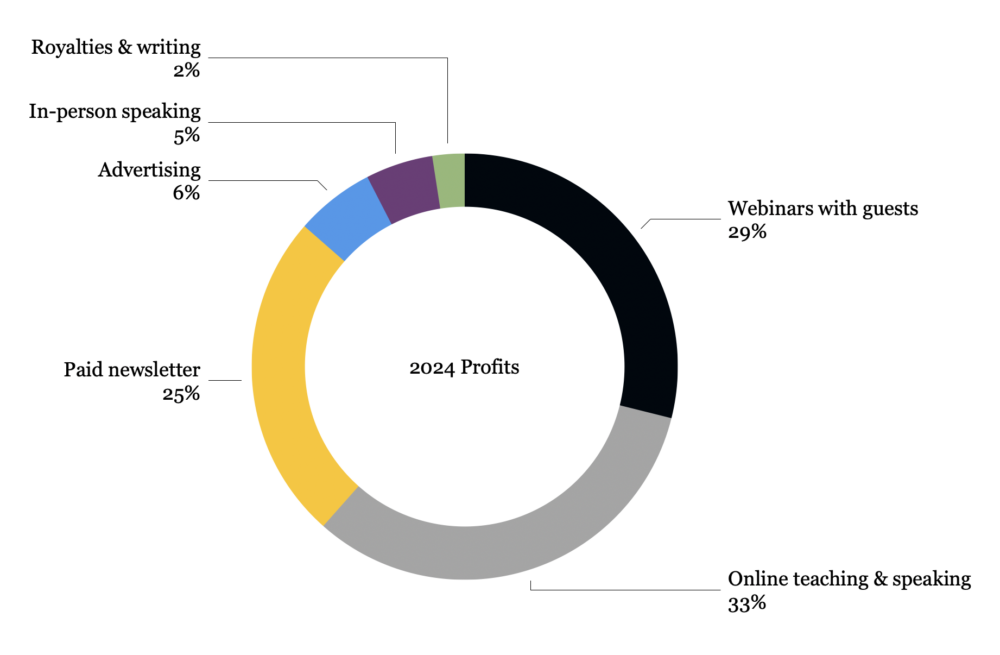
I’ve changed this graph to focus on profits since it’s a much better reflection of my business and how I earn money. When I host classes with others, the profit margin is less than 50 percent; all other aspects of my business have a much higher profit margin.
- Online speaking and teaching (33%): These are classes I teach on my own or in partnership with other organizations and businesses, such as Writer’s Digest. I earned $147,000.
- Webinars with guests (29%): These are classes that I host with other instructors; it brings me $130,000 per year in profits. The instructor and I split profits 50-50. See my online classes page to see what I offer with other instructors.
- Paid newsletter (25%): Once known as The Hot Sheet, this is now called The Bottom Line. Profits in 2024 were $112,000; top-line revenue was close to $150,000. I launched free edition of The Bottom Line in 2025, along with a higher-priced supporter tier.
- Advertising (6%): I accept advertisers in my entirely free newsletter, Electric Speed, as well as The Bottom Line. This area has the most potential for growth in the years ahead.
- In-person speaking (5%): I earned $23,000 from speaking fees for in-person conferences and workshops. Nearly all events pay for my expenses so that the speaking fee is pure profit.
- Royalties and traditional freelance writing (2%): This is income from The Business of Being a Writer and my Great Course, as well as freelance writing fees from publications like Writer’s Digest. From the book specifically, I earned $5,520 in royalties in 2024.
- I do still earn affiliate income, but it’s a negligible amount.
What I’m most happy about is that I’ve eliminated one-on-one work. I’ve always been fearful about walking away from consulting and editing. At the beginning it was my biggest category of earnings and it can be hard to turn down people who offer money upfront in exchange for time.
But as most entrepreneurs learn, there’s only so far you can go by selling your time for money. Plus, I’d rather devote more of my energies to writing work. The teaching and speaking is great and I don’t see giving that up—it also informs and improves the writing.
Questions? Let me know in the comments.

Jane Friedman has spent her entire career working in the publishing industry, with a focus on business reporting and author education. Established in 2015, her newsletter The Bottom Line provides nuanced market intelligence to thousands of authors and industry professionals; in 2023, she was named Publishing Commentator of the Year by Digital Book World.
Jane’s expertise regularly features in major media outlets such as The New York Times, The Atlantic, NPR, The Today Show, Wired, The Guardian, Fox News, and BBC. Her book, The Business of Being a Writer, Second Edition (The University of Chicago Press), is used as a classroom text by many writing and publishing degree programs. She reaches thousands through speaking engagements and workshops at diverse venues worldwide, including NYU’s Advanced Publishing Institute, Frankfurt Book Fair, and numerous MFA programs.




Thank you for the transparency, Jane! Fascinating.
Lovely to hear about all the details, Jane, and congrats on all the success (and pivoting during Covid).
I hear you on selling time for money. It’s hard to say no, but I’ve also been moving away from editing and toward more scalable models.
You say, “–there’s only so far you can go by selling your time for money.” I’d be interested to hear more. Where can we go to learn more about how to make this shift?
I talk about this dynamic quite a bit in my Sunday Sermon series:
https://www.youtube.com/playlist?list=PL81aMcw0YOtLbwkDRJPX4wxL3U_dhQVSE
“How My Freelance Business Started” might be the one to start with.
Or, here are a couple articles that get at the heart of the issue:
https://www.entrepreneur.com/article/244745
https://radreads.co/10k-work/
As an attorney who bills at an hourly rate, I totally relate to the concept that selling time for money only goes so far. Until we figure out how to change time, there’s only 24 hours in a day. And I have to sleep and still live a life outside the office.
I’m amazed at the transparency, Jane. And I so agree with “there’s only so far you can go by selling your time for money.” I stopped exchanging time for money a long time ago. Instead, I exchange value.
Thank you, Harald. It’s been a hard lesson learned here…
Fascinating, thank you for sharing this info!
Hi Jane,
Thank you for your thoughtful, informative dissection of the communications income stream you have built. It reminds me of why I invested in The Hot Sheet some years back. This column is a useful guide and model for career scribblers of all stripes. Please explain to me why agents and publishers cannot (or will not) be as transparent and forthcoming as you have been in their relationships with clients?
Vic
(Not for publication: We met a few years ago in L.A. when you spoke at the SCBWI’s summer conference. Since I missed the deadline for getting my new kidlit query critiqued by you how can I get a second chance? Thank you.)
Hi Vic: I wish agents and publishers could be more transparent, but sometimes contractually they are not allowed to discuss the financial terms of the deals they negotiate or sign. Some have been willing to speak out anyway, usually without repercussion, because it’s a bad look if publishers start punishing people for telling the truth about the money. I do think we’ll see more openness on this issue over time. But the biggest barrier is mainly the taboo surrounding money and how people tend to equate earnings with self-worth. There’s vulnerability there.
The query letter master class is the only option for getting a query critique from me right now; registration is closed at the moment.
https://janefriedman.com/query-letter-master-class-with-critique/
Thank you for this Jane – I haven’t had the chance to read The Business of Being a Writer but this post helped me get at least some idea of how freelance people in the writing and publishing industry might make their income. I would be really interested in hearing your thoughts on how newer and emerging writers can generate income (aside from their day jobs) and how we can map what our revenue streams might look like in the future.
Hi Tom: I discuss my various streams of income in my Sunday Sermon series here:
https://www.youtube.com/playlist?list=PL81aMcw0YOtLbwkDRJPX4wxL3U_dhQVSE
“How My Freelance Business Started” might be the one to start with, since I break down in dollars and cents what I was earning from specific sources, e.g., affiliate income, freelance writing, online classes, book sales, and so on.
My book has a significant section devoted to this as well.
Thank you Jane!
Jane, your post reminds me of a conversation I had with a well-known landscape designer. He was speaking at a conference and ended up sitting with me at lunch. Because I was considering a job change, I was bold in asking him about his income. He explained.
“My money comes from three areas:
1. I consult on garden design.
2. I write about garden design.
3. I speak about garden design.
Each one of these feeds the other two. It’s a sustainable model.”
His model sounds similar to yours.
Absolutely! Yes.