
Today’s post is by author Lea Page.
“I hope the bears get you,” he wrote.
I was weeks away from solo hiking the 3000-mile Continental Divide Trail, where the odds were good I would cross paths with bears. Like most women, given the choice between meeting a random man or a bear out in the wilderness, I would choose the bear, but neither were among my top concerns. Lightning strikes, river crossings, injury, even boredom were bigger worries. But a stranger’s wish that I die—that took me aback.
Exposure is baked in when you write, just as it is when you hike. This man’s comment, among many others, are the price a woman pays for sharing her thoughts and opinions in public. In this case, I had written an article for Huffington Post on talking with men about empathy—the irony is epic. As part of my hiking preparations, I watched several interviews with hikers who had completed the trail. When asked why they did it, every man responded with the same answer: “When was the last time you were in danger—real danger?” Their lack of awareness about the everyday lives of women—anyone but themselves—was stunning.
The comment section in Huffington Post is notoriously harsh, and conventional wisdom says to avoid reading it. I write to understand, but I publish to be part of a larger conversation. Therefore, I want to listen—mostly—to what readers say. And, wow, did these readers have some choice words for me. I withdrew into myself for a few days, telling myself that I was just digesting the responses, but truthfully, I had been knocked off balance.
Haters throw words to shame, to scare, and to harm, but more than anything else, they aim to silence. This is not new. Nor is it new when a person or a whole people reclaim those words: take epithets on as a collective noun, turn them into an anthem. I took a page from history’s book.
Writers are advised to avoid responding to negative comments. I followed this advice. But instead of waiting for the lurking feelings of being attacked to dissipate on their own, I decided to act. The comments about my appearance were nasty, but one of them, I felt, was quite evocative, almost poetic: “sea hag.” I laughed when I read it because it seemed almost hysterical, and the more I thought about it, the more I started to like the idea of being a sea hag. The phrase conjured an image of an old woman rising up from the vast ocean, a woman who might look ugly to those who didn’t understand her powers.
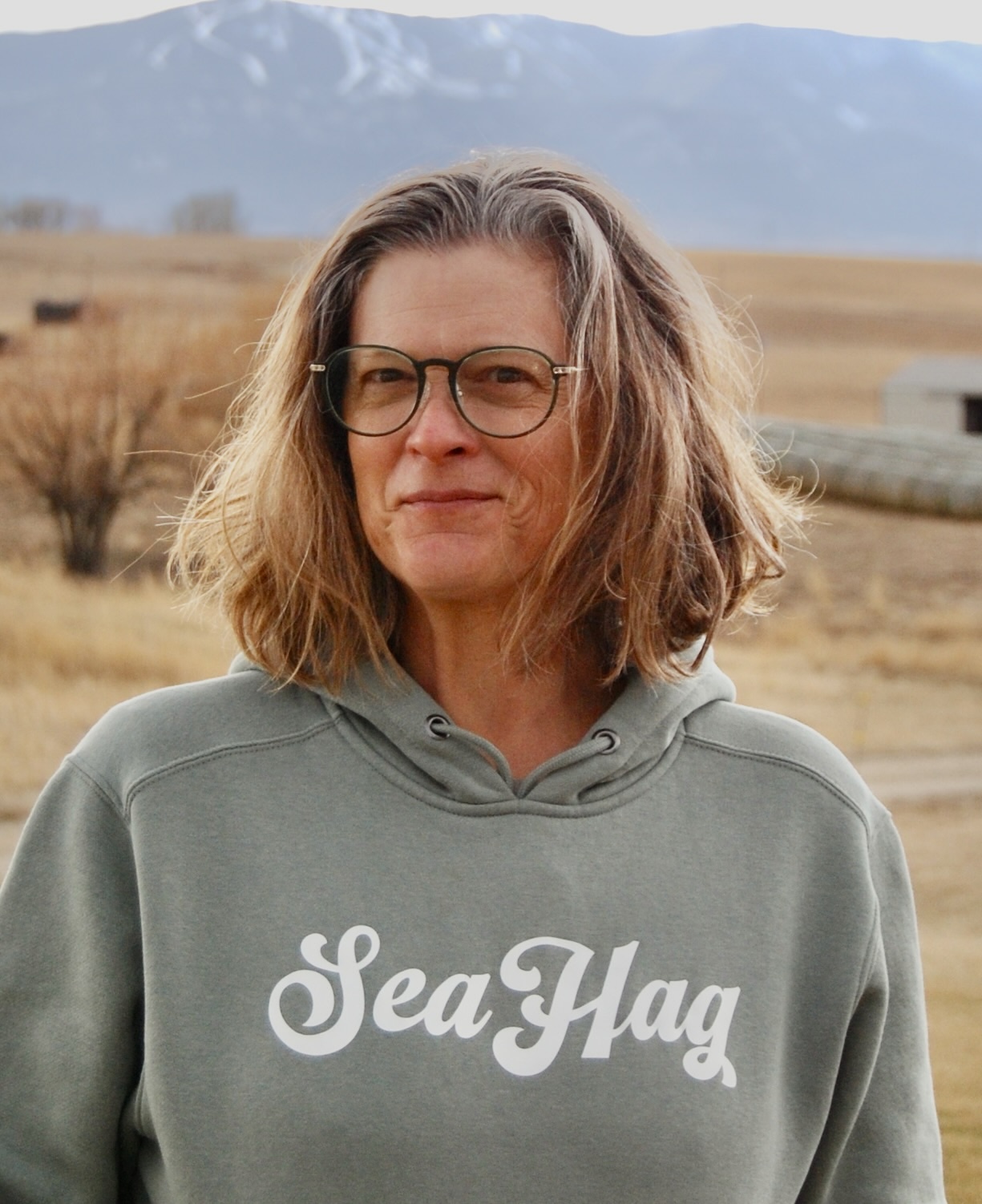
I visited our local graphic design studio and ordered a sweatshirt with “Sea Hag” silkscreened on it. We played around with various images, but none of them matched the feeling I had, so we decided to stick to the words. It took about six months—my single hoodie got lost for a while—but I picked it up the other day and was thrilled. I then went to the sandwich shop next door, and one of the young women behind the counter noticed the sweatshirt and asked me about it. I told her the story, and she and the other two nodded in recognition. We have all been called some version of “sea hag.”
“I like that,” she said. “That you are claiming it.”
I’m not celebrating nastiness by splashing it across my new sweatshirt. I’m resisting the understandable urge to not look, to turn away. I’ve learned—slowly but surely—that the best antidote to fear and shame is to bring it out into the blazing sunlight, to open up the doors so everyone can see it, and to say some version of “Hey, you all, get a load of this!” It’s a kind of judo move, redirecting an attacker’s energy. When they push, instead of pushing back, you pull—and then trip them.
Every time someone asks me about my sweatshirt, I get to tell the story. It’s a bit like revision—the traumatic memories spilled out in that raw first draft can leave you shuddering and unsteady, but those experiences have less power over you with each subsequent draft. The repetition is an exorcism. The events begin to live outside of you. The people who hear your story shoulder some of the weight by sharing their disgust with the hatred and then their delight with what you have made of it.
Turning hate into connection—even laughter? I think we can thank the Sea Hag for that. May we all be Sea Hags.

Lea Pages’ work, nominated for Best of the Net and Pushcart prizes, has appeared in The New York Times, The Guardian, The Washington Post, Huffington Post, Threepenny Review, The Rumpus, and dozens of literary magazines. She is a contributor to the anthology, Being Home, and is the author of Parenting in the Here and Now. Her memoir about family estrangement is forthcoming from Sibylline Press. Learn more at www.LeaPageAuthor.com.




Thank you for being you. I want a sweatshirt or T-shirt.
❤️❤️❤️
I rather like the idea of being a sea hag. I also find it interesting that your troll commenter chose such a powerful and, to some (him, for example) find fearful.
Love the sweatshirt!
p.s. Frankly, the anti-Semitic comments can even be worse.
You are one gorgeous sea hag. The oaf who called you one probably can’t swim.
❤️❤️❤️
There are a lot of sites–like HuffPost–I avoid because the comments are absurd. Love what you did with them.
I get it. And thank you.
Laughing in the face of cruelty…outstanding! I’m on team Sea Hag.
❤️❤️❤️
“Never argue with stupid people, they will drag you down to their level and then beat you with experience”—Mark Twain
Good one!
Understand completely. My political career left me so traumatized I now live with social anxiety. How’s the hike going, BTW? Our children are inveterate hikers, though I hung my shoelaces over a nail once and for all.
I’m so sorry!! Hike got cut short but was still great.
I’m tired of the assholes. People are so quick to be mean anymore. It takes great strength to be resilient and flip the narrative in the face of cruelty. I hope you find comments on this article more aptly match your worth.
A balm. Thank you.
Many emotions went through my heart as I read your essay. I am so hopeful to find an agent and get traditionally published, but I don’t seek fame at all. You can never please everyone, so why do negative comments hurt so much? It’s that exposure that scares me a bit, but as the saying goes “feel the fear and do it anyway” and so I keep pursuing that golden ring.
I love the Sea Hag label! I would totally own it!
Good luck!!