If you’re a self-publishing author, then you’ve probably noticed the community’s growing focus on direct-to-reader book sales. Authors like Joanna Penn have been using Kickstarter to sell pre-orders for new projects; the last 20booksto50k conference offered advice on how to use Bookvault for print-on-demand fulfillment and BookFunnel for digital fulfillment; and even the Authors Guild has hosted a session on how to drive direct sales using platforms like Shopify.
For indie authors who often build their early careers on low pricing and digital sales to compete in the market, the value and power of print is starting to be widely recognized, especially as sales of deluxe editions are booming. TikTok, in part, is behind this: The BookTok community wants to be able to show off a physical book, and that community is also discovering and buying indie authors. And indie authors have responded with enthusiasm.
Enter Beventi, a platform that streamlines pre-orders and direct sales. The Australian-based company, founded by the couple Kaydence Snow (indie author) and John Smythe (software engineer), soft launched in 2023, with a more formal marketing push starting in January 2024. By mid-July 2024, Beventi had already processed about $2 million in book sales. And of course those are all unreported book sales that never show up in official industry figures.
When Snow started managing her own pre-orders for book signing events, she cobbled together a system using Google forms and manually emailed invoices. “It was really labor intensive, really slow,” she says, a process that became more cumbersome the more books she sold. When Smythe observed this process—then talked to more authors and found out they all did the same thing—he knew he could build a better solution.
The need for Beventi is partly related to the significant growth of book signing events around the world. One of the early and successful organizers of such events is Romance Author & Reader Events (RARE), a US-based company that focuses on destination events in locations such as London, Rome, Paris, and Melbourne. RARE events sell out for both readers who buy tickets to attend and authors who buy exhibit space to sell books. More of these events—some large, some more intimate—are popping up everywhere. For example, you may have heard of Colleen Hoover’s Book Bonanza—one of the most well-known author-reader events in the US—as well as ApollyCon, hosted by Jennifer Armentrout. If not well organized, book signing events have the potential to make headlines for the terrible experience. (See this coverage of Readers Take Denver, asking “What the hell happened?”)
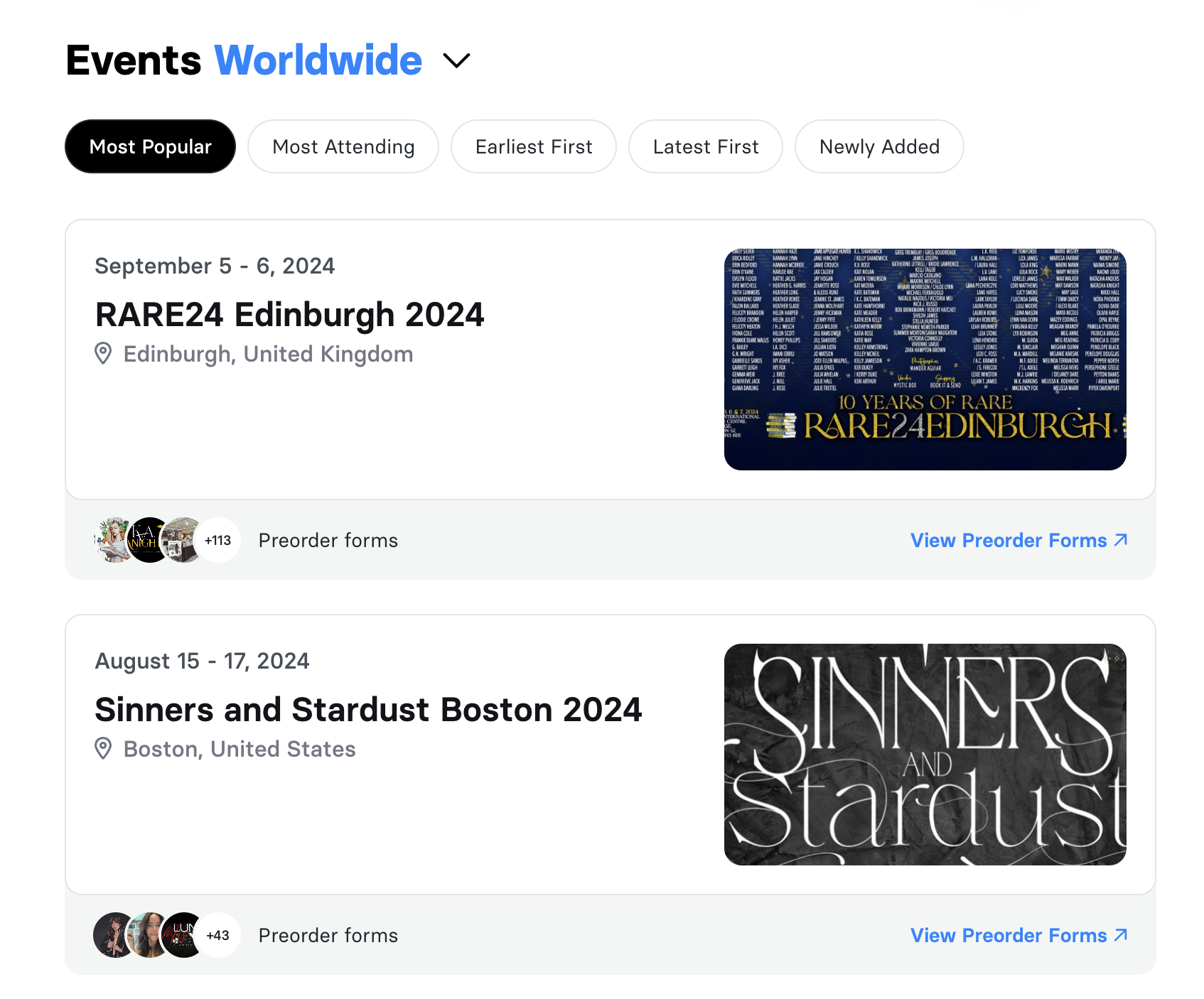
So how does Beventi work? On Beventi’s site, readers can browse and place pre-orders offered by authors at specific book signing events—plus browse events by most popular, most attending, location, and date. (See screenshot below.) Authors set up their Beventi account for free, then connect their account to their payment processor (Stripe or PayPal). Beventi never holds any money, but takes 2.99 percent per transaction. (Don’t forget the payment processor also takes a cut of the transaction, about 3 percent.) Readers get charged a 2 percent fee when pre-ordering books for a signing event through Beventi.
Snow says, “Especially in the indie space, so much of what we have to use to manage our businesses is not built for us. It’s built for other things, and we just make it work.” An example is Shopify, which she called a “beast.” “We are very much focused on building Beventi for authors in a way that works for authors.”
While the initial intent was for authors to use Beventi, it has attracted interest from other event vendors who sell books and book-adjacent merchandise. They like how Beventi allows them to see all the pre-orders from one particular event in one place. Plus, “They want to be [on Beventi] because that’s where the readers are going to purchase books,” Snow says. “If as a vendor, if my pre-order form is there as well, it’s a no-brainer to get in front of ticket holders. So that was unexpected, but it makes sense.” (Beventi can support the sale of any physical product, not just books.)
Beventi has broadened its remit to include direct sales of all kinds, not just event pre-orders. They’ve added shipping functionality, so authors can charge a shipping fee and collect shipping addresses. As a result, Smythe says some authors have reached out and asked to move their entire store from Shopify to Beventi because it’s easier to use and less expensive. Moreover, they’ve had bookstores and other retailers—the kinds of businesses that normally already have their own ecommerce solutions—use the system. In the future, Beventi expects to add support for digital book sales.
Bottom line: Direct-to-reader sales are profitable and, just as important, reduce authors’ reliance on Amazon. Beventi has been custom developed for authors and the publishing community to make selling direct easier and more economical. And it’s now being positioned by Snow & Smythe as a discovery vehicle for readers—a community where people can find new authors and books. Snow says, “We are working on building the system out to be as functional and as helpful and as streamlined as we can possibly make it for the book community. That’s our goal. ‘When books find their readers,’ that’s the tagline. And that’s what we want to do, whether it’s at events or through direct sales. We want to be the go-to platform for authors to connect with readers.”
Are book signing events right for you?
If you’re an indie author, but you’re not yet attending signing events, should you consider it? Here’s what Snow says.
Look beyond profitability. “More often than not, it’s not about making money. Obviously, there are authors at that top end of popularity that will sell the kind of volume that will make them in the tens of thousands of dollars at any one event. They are the outlier. My primary goal is never to make money. It is very much to connect with my readers, broaden my reader base, connect with other authors, network with my peers and within the industry.”
How many published books should you have before doing an event? “I think it really depends on what your goals are. Figure out what your goal is with the event. It’s not always going to be profit. So many opportunities come out of making connections with other authors. I’ve been invited to participate in anthologies, I’ve been invited to other events. Having that peer community is invaluable. So really consider what your goals are. And once you know that, it’s easier to make some decisions. Unless you have a smash hit with your debut, I would certainly wait until you have at least a small backlist before you do events, because it allows you to have a better, bigger offering at a particular event. You’ve got more to talk to readers about. Think about budgeting—you may want to start with a local event that’s not going to be as overwhelming with the logistics and the costs involved. And you might find that events are not for you. Not all authors do them; some of them find it overwhelming or just don’t enjoy the crowds. It’s not for everyone. And that’s okay. You don’t need to do events to be successful as an author; there’s so many different paths to success.”

Jane Friedman has spent her entire career working in the publishing industry, with a focus on business reporting and author education. Established in 2015, her newsletter The Bottom Line provides nuanced market intelligence to thousands of authors and industry professionals; in 2023, she was named Publishing Commentator of the Year by Digital Book World.
Jane’s expertise regularly features in major media outlets such as The New York Times, The Atlantic, NPR, The Today Show, Wired, The Guardian, Fox News, and BBC. Her book, The Business of Being a Writer, Second Edition (The University of Chicago Press), is used as a classroom text by many writing and publishing degree programs. She reaches thousands through speaking engagements and workshops at diverse venues worldwide, including NYU’s Advanced Publishing Institute, Frankfurt Book Fair, and numerous MFA programs.