
I’ve been reading and following agent Kate McKean ever since she launched Agents & Books, a Substack-based publication for writers who want to better understand the industry and how agents work. One of her latest posts, Honest Answers to the Questions New Clients Ask on the First Call, is emblematic of her guidance: highly informed, direct, and likely to reduce writerly anxiety, which I particularly appreciate.
This year, McKean released a new book for writers, Write Through It: An Insider’s Guide to Publishing and the Creative Life, which delivers her sound guidance in book form. I took the opportunity to ask McKean a few questions that have been on my mind about agents and the current state of the industry.
Jane Friedman: I’ll start with maybe a silly question, but I’m always wondering why agents decide to have agents for their own books. You’ve been an agent for about 20 years and you know the industry as well as anyone. I imagine you’ve dealt with all kinds of situations, contracts, publishers, and personalities. I think writers would love to know why you value having an agent as an agent.
Kate McKean: I absolutely wanted an agent because I knew I would need the help all writers need with their projects: bouncing around ideas, editing, emotional support. And also, I did not want to call up editors I’d known for years and say I wrote the best book. Don’t you want to buy it? As Michael Bourret [my agent] will attest, I still did all the goofy things writers do, regardless of my 20 years’ publishing experience. Some things are easier because he doesn’t have to explain the basics to me but we had plenty of conversations where I said, “Tell me to stop worrying about this thing I know I should not worry about.” Heck, I did that this week!
You’ve been writing the newsletter Agents and Books since 2019, and I imagine there are specific topics where you know that if you write about them, you will get more traffic, interest, sharing, etc. But they might also be topics that, at this point in your career, now feel boring or you struggle to address in a way that’s interesting to yourself. For me, that topic is anything related to query letters. What’s yours?
Yes, for me, it’s query letters, too. My theory is that this is the first thing writers start googling when they embark on their traditional publishing journey and it trails off from there. I try to remember that not everyone has been reading my newsletter since the beginning and I link back to previous posts regularly so people know they’re there. I also know that if I post what agents REALLY think about XYZ, it will get traffic. I try to avoid making my posts read like TikTok trends (propaganda I’m not falling for, etc, etc) but long time readers know I’m not above a tongue-in-cheek clickbait-y headline.
There are a lot of depressing messages right now surrounding kids’ reading (how the kids can’t read or don’t read), middle-grade reading in particular. I try to reassure writers that these things are cyclical and nothing is forever. (I hope I’m not wrong.) What keeps you optimistic or what do you see as bright spots for middle-grade writers?
I have an eight year old, so I am in the thick of this. And it’s doubly hard because my kid knows just how much reading and books mean to me and my husband, but they also do not want to be told what to do, of course. My kid has read the Heartstopper series over and over again. and I am totally OK with it. If my kid, and anyone else’s, is destined to become a reader, they will become it, and forcing it is guaranteed to have the opposite effect. Their tastes will develop just like ours did. I can’t wait to see what totally inappropriate book they sneak and read, like we all did Stephen King and VC Andrews. It’s a rite of passage. And this cohort of MG readers will want YA novels soon enough, and then King and whoever, and publishing will have plenty for them. There’s also a cohort of MG readers behind this one, and one after that, and one after that. And they’re all going to need books. That’s never going to change.
My own career in publishing started with how-to books, so many how-to books. The perennial bestseller for the publisher I worked for was The Art of Painting Animals on Rocks by Lin Wellford, which sold more than 1 million copies across its many spin-offs. It’s been a long time since I was in the position of acquiring and editing how-to books, but my impression is that it’s a far tougher environment today for all kinds of how-to given the predominance of YouTube, TikTok, and other ways that people now learn—ChatGPT even. When you’re assessing a how-to book concept in 2025, what helps you determine if it’s worth pursuing in book form? Does it boil down to an author’s platform?
I cut my teeth on selling craft books (sewing, knitting, etc) and boy do I hear you on how that’s changed in the last 15 or so years. I think an author’s platform is vital, but so is the content and how it’s presented. Above all else, the reader has to want that information in book form. Their first instinct should be I need to read a book about X, not I should read Wikipedia about X. Maybe readers do a cursory google to get a better sense of things, but if they get all they need from that (or TikTok or whatever) then that topic is not a good one for a book. I do not go to books for TV episode recaps or current fashion trends for good reason.
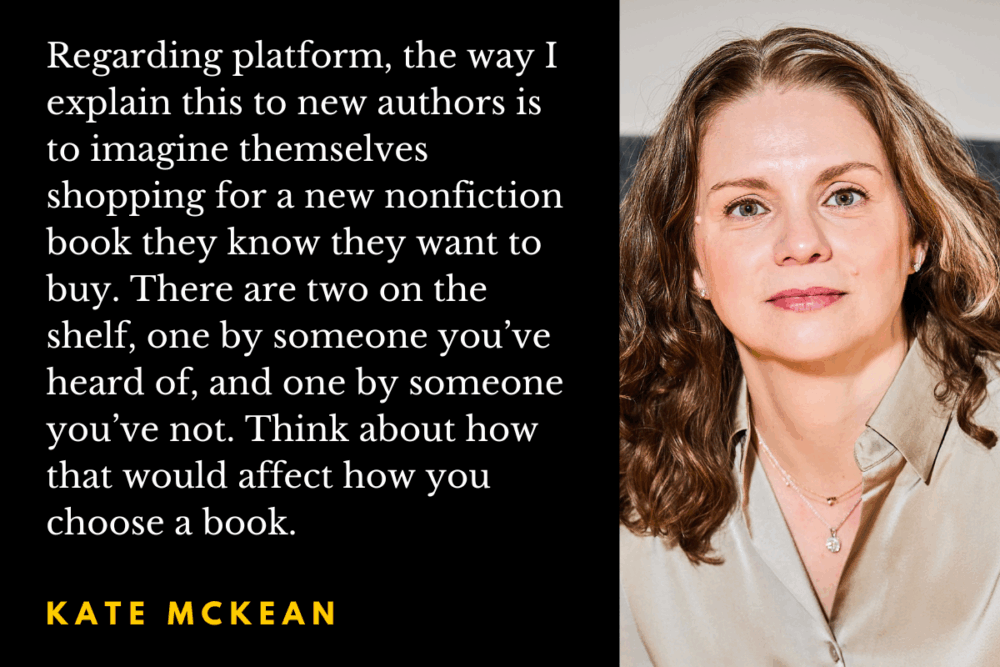
But regarding platform, the way I explain this to new authors is to imagine themselves shopping for a new nonfiction book they know they want to buy. There are two on the shelf, one by someone you’ve heard of, and one by someone you’ve not. Think about how that would affect how you choose a book. Then think about how you would have heard about that author in the first place—social media, magazines, TV, a friend—and what it is that makes you trust them. In fact, I encourage authors to go out and shop for a book for themselves like this and think about how they made their choice. That can tell you a lot about how to craft your own platform, and how to better define your topic.
Can we also talk about humor books? For a very brief time, I partnered with John Warner on a humor imprint that was a spectacular failure. There were several reasons for that (none of them John’s fault), but it opened my eyes to how challenging that category is. I couldn’t help but notice that about a decade ago, you sold a lot of humor, but I’m not seeing anything lately as far as reported deals to Publishers Marketplace. It feels to me like social media has hobbled this category for book publishers unless you’ve licensed Calvin & Hobbes or Garfield. All of this to ask: What’s a humor writer’s career path today?

You’re right, I did do a lot of humor books in the past and they were tons of fun. And yes, they’re really hard to do now. But I think it was the death of Borders and the rise of online shopping that kicked off the meme/blog-based humor book. Those were impulse purchases and when fewer people were in stores, they bought fewer of those books.
I also think as Anthropologie and Urban Outfitters moved away from stocking so many books it really hurt publishers’ bottom lines—especially because those books were mostly non-returnable! The death of blogs like The Toast and The Awl also struck a blow to this market because it took away a great platform for writers to be discovered.
But on top of all this, I think readers are bombarded with memes and they just don’t need them in book form anymore. The ones that work now either offer something new to the reader they can’t get online, or act as merch, just the same as buying a Mets hat or a band T-shirt.
Nowadays, the best path for a humor writer, IMHO, is essays or comics/graphic novels, especially when they center on a theme or tell a story. A writer still can or has to build a platform online, and that can be with funny pictures of cats or whatever, but a book they do out of that has to offer the reader more.

Jane Friedman has spent her entire career working in the publishing industry, with a focus on business reporting and author education. Established in 2015, her newsletter The Bottom Line provides nuanced market intelligence to thousands of authors and industry professionals; in 2023, she was named Publishing Commentator of the Year by Digital Book World.
Jane’s expertise regularly features in major media outlets such as The New York Times, The Atlantic, NPR, The Today Show, Wired, The Guardian, Fox News, and BBC. Her book, The Business of Being a Writer, Second Edition (The University of Chicago Press), is used as a classroom text by many writing and publishing degree programs. She reaches thousands through speaking engagements and workshops at diverse venues worldwide, including NYU’s Advanced Publishing Institute, Frankfurt Book Fair, and numerous MFA programs.


Well Done! Great Questions , Jane! Great Responses to allow us nonagented figure things out!
Thanks for these insights. It looks like a great, practical book. I ordered it because of the article. Also, I loved the author’s graphics on the “publisher” section of Amazon; it was pretty and engaging.
Delighted to see this interview—between two of the most helpful, de-mystifying sources of info for writers! Thx to both of you for your writing over the years.