
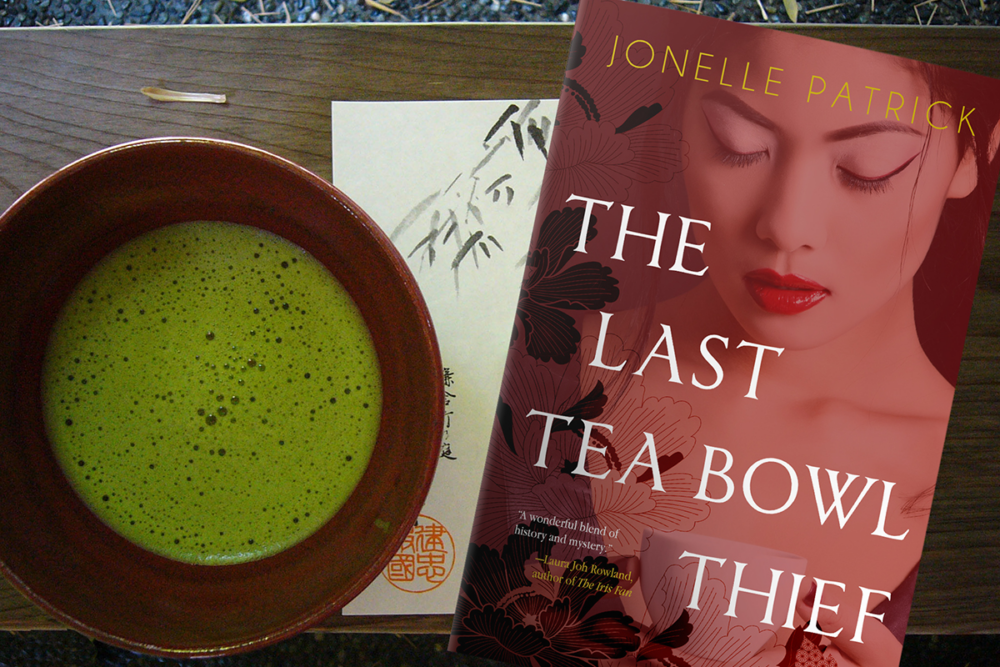
Today’s guest post is by author Jonelle Patrick, author of The Last Tea Bowl Thief.
Drinking problem, bad childhood, dirt poor—nearly all of literature’s most interesting characters have some sort of personal challenge to overcome. It is, after all, the easiest way to get inside readers’ hearts and start them cheering for a character from page one.
But what about characters with more serious physical challenges? Or psychological issues that can’t be “cured” or ignored?
Yes. But—no surprise—few writers dare to try, because great reward also comes with great risk. There are the obvious thin-ice issues of writing a character whose daily experience is so different from your own, but it also requires commitment. Even the most mundane tasks performed by your character require that they adjust themselves to a world not designed for them. That can be hard to keep up for 350 pages, let alone a series.
But this is the stuff of which compelling novels are made, so start by asking yourself these three questions.
1. What can your character do that ordinary people can’t?
When I started writing The Last Tea Bowl Thief, I wasn’t asking myself if one of the main characters should be blind. I was asking what missing Japanese art object might inspire a centuries-long hunt, with the power to change the life of whoever finds it. A calligraphy scroll? Nah, too fragile. A Buddha statue? Too awkwardly shaped and hard to hide. What about a tea bowl? Yeah, what about one of those super-expensive pieces of pottery designed for tea ceremony?
Turns out, what makes a tea ceremony bowl priceless rather than just pretty is the experience it delivers while drinking the tea. Okay, good, the main character can be an artist who’s not merely focused on how a tea bowl looks. In fact, what a pleasure it would be to write one who’s exquisitely aware of how a tea bowl feels in his hands, how it focuses the scent of the matcha, how sipping from it makes the angel choirs sing!
But wait, how can an artist not be focused on how his work looks? Unless…he can’t be. What if he’s blind? But how can an artist be blind?
And therein lies the tale that became the heart of The Last Tea Bowl Thief. The character’s lack of an ability that the rest of us rely on not only shaped the kind of person he was, it freed a character with the training and talent to become a major artist from a boring, predictable life of following in his father’s footsteps. It put him on a path to a life that was not only far more interesting to write and read about, it changed other characters’ lives in the parallel timeline, centuries later.
Which leads us to question number two:
2. How can your character’s differences be a talent that gives them the power to see unique solutions instead of a roadblock that needs to be overcome?
Nita Prose’s main character in The Maid is proud of being the absolute best at a job most readers might think is beneath her. But she’s a little too neurodivergent to be comfortable doing any job that relies on reading social cues for success. As her inability to sense that she’s being set up and lied to ratchets up readers’ anxiety, her job as a cleaner gives her an inside view of what goes on behind closed hotel doors, and her perpetually analytical way of thinking points to a culprit dismissed by more average investigators.
In the same way that a blind potter can be sensitive to things a sighted person experiences far less acutely, Nita Prose’s maid notices details that ordinary people take for granted, and puzzles out the solution without the assumptions and prejudices that cloud others’ judgment.
Which brings us to the third question.
3. How does your character interact with the world in ways that surprise and delight?
Nothing pleases readers more than being shown something familiar in a whole new way. And characters with major differences do experience the world in new and different ways. It’s fun to read and can be a joy to write.
The Last Tea Bowl Thief’s potter, for example, is in love with the most beautiful woman in the world. He knows this for a fact because her voice is so lovely, and she smells like flowers after the rain. Ordinarily, a mere artist’s son would have no a chance to win a high-ranking samurai’s daughter, but he has an advantage over other potential suitors because he’s not handicapped by the gift of sight. They care far too much that she was disfigured by fire when she was a child, so they’re blind to the beauty that only he can see.
If you’d like to try supercharging your creativity by giving a character a bigger challenge than a martini addiction or a mean mom, try this: Dig out that unfinished manuscript you just couldn’t sell. Which character would change in the most interesting (and useful) ways if they were neurodivergent or coping with an ongoing physical challenge? Now rewrite the first chapter where they appear and see where it takes you. You might be surprised.

Jonelle Patrick is the author of five novels set in Japan and has been writing about Japanese life, culture and travel since 2003. Her new mystery, The Samurai’s Octopus, is out April 21, 2026.

Love this article and it sounds like a great book I will have to read! One thing that attracted me to watching K-Dramas was their bold & creative use of unusual character traits – blind, muteness, facial blindness, deafness, special powers, you name it —and then using it to fuel the drama, romance, thriller, whatever.
I’m so with you on the K-Dramas! It one of the reasons they’ve been totally eclipsing J-Dramas, even here in Japan.
Terrific post, thank you!
I’m so glad you enjoyed it! (I love Jane’s blog—it’s always stuffed with useful and interesting info I know I can trust, so I’m thrilled to be here.)
What an interesting premise! Never thought of characters that way. Will look for the book, thank you.
I’m so honored that an author who has written so many wonderful books herself found this post worth reading. So happy you commented, because I just nipped over to your Amazon page and am starting with “Last Seen In Havana”!
Thanks Jonelle. I enjoyed that and I’ll have a read of your work.
The protagonist of my novels is a doctor who has her own medical problems at times–so the books include medical drama with patients, but also the doctor’s struggles. And her wife is a below-knee amputee. These help reveal the doctor behind the profession’s mask.
The couples’ abilities are not the main point of their existence. But their ways of being in the world lead to different ways of seeing things, as you say. Just as diverse experiences can make us richer and smarter in real life.
Readers and reviewers have taken my characters’ diversity in their stride. But there was one special fellow (an older, white man in the US, as it happened) who complained: Why did the characters have to have and be, all those things? He felt that being one of them [e.g., disabled, foreign, queer, indigenous] should be enough for one book.
I thought about it. I may have put too much into my first two novels, unsure of whether the next ones would make it.
But he also didn’t get it. Some of us are just made that way. And some of us find that endowing our characters with different abilities and ways of being expands the consciousness/imagination of our readers.
I appreciate the sense of connection I felt from your writing.
Added: Your blog is gorgeous! Thank you.
I bow in admiration that you went straight for the Olympic-level challenges (especially if you know about any of them first-hand). And that I’ve found another sister who understands that painful thing we all get hit over the head with at some point, that our books just aren’t going to appeal to everyone (sadly, in your case, one who might benefit from having his eyes opened a bit…)