
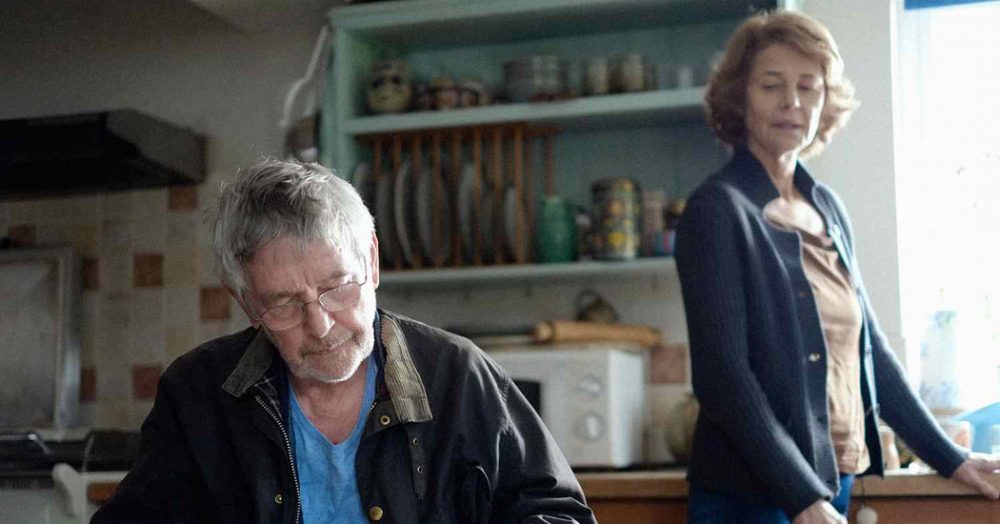
A story I often find myself reflecting on, with no prompting, is 45 Years. It’s a British drama based on the short story “In Another Country” by David Constantine.
While the movie portrays some of the most ordinary events you can imagine, the context of those events amplifies every scene. It’s about a married couple planning their 45th wedding anniversary right when a stunning revelation surfaces from the husband’s past.
Without the context of the anniversary—which is right there in the movie title—the story wouldn’t be half as affecting. In the latest Glimmer Train bulletin, Monica Wood discusses how context is a “descriptive background in a story that sheds light on its meaning.” And, as she points out, it’s larger than plot:
Context provides forward motion at the emotional level, using symbols and metaphors that reinforce emerging themes in a story. It also can serve the practical purpose of organizing the physical movement of a story into beginning, middle, and end.
She goes on to offer a few excellent examples, including Edith Wharton’s Ethan Frome (the context of a cruel New England winter) and A Thousand Acres by Jane Smiley (the family-owned and generations-old thousand acres of land). Read Creating Context.
Also in this month’s Glimmer Train bulletin:
- On Beginning with Image by Rachael Uwada Clifford
- The Leap by Robin Halevy
- Language and War by Siamak Vossoughi
- A Vessel for History, Life with Maline, and Other Fictions by Andra Nicolescu
- A 20 Year Itch by Cat Seto
- Vandals, Romans, and the Stories We Tell Ourselves by Kent Wascom

Jane Friedman has spent her entire career working in the publishing industry, with a focus on business reporting and author education. Established in 2015, her newsletter The Bottom Line provides nuanced market intelligence to thousands of authors and industry professionals; in 2023, she was named Publishing Commentator of the Year by Digital Book World.
Jane’s expertise regularly features in major media outlets such as The New York Times, The Atlantic, NPR, The Today Show, Wired, The Guardian, Fox News, and BBC. Her book, The Business of Being a Writer, Second Edition (The University of Chicago Press), is used as a classroom text by many writing and publishing degree programs. She reaches thousands through speaking engagements and workshops at diverse venues worldwide, including NYU’s Advanced Publishing Institute, Frankfurt Book Fair, and numerous MFA programs.




‘half as affecting’? Did you mean half as effective?
I meant what I wrote.
Thank you for this article, Jane. The examples bring home the idea of context as a means of (among other things) bringing thematic resonance to a story, whether novel-length or short. Thanks also for reminding me of the excellent Glimmer Train bulletin!
I think it will take several thousand years to reach the literary quality of the 20th century again.
[…] https://janefriedman.com/context-when-a-story-demands-more-than-plot/ “A story I often find myself reflecting on, with no prompting, is 45 Years. It’s a British […]
[…] Context: When a Story Demands More Than Plot […]