

Today’s post is by doctor and novelist Emma Olive Billington.
I’ve been known to ruin dinner.
Not because I’ve cooked something inedible (although that does happen), but because I am miserable company. Why? Because I am not making progress with my writing.
I’m a doctor and medical researcher who caught the unshakable urge to write a novel in 2019. Six years later, I’ve had no success in finding a cure for the compulsion to write. Worse, I’ve become all too aware of the ill-effects that not writing have on my mood and well-being. The obvious treatment would be to, well … write. And yet, I often have difficulty prioritizing it. As an unpublished hopeful, it can feel difficult to justify taking time away from more urgent (and lucrative) responsibilities to write fiction.
As a result, I would find myself in a self-perpetuating cycle. I’d push off writing one day because I was too busy. That day would turn into a week, and before long, I’d be in Ruining Dinner Mode. Because I didn’t have a reliable way to break the cycle, I’d often be stuck for months before finding my way back to my writing.
That is, until I discovered the life-changing magic of tiny tomatoes.
Like many writers, I have long been familiar with the Pomodoro technique. It’s even been discussed on this blog. Developed in the 1980s by an Italian university student who used a timer in the shape of a tomato—pomodoro in Italian—to break his study sessions into manageable chunks, this technique has become one of the most popular productivity hacks in the book. Not surprising: it’s simple and free. The only equipment you need is a timer. (I use this app, but you can also use your phone timer or the OG tomato timer if you like.)
Here’s how Pomodoro works: Set your timer for 25 minutes. Work on a single task until the timer goes off. Take a five-minute break. Repeat the cycle four times, then either stop for the day or take a longer break (usually 20–25 minutes) and repeat.
The Pomodoro technique is great. It activates my concentration and allows me to produce high quality work. In fact, I use it frequently for my day job. But when I’m in “Ruining Dinner Mode”, the classic Pomodoro method (4 cycles) isn’t always effective for getting me back into writing. By that point, either it’s been so long since I touched my work in progress that spending two hours with it feels impossible, or my schedule is so packed that no amount of calendar gymnastics will provide a consecutive two hour gap. I need something with a very low barrier to entry.
Enter the Pomodorini, or “tiny tomato” technique.
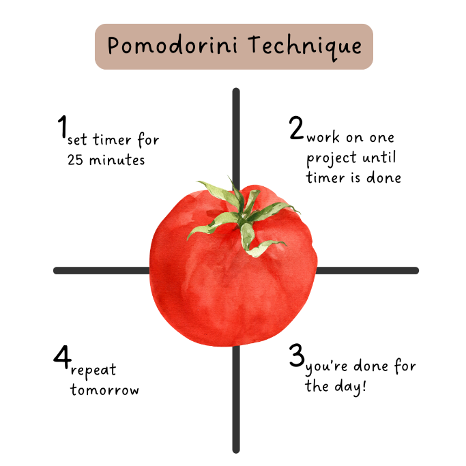
Here’s how it works: Set your timer for 25 minutes. Work on a single task related to your work in progress until the timer goes off … and that’s all! You’re done. Repeat tomorrow.
I’m aware of how silly this sounds, but the Pomodorini technique has changed my life. In the year I’ve been using it, I’ve made progress on my writing more days than not. I’ve pulled apart my first novel, put it back together, and drafted a second novel. There are still periods of time where I’m not writing, but my mindset around those has shifted now that I have an easy way to get back into it.
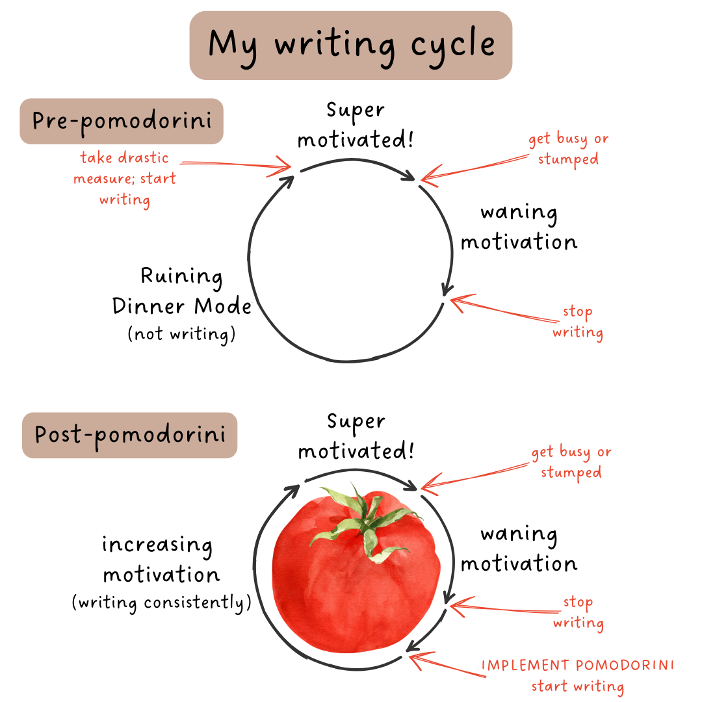
Importantly, Pomodorini has also made me more pleasant to be around. It is now safe to invite me to a dinner party! (Ina Garten, if you’re reading …)
If you’re interested in trying the Pomodorini technique to reignite your creative life and improve your writerly wellbeing this year, here are a few tips you might find helpful:
1. Start low. I do no more than a single 25–minute session a day for the first week. You might even choose to skip a day or two if you know you’ll be busy. You want this to feel easy!
2. Commit and defend. Once you’ve decided on your session frequency, schedule the sessions in your calendar. Defend this time as if your life depends on it!
3. Try not to be too prescriptive. I usually use my Pomodorini sessions to draft or revise my work in progress. However, on days when my brain refuses to engage in either of these tasks, I let myself use the time for anything that will ultimately push my writing forward. This could be reading a chapter of a craft book or a potential comparative title, researching something relevant to my story, working through a plot problem, or even re-reading my draft. My only rule here is that I must decide what I’m going to work on before starting the session and I can’t abandon ship partway through.
4. When the timer’s done, you’re done. I know that the ‘Pomodorini magic’ is happening when I find myself tempted to sneak in a few unscheduled writing sessions. I try to avoid doing this. I want to keep the momentum going—it’s easier to pick up again the next day if I’m itching to write again, than if I’ve exhausted my writing energy with a marathon session. Instead, when I feel momentum kicking in, I’ll increase the number of days or sessions I schedule for the following week. The key here is to go slowly—you want to make sure you’re being realistic about how much time and energy you have for writing.
5. It’s okay to stop. The point of Pomodorini isn’t to keep doing it forever. It’s to get you out of a creative slump. At some point, either your writing will become so embedded in your routine that you no longer feel the need for a timer, or you’ll hit a roadblock and fall off the writing train again. Both of these situations are expected and normal. Don’t stress: your timer will be there whenever you’re ready to start again.
If you’re in a creative rut, I hope my experience has inspired you to try Pomodorini for a week. If, on the other hand, you think Pomodorini sounds completely ridiculous and only read to the end of this post because you were hoping I’d talk about real tomatoes at some point, here’s my attempt to appease you. This recipe for Baked Feta Pasta with Jammy Pomodorini is guaranteed to save any dinner from the writerly woes.

Emma Olive Billington is an endocrinologist and medical researcher who writes novels about women in STEM and helps busy professionals prioritize creative pursuits. For a monthly dose of writing inspiration and the occasional unsolicited dog photo, sign up for her newsletter.




Emma,
Thank you, thank you, thank you!
Now, I can have guilt-free busy days!
I tried this before but didn’t stick with it because I didn’t understand the why. But a recent article on it and brain activity (I’m an MD too) showed me why. I was doing it instinctively but without a timer, so I took too many unscheduled breaks. This timing has now got me squared away to stay in my chair. Plus I have arthritis and should move anyway! Great article and thanks for the recipe!
Yes! I was the same without the timer. I often feel like it will be no problem to focus for 25 mins without a timer, and five minutes later I have six browser tabs open. I would love to read the article you mentioned if you have the link!
The title of your post was so intriguing, I had to click on it. I’m familiar with writing sprints, but this adds cyclical touch that I like. Thanks.
This is really good advice. I was having difficulty editing my novel last fall due to many personal commitments, including a cross-country move. In mid-November, I decided I would spend 15 minutes/day on my WIP. (Even less than a Pomodoro!) I have kept my goal of 15 minutes/day for three months now. Most days, I get more than 15 minutes in, but the minimal commitment has kept the goal from becoming overwhelming and it has made a difference in the progress of my editing. Still a ways to go, but at least I feel a daily sense of forward momentum.
This is fantastic! The sense of forward momentum is so crucial for keeping up morale.
This is fascinating! I’ll try it. I’m afraid I spend too much time in the “Ruining Dinner Mode.” Thanks so much, Emma.
I am glad I’m not the only one 🙂 I can’t wait to hear how it goes for you.
I’m going to add the timer. Thank you!!
Emma, really great tips for writers trying to develop consistency. A novel is a gargantuan undertaking that’s overwhelming. You have to approach it the same way you eat an elephant: one small bite at a time, preferably slathered in Pomodorini sauce.
Haha Debbie, love that visual!
I love, love, love this article. It’s creative, informative, helpful, humorous, and well written. I don’t see how this method could NOT help any writers trying to get back on track. Well done, Emma!
Thank you so much, Liesbet!
Thanks so much for this tip. I believe you! I think I’ve been implementing it at times without realizing it. Love your graphics too!