

Today’s post is by novelist, columnist, and former police officer David Lane Williams.
For many years, I was a detective in a Special Investigations Unit. Our cases centered on violent and predatory crimes, most of which were perpetrated against women and children. Part of that mission included working with other professionals in a variety of disciplines to help people stuck in a violent lifestyle identify avenues of escape and paths to live their lives safely. It was always a touchdown moment when someone who had endured cruelty came to trust themselves and us enough to break free and, later, to thrive. Such courage became the catalyst for my debut novel, as well as a journey for me to discover how to write it in an authentic and compelling way, despite vast differences between my own experiences and those of the protagonist.
I was an English major before I was a cop (which meant I wrote good police reports—extra points if I could throw in a metaphor). I’d long wanted to write a novel, and while I always knew I’d someday tackle genre fiction based on stories from my career as a first responder and detective, I felt compelled to start with something outside the mainstream. Let’s call it a rite of passage for a Lit major.
The idea of paying homage to survivors and their courage in escaping toxic relationships through a fictionalized story became my new mission. Further, it was important to me that the tone of such a story be dark-“ish” comedy, because humor is how I’ve always managed my own fears and doubts.
One challenge of such an endeavor was that the novel I envisioned centered on the life of an amusement park owner who had been arguing with her emotionally abusive, long-dead father for the last thirty years, blinding her to the soulmate standing by her side the entire time. To be clear, I’ve never run an amusement park, never had an abusive father, and never been a woman. It was quite the puzzler.
How was a middle-aged male, a cop for that matter, supposed to write about a woman trying to make sense of her complicated life? More to the point, how do we write authentically when a character’s life experience is so different from our own? It’s a fair question, and I’ve experienced my share of imposter syndrome in coming up with an answer. Voice matters, and telling a story from the limited perspective of someone who has never lived the life being described can come off as contrived.
Part of the answer, at least for me, meant realizing that this was going to be a team effort. A few years ago, I asked an English teacher friend of mine to read a draft of the novel. My friend came back days later and said, “I never would have imagined you writing women’s fiction.”
That made two of us. I’d never heard the term “women’s fiction,” so I googled it, which led me to an illuminating conversation with the then-guiding scribe of the Women’s Fiction Writers Association. She assured me that I had, in fact, penned something that fell within that genre, and she invited me to join their organization. I let her in on the fact that I’m a guy. She welcomed me, anyway, and I’ve been a member ever since.
I was soon matched with a writer’s group, three outstanding novelists who have become lifelong friends. They made me a better writer, and in the case of my debut, they taught me how to write from the perspective of a woman who’d endured abuse, raised a daughter as a single parent, and found a way to forgive the old man, as well as herself for having put up with his shenanigans for so long.
Some things were simple remedies. I’d mixed up eyeliner and mascara, for example. Far more importantly, my team helped me analyze and fix much bigger issues. One critical scene involved the amusement park owner having a serious talk with her teenage daughter before her first date. I’d raised two sons, and I’d had those talks with them, but my critique group helped me find a nuance unique to the conversations between a mother and daughter. I literally could not have written that scene with any kind of quality had it not been for them.
Developing a team to support your creativity often requires admitting how little you know. That might mean riding out with police officers if you’re writing procedurals, arranging an online meeting with a nurse anesthetist for a medical thriller, or taking a class where you’re the oldest and least talented person in the room. Allowing ourselves to be a novice opens doors that a closed laptop never will.
Another facet of this path regarding writing outside my comfort zone involved accessing the empathy I’ve accumulated over my six decades as a human being. Yep, we’re all different, but love, dreams, grief, fear, and triumph are universal. Tapping into that shared wisdom and translating what it might feel like to be a specific person living through a specific challenge is at the core of what it means to be a writer.
And finally, I believe in the value of discipline-centered antagonism. We must be as vigilant in questioning our own written work as a jury is in weighing the facts presented at trial. Listening to our intuition, editing with near-obsessive focus beyond those first five perfect pages, and questioning our own logic and choices is how we must set our bars. Writing outside ourselves isn’t just about getting facts right. It’s also about being willing to learn who we are when we listen closely enough, allowing us to see the world through eyes not our own.

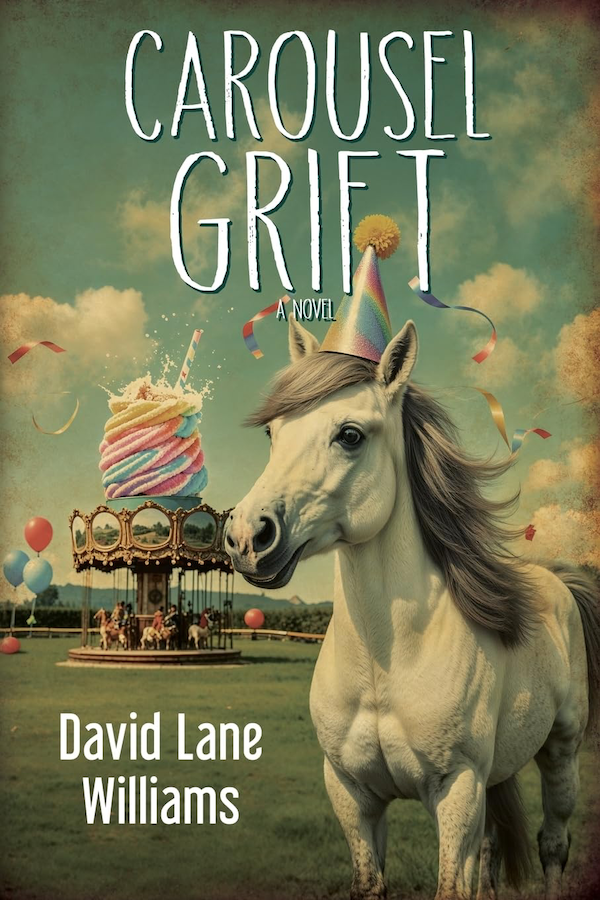
David Lane Williams is the author of Carousel Grift, a comedy about forgiveness. He teaches criminology at the University of Arkansas and writes a monthly column for Killer Nashville Magazine on authentic police practices for mystery and thriller writers. He and his family have settled in the Ozarks, where they offer a haven for rescued donkeys and horses. You can find him at www.davidlanewilliams.com.




As a card-carrying survivor of serious childhood sexual and other abuse who’s gone on to thrive, I cannot wait to read Mr. Williams’ book. As an adult I worked with a statewide group of survivors of incest and childhood sexual abuse. In our experience, the one group of people who consistently understood the mind of our sociopathic abusers were police detectives. I am deeply indebted to the ones who helped me along the way.
Thank you, Mr. Williams, for your passion and understanding.
I’m honored by your comments, and I’m in awe of your courage. I’ll hope you’ll call me David.
Thank you, David. I’ve passed on information about your book to a friend of mine in the US. He just wrote a memoir of his experiences in building a new life. It can be done–with time and compassionate help.
PS: I now live in Ireland. The police force here is called An Garda Síochána–Guardian of the Peace. Not a perfect organisation, I’m sure, but the name alone is pretty inspiring.
Small world! I have a Garda Síochána t-shirt. Picked it up in a little hideaway shop in Albuquerque, New Mexico, that only sold items from Ireland. I thought it was cool, so I grabbed one in my size. I do like the message of their organizational name.
When I opened this article this morning it changed my entire day. A wonderful insightful account of Mr. Williams experience writing his novel. Hope to meet him some day!
I hope you’ll come say hi when that opportunity comes, and I feel like we’re gonna be on a first-name basis when that happens. Have a great rest of your day.
This is a question close to my heart — I am a white woman writing about the life of a Japanese poet. As my novel approaches launch date, I am steeling myself for the inevitable question of what-gives-me-the-right. I think it’s a fair question, and to your point, we can ‘earn the right’ to approach topics that are very different from our own experience by doing our homework, consulting with those whose experience mirrors our characters, and staying honest and open about what we don’t know.
That sounds fascinating. I hope you’ll let me know when it goes live. I’m curious about the historical period in which the poet lived.
Love this! It’s scary to write outside our own experience, and I think you hit on one of the key: getting insightful readers to help steer you in the right direction.
Awesome David!!
I am grateful for the work that you did David Lane Williams helping victims of crimes, many of which, remain in secret. These crimes can have a lifelong impact upon the survivors…I know this only too well as a young boy and teenager, brutalized and trafficked by my parents.
Thank you for your work as a police offer and also as an author which is a great venue to help raise awareness. I will look for your book.
Take care, Michael Skinner, musician, author and advocate.
Yours is a story of courage and resilience. I’m proud to meet you.
Mike’s a friend of mine. A great guy, good writer and incredibly loyal friend. So glad you two have “met.”