

Today’s post is excerpted from The Memoir Engineering System: Make Your First Draft Your Final Draft by Wendy Dale.
I started teaching memoir writing in 2008. At first, the only knowledge I had to draw on was what I had learned from writing my own book. So that was what I taught my students. Unfortunately, I was working with very limited information. I was like a doctor who had treated one patient in her life and was now using a single medical case to diagnose every other person I saw. Just having written one book did not make me an authority on the genre.
Little by little, however, I kept seeing new manuscripts, new problems, and each time I solved one person’s problem, I was in a much better position the next time I saw the same issue creep up again.
After doing this for seven years, my situation was dramatically different. I thought I’d seen it all. I’d seen the chicken pox, hepatitis and gangrene of memoir problems. I had a lot more data to draw on and was doing a much better job at diagnosing the issues that most of my students were having.
But there was one thing that I hadn’t been able to quite work out.
As I kept looking at chapter after chapter submitted to me, it seemed like what separated the texts that worked from the ones that didn’t was that the good texts had an argument woven through them. What fascinated me was that sometimes this argument would be interrupted by a scene and then the argument would pick up later exactly where it left off, as if the scene hadn’t even been there. What was going on here?
It would be many more years before I figured out all of the nuances of what exactly was happening, and I’ll spare you the steps it took to completely solve this puzzle. What I wound up deducing was that this argument was serving the purpose of connecting the scenes. But even more important was this: I had discovered the two essential components—scenes and transitions—that work to create structure in any story, whether it is memoir or fiction.
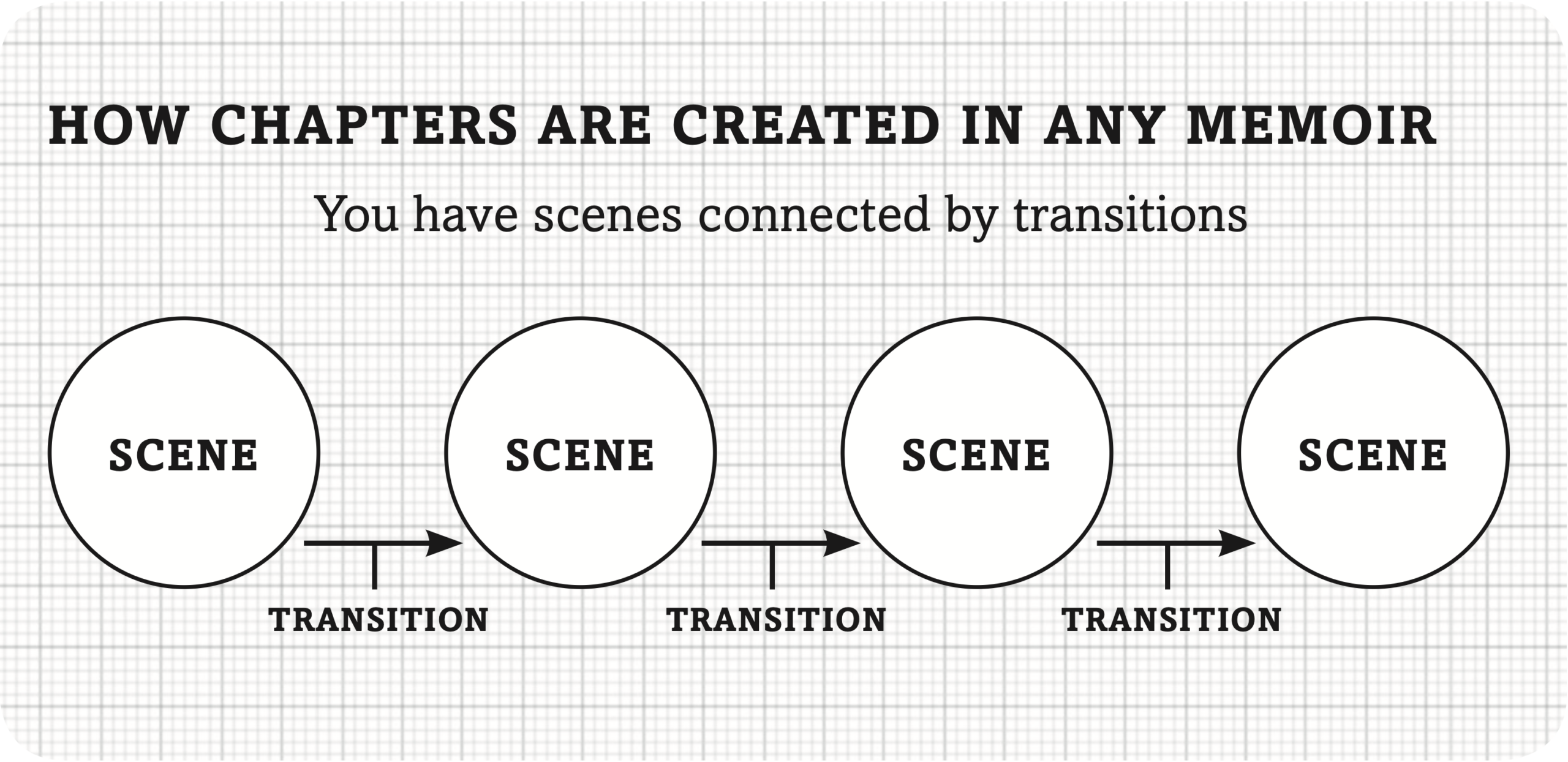
Here is what I want you to remember:
In your memoir, you are working with scenes and transitions. Each of these components relies on very different principles. If you use either component in the wrong way, your book will not work.
Most structural problems I see come about when people include information in their scenes that should be in their transitions, or they put stuff in their transition writing that should be in their scenes. So, understanding how each of these two components works is critical to getting the structure right in your book.
These are the two key ideas I want you to take away from this chapter:
- Whenever something happens in your book, it needs to go in your scenes.
- Your transitions exist to connect your scenes. They do this by making a point.
This is why I often say that structure is connected events. Things happen in your scenes. And your transitions let your reader know why the next scene is relevant to what has happened already.
Let’s look at an example.
SCENE: At work, my boss trips on her high heel and goes to the hospital with a broken ankle.
TRANSITION: There is a weird sense of chaos at the office, as if people have just been waiting for this opportunity to act up. Accounting is the first department to rebel. Suddenly they can’t be bothered to cut anyone a paycheck.
SCENE: I go up to the fifth floor to ask about my check, but they are too busy having a birthday party to pay any attention to my request.
SCENE: My boyfriend calls me up to ask me to go out for sushi after work.
TRANSITION: However, I’m nervous about spending money. After all, I don’t know when I’m going to get paid. The next day, the chaos is worse.
SCENE: Terri the office manager refuses to wear shoes and walks down the hall barefoot.
TRANSITION: I feel like it’s only a matter of time before our office becomes clothing optional.
SCENE: My boss calls to check in and I tell her everything is fine.
TRANSITION: But it’s not. And the stress is starting to get to me.
SCENE: I go into the bathroom and try to control my breathing. I’m getting a panic attack.
SCENE: As I walk home from work that day, I see a stray cat.
TRANSITION: His life is totally out of control too. His fate is out of his hands. I can’t change my circumstances, but I can make life better for him.
I want you to notice how I’m usually making a point between my events. That is how any good memoir is structured. And the point that you are making is what takes disconnected events and turns them into a story.
Good structure keeps your reader from being confused. By making a point, you’re joining one scene to the rest of the chapter. How? Well, you’re basically explaining to your reader why you’re bringing up the next event. Your transition exists to help your reader understand the relationship between what has already happened in your chapter and what is about to occur.
Let me explain it another way. Let’s say you’re talking to your sister about her annoying neighbor who dumps his trash everywhere. Your sister says, “You won’t believe what Mr. Simmons did yesterday. He left his old TV in our yard right next to the kids’ swingset.” And you respond, “We just got a dog named Skittles.”
Your sister is likely to look at you strangely. She will be confused and might even smell your breath for signs of alcohol. What in the world does Skittles have to do with Mr. Simmons?
However, this is exactly what you’re doing to your reader when you just tell them a bunch of stuff that happened to you. You give them a scene about getting a spiritual realization from a workshop. Then you give them a scene about breaking up with your boyfriend two days later. Well, what does one have to do with the other?
So many manuscripts I read give the reader the “Why is the author telling me this?” sensation. As the writer, you are recounting what happened to you and it feels like a story because all of these things happened to you around the same time, but to a reader, you are just rambling on about a bunch of random stuff. You are bringing up Skittles when the topic at hand is Mr. Simmons.
If you’re going to mention unrelated events in your memoir, you’re going to need a transition. In conversation, it would go something like this:
Your sister says, “You won’t believe what Mr. Simmons did yesterday. He left his old TV in our yard right next to the kids’ swingset.” And you respond, “Speaking of annoying, we just got a dog named Skittles. And he has been pooping all over the living room.”
Suddenly, your sister knows why you brought up your new dog. Add a transition and your reader is right there with you, following along with the story.
If you do this effectively in your book, your reader should never ask themselves, “Why is the author telling me this?” This is just one of the problems that good structure solves.

Wendy Dale is the author of The Memoir Engineering System, the result of 15 years of research analyzing thousands of texts to deduce the principles that all memoirs rely on. Her own memoir, Avoiding Prison and Other Noble Vacation Goals, was published by Three Rivers Press, an imprint of Penguin Random House.
She is the creator of Write or Flight, the world’s first reality show for writers and is also the co-writer of the Emmy-nominated TV special, The New Adventures of Mother Goose. She offers classes and coaching at Memoir Writing for Geniuses. For a free course on how to craft your memoir in seven steps, click here.




Wow! This is deep stuff. You made the importance of scene and transition so clear. Thank you. My brain hops from Mr. Simmons to Skittles stories without the transitions. I will put your advice to work.
Your brain and everyone else’s! One of the biggest problems people have when writing memoir is that they want to recount a bunch of stuff that happened to them, but these events just don’t add up to a cohesive story. Using transitions in the right way is the key to solving this. Glad you liked the advice
I love your explanation about how to use transitions between scenes. It’s very clarifying. I worked with Marion Roach Smith for six months. She insists her students identify their memoir’s argument before beginning to write/take her master class. Thanks so much, Wendy.
Glad this helped, Kathryn. It took me 15 years to fully understand how structure works in memoir and I love sharing the knowledge with other people.
I’ve just got your book and I’m using it for my third draft. So helpful.
So glad to hear it, Daphne! Hope the book is tons of help
This reminds me of Jack Bickham’s scene-and-sequel concept in his book Scene and Structure. Bickham’s “scene” is where things happen–action. His “sequel” is where the characters respond, especially emotionally/psychologically, to what happened and plan what they’re going to do next. The “sequel” serves as the transition between “scenes.” Whatever terminology you use, the concept is sound.
Interesting! Never read Scene and Structure but it sounds like Bickham and I think of story in a similar way.
Really excellent analysis, Wendy! Like Ross, I also thought of Jack Bickham’s scene and sequel structure which was a big epiphany for my fiction.
I’m going to send this article to an editing client who’s working on his memoir. This will ring a bell for him. Many thanks!
Thanks, Debbie! So glad you found this helpful. Hope your editing client does too!
This article clearly explains why many memoirs can feel unfocused or rambling. The tips on organizing thoughts and creating a clear narrative flow are very helpful for writers. I especially liked the practical advice on structuring personal stories. A great guide for anyone who wants to turn memories into a meaningful and engaging memoir.
Thanks so much, Billy! Rambling memoirs are one of the biggest problems that writers struggle to fix. Glad this made sense to you.