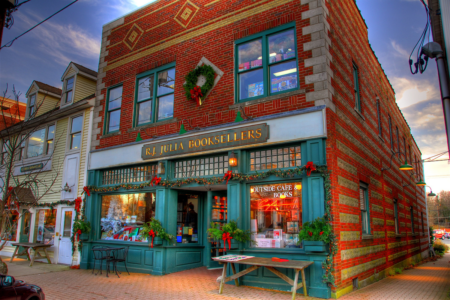
Despite misleading headlines in the New York Times and elsewhere in 2015 about U.S. book publishing, there’s one significant trend to remember: print book sales continue to shift toward bookstores—bricks-and-mortar and online stores—and away from mass merchandisers. This means that non-book retailers such as Walmart and Target are cutting back on book inventory, and retailers that specialize in books are gaining market share.
Across the board, sales volume hasn’t changed much: print sales are up 2 percent, just as they were in 2014, according to Nielsen BookScan data. However, the mix of print sales has shifted more toward backlist, with frontlist sales declining. This matches what the industry witnessed in 2014 as well.
A few specifics from Nielsen BookScan:
- Core print book sales growth this year has been driven by the nonfiction category.
- Trade paperback sales are up, driven partly by the success of adult coloring books.
- Juvenile fiction is down, since there were no big crossover YA books in 2015.
Nielsen BookScan allows for up-to-the-minute analysis of the print book sales data for 2015, but not ebook data. We won’t know how ebooks performed in 2015 for another four months.
Critical to authors’ understanding of adult coloring books’ popularity: At the time this edition of The Hot Sheet was being prepared, Amazon’s Hot New Releases ranking listed four of the top twenty and nine of the top forty as adult coloring books. The New York Times cites Publishers Weekly in counting more than 150 adult coloring books on the market.
While popularly selling products are good for the commercial success of the business overall, writers should beware the idea that adult coloring book success (which has been building for many months in both the U.S. and U.K.) is good for writers. Adult coloring books don’t deliver readers; they deliver colorers. If profits from this subsector help publishers be more generous to authors, this is good, but it’s a derivative effect.

Jane Friedman has spent her entire career working in the publishing industry, with a focus on business reporting and author education. Established in 2015, her newsletter The Bottom Line provides nuanced market intelligence to thousands of authors and industry professionals; in 2023, she was named Publishing Commentator of the Year by Digital Book World.
Jane’s expertise regularly features in major media outlets such as The New York Times, The Atlantic, NPR, The Today Show, Wired, The Guardian, Fox News, and BBC. Her book, The Business of Being a Writer, Second Edition (The University of Chicago Press), is used as a classroom text by many writing and publishing degree programs. She reaches thousands through speaking engagements and workshops at diverse venues worldwide, including NYU’s Advanced Publishing Institute, Frankfurt Book Fair, and numerous MFA programs.