
Today’s post is by author, book coach and historian Christina Larocco.
Nearly a decade ago, I worked as a consultant on a project to digitize manuscript collections related to the women’s rights movement in the Philadelphia region, where I live. It was a great job: I spent the summer of 2016 going from archive to archive, devouring the writing of activists both well-known, like Lucretia Mott and Alice Paul, and less so, like Martha Schofield.
Schofield was born in 1839 to a family of devout Quaker abolitionists whose family farm was a stop on the Underground Railroad. She attended women’s rights conventions with her mother as early as 1854, and in her thirties and beyond she devoted herself to the woman suffrage movement. During the Civil War, she volunteered at a local hospital, which took in hundreds of United States soldiers wounded at Gettysburg and elsewhere. From 1865 until her death in 1916, she taught freed people in South Carolina and tried to stem the tide of racial terrorism across the nation.
When the project was over, I recommended that Schofield’s letters and diaries be digitized. Part of this was selfish: I had fallen in love with and started to write a book about her, and I wanted to be able to continue my research at home in my pajamas. But the reason I fell in love with her was that her papers were so different from anything I had come across in my twenty years as a women’s historian, then or since. It didn’t seem like an ethical dilemma.
Guides to women’s paper collections often issue a version of this disclaimer: “scant information about her personal life.” The first generation of women’s historians was understandably focused on highlighting extraordinary women’s accomplishments, disentangling them from home, family, and the personal or private to show what they had done in the public realms of politics, science, and the arts. For generations, it was only women whose lives adhered to male models of achievement whose papers were deemed worthy of collecting. At the same time, many public women—or their descendants, who were concerned with propriety—purged their records of anything personal.
Schofield, however, wrote about her thoughts and feelings constantly. It was this access to her inner life, not her impressive resume, that made me want to write about her.
Now, part of me worries that digitizing her papers has diluted their power, precisely in the area that first attracted me to them.
Here’s an example: one of the challenges I faced in writing about Schofield was figuring out how to characterize her relationship with Robert K. Scott, a Civil War general, assistant commissioner of the Freedmen’s Bureau, and the Reconstruction governor of South Carolina. He and Martha first met in 1866, as he traveled through the state. Late in life, Schofield confessed in both a poem and a letter to her niece that she had loved him. But you wouldn’t know it based on her extant writing from the time—she rarely referred to him by name, and she never identified him as more than a friend.
She did leave behind clues to these deeper feelings, though—ironically, more in her attempts to hide them than anywhere else. As forthcoming as Schofield was, she had a habit of destroying materials she didn’t want people to see. In 1862, she destroyed a group of letters from school friends. In 1865, she dropped her letters to John Bunting, her first love, into the Atlantic Ocean. “Destroy this unread,” she wrote years later into her diary from 1868–1869, when her best friend’s engagement led her to contemplate death.
In other words, if she destroyed it, it’s probably pretty juicy.
So it’s significant that her writing about Scott is rife with redactions. She tore out the page of her diary immediately preceding her first mention of Scott. Sections from pages covering April 1866, when Scott spent days traveling just to visit her and the two declared their love, and June and July 1866, including the day of Scott’s birthday, are neatly excised, as if cut out with scissors. Sometimes she cut out only his name, still evident through context clues.
I know these events happened because she wrote about them later. But I know how much they meant to her because she removed the evidence.
For that reason, I’m glad I first read her diaries in physical form, where I noticed the alterations immediately. They’re much less apparent, much easier to miss completely, in digital form. How can you determine that pages have been removed when only the pages themselves are digitized? How can you even begin to figure out what was on those missing pages if you don’t know they existed?
So, was it wrong to advocate for these papers to be digitized?
Of course not. In-person research presents significant barriers to access, and physical archives aren’t complete either. But it’s worth remembering that documents are objects with their own material lives, often not reproducible by technology.
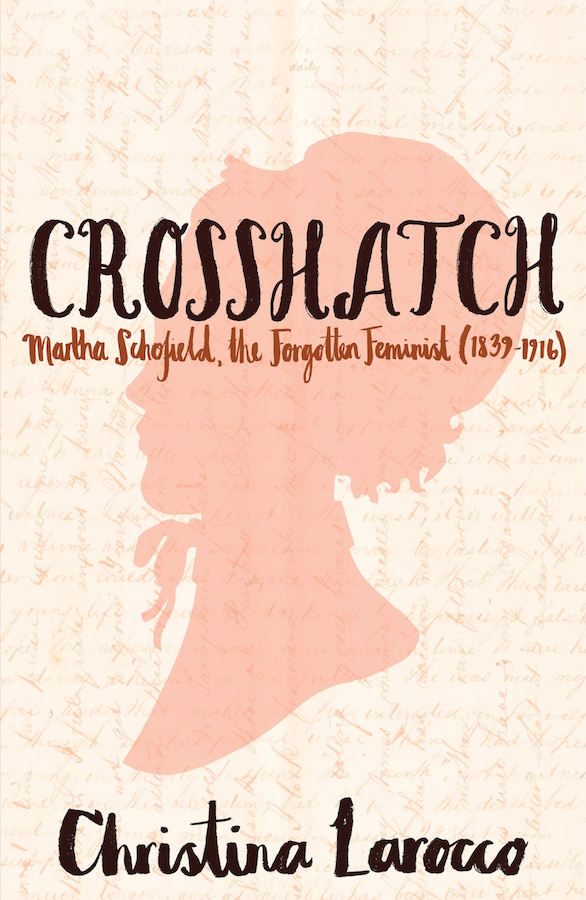
Writer, book coach, and historian Christina Larocco’s latest book, Crosshatch: Martha Schofield, the Forgotten Feminist (1839–1916), is now available for preorder. This March, she’s giving away 31 free writing strategy sessions to nonfiction writers who love to gather information but sometimes get stuck in research rabbit holes. Grab your free session here.

Christina Larocco is the author of Crosshatch: Martha Schofield, the Forgotten Feminist (1839–1916) (Blackwater Press, 2025) and The Women’s Rights Movement since 1945 (Bloomsbury, 2022), as well as an Author Accelerator–certified book coach who helps research-driven writers stop spiraling and start writing. Learn more about her, including how to schedule a free consultation about your work, here.



Evidence of what’s redacted and the power of absence fascinate me. In working with my father’s heavily redacted FBI file, I’ve become interested in the power of a blank space. Thank you for this piece, Christina.
Thank you for this thoughtful, relevant, and interesting post.
Conducting research for my nonfiction book about the life of my great-grandfather who was a succesful and controversial building contractor in Chicago and his impact on the development of the city, I’ve found scant information on his wife, Marie. If I were able to find more details about her life, the story would be richer. She founded and led several charitable organizations in Chicago and later Pasadena. She appears in many newspaper articles as “Mrs. Victor Falkenau” but without description. Ironically, were it not for her well-known husband, she would not have had so many leadership opportunities.
Non-digitalized “documentation” I have — two dresses, a fan, a silver letter opener, photographs, and some essays my grandmother wrote — help me draw clues and details about her life to bring her to life a bit more. In these cases, we have to look for all kinds of information to piece together and enliven the story.
I appreciated reading your experience and your reminding me it IS about the research.
I noticed similar things going through my great grandfather’s Civil War journals. He was assistant surgeon to the 11th PA and was at the Battle of Gettysburg. His daily notes were interesting, but I was fascinated with what he wrote in the back and sides of the day books. So much more.