
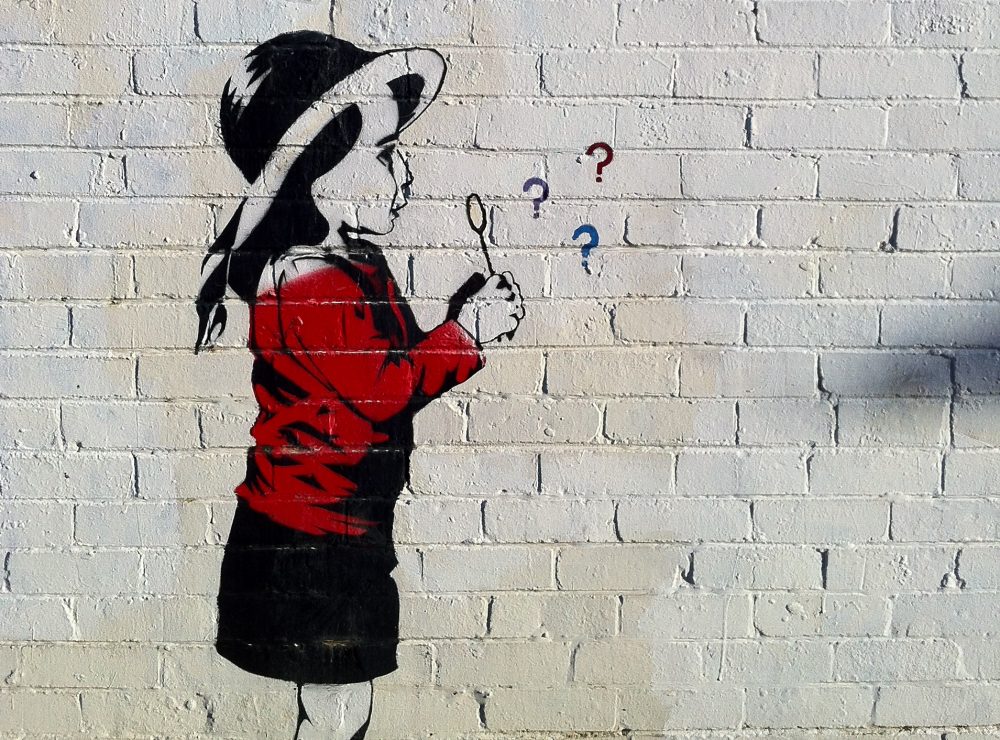
Lately, I’ve been reading Thomas Merton’s Confessions of a Guilty Bystander (thank you, Ed!), which was first published in 1968 but remains as relevant as ever on the 50th anniversary of its publication. Here’s one of the first passages I underlined, from Merton’s introduction:
I do not have clear answers to current questions. I do have questions, and, as a matter of fact, I think a man is known better by his questions than by his answers. To make known one’s questions is, no doubt, to come out in the open oneself.
This quote came to mind as I recently read Danielle Lazarin’s essay in the latest Glimmer Train bulletin, Question Everything. She discuses her use of writing notebooks, where she tops and ends pages with questions. She writes:
At every stage of my work, questions are my most essential writing tools. I use them to move through to the other side of murky. It’s only by stepping into that unknown and uncomfortable space repeatedly during my process that I can become more deliberate in the story I’m telling.
Also this month from Glimmer Train:
- Writing Archival Fiction by Thomas Fox Averill
- On Rejection by Aline Ohanesian

Jane Friedman has spent her entire career working in the publishing industry, with a focus on business reporting and author education. Established in 2015, her newsletter The Bottom Line provides nuanced market intelligence to thousands of authors and industry professionals; in 2023, she was named Publishing Commentator of the Year by Digital Book World.
Jane’s expertise regularly features in major media outlets such as The New York Times, The Atlantic, NPR, The Today Show, Wired, The Guardian, Fox News, and BBC. Her book, The Business of Being a Writer, Second Edition (The University of Chicago Press), is used as a classroom text by many writing and publishing degree programs. She reaches thousands through speaking engagements and workshops at diverse venues worldwide, including NYU’s Advanced Publishing Institute, Frankfurt Book Fair, and numerous MFA programs.




I’d love to see one of her notebooks with all the questions. 🙂
“What if” is always a wonderful question, especially for finding your way to something new. I also like to ask “Why?”
Why is this character saying this, as opposed to that? Why this setting? Why this plot point? Does it go beyond the arbitrary… or is there a deep-seated reason for this and that choice?
And, great Merton quote.