Authors and agents can expand a book’s reach and readership by offering libraries more lending access models
Last month, we covered in-depth the changing ebook lending terms for libraries, as well as how authors earn money from libraries. Since then, we’ve had the opportunity to speak to OverDrive’s CEO, Steve Potash, for further insight into the earnings issue and its history. OverDrive is the leading distributor of ebooks to libraries, and Potash has been at the company for 33 years, giving him a unique long-term view on market developments.
Potash says it’s frustrating that today’s royalty statements do not include library sales data, yet those same statements offer pages of information on other revenue, like mass market, audio, and foreign rights sales. However, he understands how we’ve reached this point: for most of their history in selling to the library market, publishers simply didn’t have the information and couldn’t report it. “Maybe at the end of the month, they’d get a statement from Baker & Taylor or Ingram Library or one of the jobbers,” he said. “But they never really knew where the products went.” However, since OverDrive introduced digital lending about 15 years ago—and especially by roughly 2014, once all the Big Five publishers were lending ebooks to libraries—publishers have had access to real-time reports on every unit sold to an institution from OverDrive.
In an effort to bring attention to this issue, Potash has been speaking with the Authors Guild as well as the Association of Authors’ Representatives. At the AAR, he spoke about library sales as a guest of the royalties committee. He says that “There was a big aha moment” when he brought up OverDrive’s real-time sales reporting dashboards. “I demonstrated every publisher knows with detail how many units, for what amount, and who bought it—like within a minute.” Moreover, he says, this is one of the fastest growing sales areas for publishers. “It’s not the mothership, but as far as driving growth—double-digit, when other parts are not growing as fast—it’s an important, growing part of the business.”
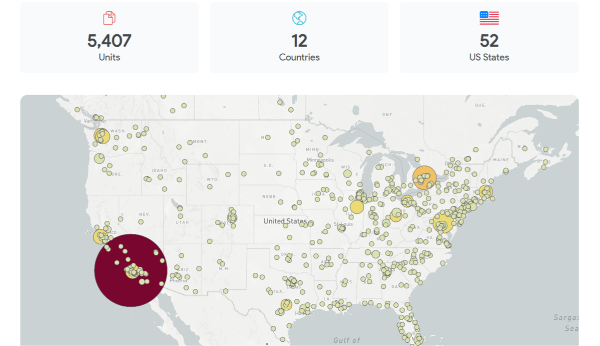
shows public library unit sales and holdings for Susan Orlean’s The Library Book in ebook format.
In June, Potash wrote an editorial, What Every Author and Agent Should Know about Library Sales of Their Titles, in which he suggests that authors and agents ask their publisher the following:
- Does my royalty report include itemization of units sold and revenue earned from library, school, and institutional sales?
- At what price and under which access models are my titles available for schools and libraries to purchase?
What most authors and agents miss are not just the sales figures but the available access models. OverDrive offers its ebook catalog to institutions through a business-to-business service (OverDrive Marketplace) that allows publishers to set the terms and permissions for each title. The baseline for ebook lending and purchases—and still the most prevalent model—is one copy, one user. In other words, the ebook lending model replicates the print model. Over the years, OverDrive has urged publishers—if they want to maximize sales and exposure for the author—to increase the types of access available. “We have evangelized to anyone who will listen that if the publisher provides multiple access models for institutions, their economic interests will be enhanced,” says Potash.
Potash says the second most important access model is simultaneous use, which is akin to a subscription model. In such cases, the publisher sets the price based on the size of the institution or potential audience. OverDrive works with authors and publishers to set the right price or access level to start, then recommends pricing adjustments based on actual use. Potash says if ebooks are fairly priced for simultaneous use, it can become a renewable source of revenue for the publisher and author.
Potash gave a couple of examples of why flexible access models are important and lead to increased institutional and subscription sales.
- For K-12 classrooms, OverDrive creates a special form of access called a classroom set, available only to schools. Schools or teachers can acquire access for 90 days, six months, or one year.
- Some institutional buyers shop by access model, especially for city or summer reads at libraries. Publishers can opt into such access programs on a title-by-title basis and base pricing on the city size and length of time (e.g., a few weeks or the entire summer).
Potash says, “I’m getting agents saying, ‘My author has a goal of being widely discoverable everywhere. Which model should we use?’ My stock answer is that it’s not one model, it’s all of them. With each model, you have the ability to set your price and your terms.”
Of the Big Five publishers, Potash says HarperCollins has been entrepreneurial in its access and wants to see its titles promoted to the children’s market and international markets. He says, “Sometimes we just tell the school, if you look at HarperCollins, there’s a high probability they’re going to be flexible and say yes. We have a great history with them.” He also mentioned Sourcebooks and Chronicle as open to varied models of access.
Bottom line: Potash says his company is still in the early days of spreading the word to authors and agents about the importance of diverse access models for ebook lending. And it’s been challenging to educate the publishers, he says. “I still have publishers I’m trying to show the hard data and the reality. It’s only been about a year or two that we started to say [we] really have to go to the source of the permissions”—the authors and agents.

Jane Friedman has spent her entire career working in the publishing industry, with a focus on business reporting and author education. Established in 2015, her newsletter The Bottom Line provides nuanced market intelligence to thousands of authors and industry professionals; in 2023, she was named Publishing Commentator of the Year by Digital Book World.
Jane’s expertise regularly features in major media outlets such as The New York Times, The Atlantic, NPR, The Today Show, Wired, The Guardian, Fox News, and BBC. Her book, The Business of Being a Writer, Second Edition (The University of Chicago Press), is used as a classroom text by many writing and publishing degree programs. She reaches thousands through speaking engagements and workshops at diverse venues worldwide, including NYU’s Advanced Publishing Institute, Frankfurt Book Fair, and numerous MFA programs.