

I’m speaking at Digital Book World (DBW) this year, and even though I missed the first day events, I followed closely on Twitter. One of the big themes on Tuesday was the children’s market, with a full day of sessions presented by Publishers Launch in partnership with DBW.
Jonathan Nowell from Nielsen presented some fascinating charts and trends in a morning session. This one was my favorite.
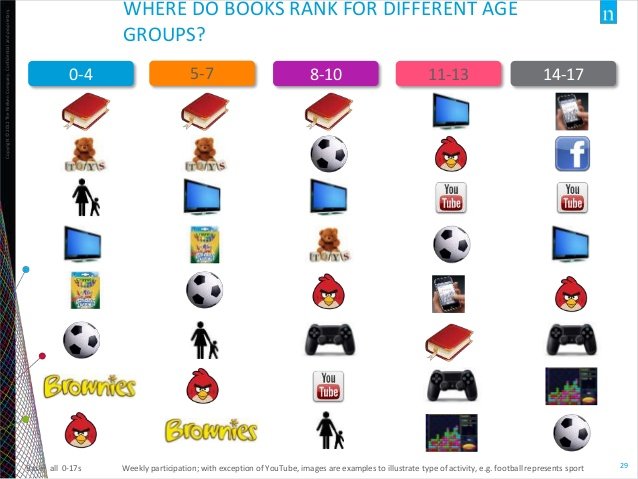
Other takeaways from Nowell’s presentation:
- Print juvenile books experienced 12.8% unit sales growth from 2013 to 2014.
- Juvenile bestsellers are taking up a bigger percentage of the overall bestseller list—its growth is driving the industry.
- Children are starting to read e-books at a younger age, and the e-book format is growing as a percentage share of all books purchased. (It increased to 21% in 2014, up from 14% in 2013.)
- 80% of YA books are bought by adults for themselves.
- Nowell concluded by saying the greatest challenge is expressed by the chart above.
For more:
- View Nowell’s presentation at Slideshare.
- Take a look at all the slide packs from presentations at the Publishers Launch event.
- Read Porter Anderson’s detailed full-day recap at The Bookseller.

Jane Friedman has spent her entire career working in the publishing industry, with a focus on business reporting and author education. Established in 2015, her newsletter The Bottom Line provides nuanced market intelligence to thousands of authors and industry professionals; in 2023, she was named Publishing Commentator of the Year by Digital Book World.
Jane’s expertise regularly features in major media outlets such as The New York Times, The Atlantic, NPR, The Today Show, Wired, The Guardian, Fox News, and BBC. Her book, The Business of Being a Writer, Second Edition (The University of Chicago Press), is used as a classroom text by many writing and publishing degree programs. She reaches thousands through speaking engagements and workshops at diverse venues worldwide, including NYU’s Advanced Publishing Institute, Frankfurt Book Fair, and numerous MFA programs.




Very interesting presentation. I have to ask: what is CAGR? I couldn’t quite figure that one out. I’d be curious to see how that chart changes in the adult age groups. I also found it interesting, the teens general preference for print books over ebooks. Finally, a comment on the % of teens who read for fun: I have two girls, and while one of them is no longer a teen, there’s almost no time to read for pleasure. Granted, if you want to do it, you’ll make the time, carve it out somewhere, but by the time a lot of kids are done with schoolwork and other obligations, they no longer really want to think a whole lot. Thanks for sharing that, Jane.
I believe it’s Compound Annual Growth Rate.
Thanks, I believe you are correct.
[…] print book sales in 2014: 37% juvenile, 23% adult fiction, and 40% adult nonfiction. If you read the day 1 recap, then you know that 80% of YA purchases are by adult readers, for adult readers. I had a […]
[…] print book sales in 2014: 37% juvenile, 23% adult fiction, and 40% adult nonfiction. If you read the day 1 recap, then you know that 80% of YA purchases are by adult readers, for adult readers. I had a […]
[…] Status of the Children’s Book Market (2014) | Jane Friedman […]
[…] Digital Book World 2015 also reported that children are starting to read e-books at a younger age, and the e-book format is growing as a percentage share of all books purchased. (It increased to 21% in 2014, up from 14% in 2013.) […]
[…] then, to add insult to mortal injury, I found this dreadful little pictograph at Jane Friedman’s blog (it’s at the top of the post, so you can click over to view it); it shows how books rate in […]
[…] Jane Friedman also reported that “Children are starting to read e-books at a younger age, and the e-book format is growing as a percentage share of all books purchased. (It increased to 21% in 2014, up from 14% in 2013.)” She shared a great chart from Nielsen on where books rank for different age groups. You can see it here. […]
My teen doesn’t read either. But like yours, he has learning disabilities and it is difficult for him. I am happy for his gaming and chatting because he is required to read a lot of information on the screen, sharpening his skills.
He did recently listen to an audiobook for fun. The first time he’s read a book on his own initiative. But then the movie was released, and, well…
However, take a look at Wattpad. The audience is overwhelmingly teen. My reader demographics over there are 35% teen, and 35% undisclosed. If you assume that 1/3 of the undisclosed are also teen (probably it’s more like 90% of them!) then 47% of my readers on Wattpad are teens. Wattpad claims they have 40 million readers. I have other teen fans who have e-mailed me, and I have teen or nearly teen nieces and nephews who read for enjoyment. They are out there! They’re just too busy reading to respond to surveys.
[…] industria editorial en Gran Bretaña.” La tendencia se aceleró rápidamente y nunca ha ceased- libros para adultos jóvenes de los niños y ahora impulsar las ventas en la industria editorial (con un 80% de los libros yA comprados por los adultos por sí […]
[…] part of the publishing industry in Britain.” The trend accelerated rapidly and has never ceased—children’s and young adult books now drive sales in publishing (with 80% of YA books bought by grown-ups for […]