Given that more than 50 percent of all book sales occur online in the US, the big questions (and frustrations) that surround book sales and marketing often begin with one word: Amazon. Authors and publishers are always seeking new information and insights about how to better understand the retailer to increase sales.
In a presentation last month, Peter McCarthy and Jess Johns of Ingram Content Group discussed what they’ve learned from tracking the data of more than 100,000 titles between October 2019 and August 2021. The data set skews more heavily toward adult titles and nonfiction but includes a mix of categories, both print and ebook.
During the pandemic, there was a spike in third-party sellers winning the buy box at Amazon, peaking at 45 percent. Winning the buy box is when a third-party seller (as opposed to Amazon itself) is shown to the consumer as the default buying choice; about 25 to 40 percent of titles are sold by a third-party seller at any given time. For those unfamiliar with the buy box and how it’s sometimes tied to sales problems, be sure to read our in-depth article from October 2019 (with tips for keeping the buy box). While such issues tend to affect publishers more than self-published authors, it’s a headache for anyone who sells a meaningful number of print copies, especially when they end up in the used books market.
During periods of supply chain challenges and increased consumer demand, third-party sellers are more likely to increase their buy-box wins, suggesting that Amazon moves more strongly in their direction when the system is under duress. The good news for authors and publishers: In 2021, these spikes have leveled off, although they’re starting to lift again as we move into the holiday season.
Amazon availability messaging does affect a book’s sales rank. The chart below shows just how much. The five most common availability messages from Amazon are:
- in stock
- only [X] left in stock
- temporarily out of stock
- this title will be released on X
- available to ship in 1–2 days
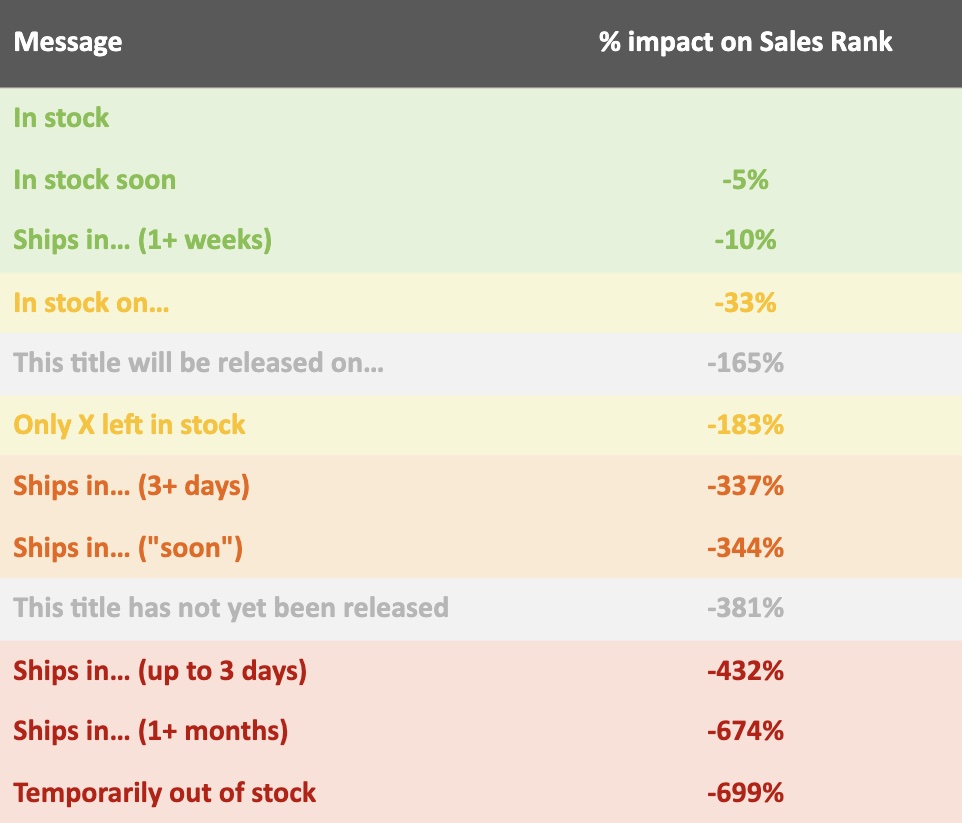
Publishers should always list a specific release date. A message that has a dramatic negative impact on sales is This title has not yet been released. That performs far worse than This title will be released on X.
For a number of different reasons—such as the location of the consumer, how fast Amazon can get a book to them, and what they think is about to happen in the next hour—the messaging that Amazon displays to consumers does not always match what’s available in warehouses or what publishers have available, McCarthy said. “We found it very interesting that in stock as a message has increased,” he added. In 2020 Amazon was having a hard time saying that, but now it appears about 50 percent of the time. Johns added that it’s a myth that only X left in stock creates urgency and leads to more sales; Ingram did not see that effect at all in the data. In fact, Amazon has been using only X left in stock less over the period of time studied.
McCarthy noted that publishers and authors often complain about Amazon listing a book as not in stock or immediately available when the book is in fact available. To this, he said, “It can matter how many are in stock at Amazon,” or what Amazon believes about a book’s stock situation. In such situations, McCarthy advises looking for patterns in the messaging to help understand what leads to an in stock message for your situation and to control whatever variables are available to you.
Amazon did less deep discounting on hardcovers in 2020, but discounting is increasing in 2021. The rate of discount matters to both authors and publishers because, in general, a higher discount means higher sales without loss of profit. (Amazon pays the same to publishers or authors when it chooses to discount.) Overall, over 50 percent of the books tracked by Ingram were not discounted to the consumer at all. Last year, there was more discounting at the 10 to 20 percent level and less happening at 40 to 50 percent off, but that is now shifting. McCarthy still emphasized: The most likely consumer discount is 0 percent, and discounting should not be expected.

Amazon is more likely to discount under certain scenarios. Most often they discount when someone, usually the publisher, drives pageviews to Amazon that lead to a sale. So when they think something is working, they often add a discount to it to keep it working. That also leads to greater merchandising on the site. Thus, McCarthy said, “Monitoring the consumer price is very important. Knowing when Amazon is discounting is key, because you can sell more, in our language, on their dime. They are discounting to the consumer and helping you with your sell-through. It’s basically a promotion for your title.”
If you’ve always felt like Goodreads reviews are tougher than Amazon reviews, you are correct. Goodreads typically has both more reviews per title and lower star ratings than Amazon. Johns said what most correlates with sales success is a high number of reviews and a consistent or growing number of reviews that maintain that high star rating. Better-ranked and better-selling titles typically have more reviews with less variance in star ratings.

Bottom line: At the end of the presentation, McCarthy said authors and publishers tend not to monitor or measure things that in fact matter to book sales and can be acted upon. The two big examples from the presentation included knowing when Amazon discounts your book and knowing when you’ve lost the buy box. (Ingram offers paid tools to help publishers monitor this.) But there are also lesser-known things to watch for. For example, if an author’s Wikipedia page is getting a lot of views, their book sales will go up, so it’s worth monitoring and ensuring an author’s entire body of work is accurately and fully listed there. Staying on top of opportunities that can be acted upon is at the heart of today’s book marketing.

Jane Friedman has spent her entire career working in the publishing industry, with a focus on business reporting and author education. Established in 2015, her newsletter The Bottom Line provides nuanced market intelligence to thousands of authors and industry professionals; in 2023, she was named Publishing Commentator of the Year by Digital Book World.
Jane’s expertise regularly features in major media outlets such as The New York Times, The Atlantic, NPR, The Today Show, Wired, The Guardian, Fox News, and BBC. Her book, The Business of Being a Writer, Second Edition (The University of Chicago Press), is used as a classroom text by many writing and publishing degree programs. She reaches thousands through speaking engagements and workshops at diverse venues worldwide, including NYU’s Advanced Publishing Institute, Frankfurt Book Fair, and numerous MFA programs.