We’ve tested the service with two novels and asked the authors for their take on the results
Some years ago, you may recall seeing—or even reading—The Bestseller Code: Anatomy of the Blockbuster Novel by Jodie Archer and Matthew L. Jockers. The book’s central claim was that the novels appearing on The New York Times bestseller lists share “an uncanny number of latent features.” The authors designed an algorithm to read the bestsellers and come up with the hallmarks of bestseller DNA, which is broken down and explained in the book.
That algorithm has now been integrated into a new, for-profit service, Authors A.I. (co-founded by Matthew Jockers), which allows anyone to upload their novel manuscript and receive an analysis of plot structure, narrative beats, pacing, characterization, dialogue versus narrative, and more. Earlier this month, we spoke with two authors who work for Authors A.I., JD Lasica and Alessandra Torre, to learn more about the service. In all, more than 120 collaborative authors are helping inform the AI—named Marlowe—by offering it manuscripts to learn from. But Marlowe is also built on that gold standard discussed in The Bestseller Code: traditional bestsellers that were on the list for at least 10 weeks. Overall, Marlowe has read close to 1,000 titles so far.
The first point they were quick to emphasize is that Marlowe is not trying to displace humans. Lasica and Torre still recommend working with a human editor, because even though the AI can tell you that the book is slow in the beginning, it can’t tell you how to solve the problem. That’s where a real person comes into play.
Currently, Marlowe is best suited for commercial work that has an easily understood point of view. Marlowe can’t yet handle dual first-person POV because it can’t distinguish between the characters. It’s also not particularly built for the literary world or high-brow crowd—and it might not love really challenging work. However, Marlowe has analyzed acclaimed novels from past eras, such as For Whom the Bell Tolls by Ernest Hemingway and The Hobbit by JRR Tolkien; you can find those reports at the site.
Marlowe can’t offer genre-specific feedback—yet. Something the Authors A.I. team quickly discovered is that authors want genre-specific reports, and they’re working on that for the 2.0 version of Marlowe, possibly to launch early next year. Also, for now, Marlowe refrains from assigning books a numerical bestseller score, something that the algorithm can do and that was discussed in The Bestseller Code. (For example, the algorithm gave Dan Brown’s Inferno a 95.7 percent chance of bestseller status and Michael Connelly’s The Lincoln Lawyer a 99.2 percent chance. Both books ranked number one on the NYT bestseller list.)
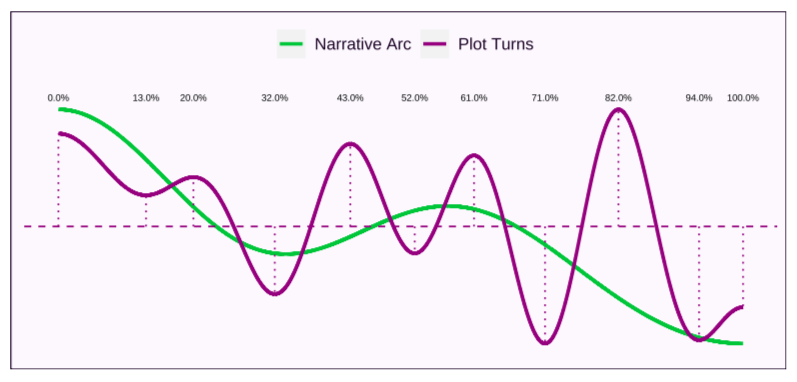
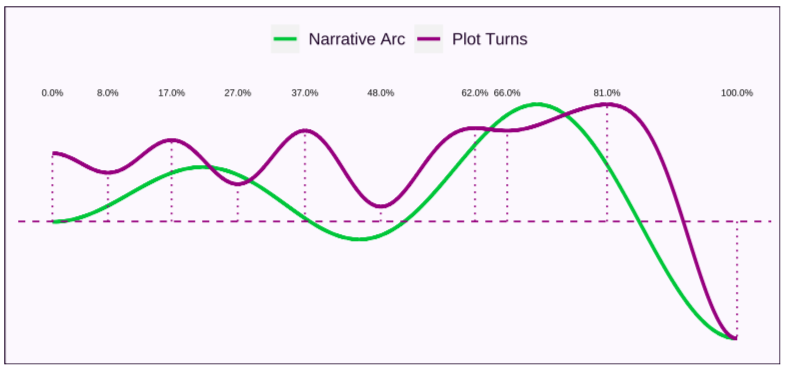
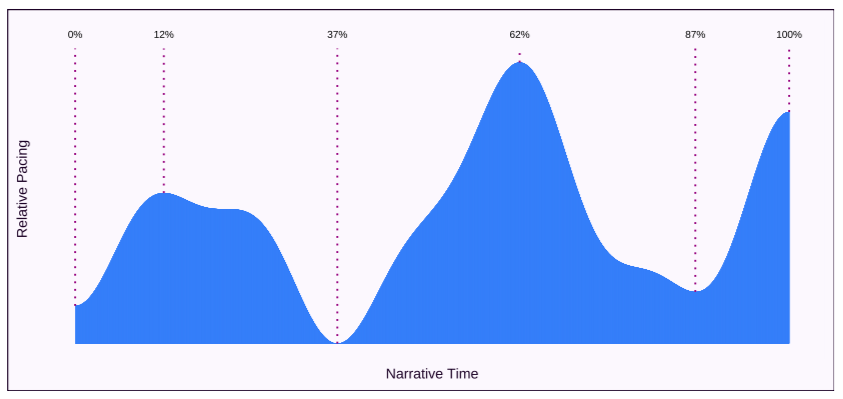
We tried out Marlowe with two different novels: a published mystery novel by G.H. Ephron and an unpublished literary novel by Elizabeth Fyne. Authors A.I. gave us these reports for free; ordinarily they would cost $89 apiece. Below are a few (but not all) of the graphs included in the report. The graphs are specific to the novel analyzed, but the text of the report—not shown here—remains the same across all reports and is pre-written. It explains the data and how to use it.
Plot structure graph: The green line represents the trajectory of the characters’ journey, or the narrative arc. When the plot turns (indicated by the purple line) move above the dotted line, this indicates a hopeful or positive turn in the story. Anything below the dotted line is a dark turn or a complication. The vertical dotted lines indicate plot twists, reversals, or some other major event in the story line. There isn’t an optimal shape for these lines, but if a story remains neutral from beginning to end, it may be boring.
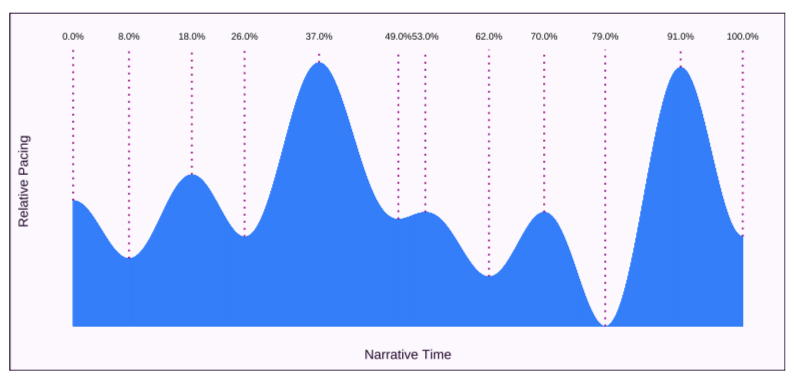
Pacing graph: This is meant to indicate the reader’s experience of moving through the narrative. Peaks indicate fast-page-turning quality, while valleys indicate slower moments. Vertical dotted lines indicate key changes in pace.
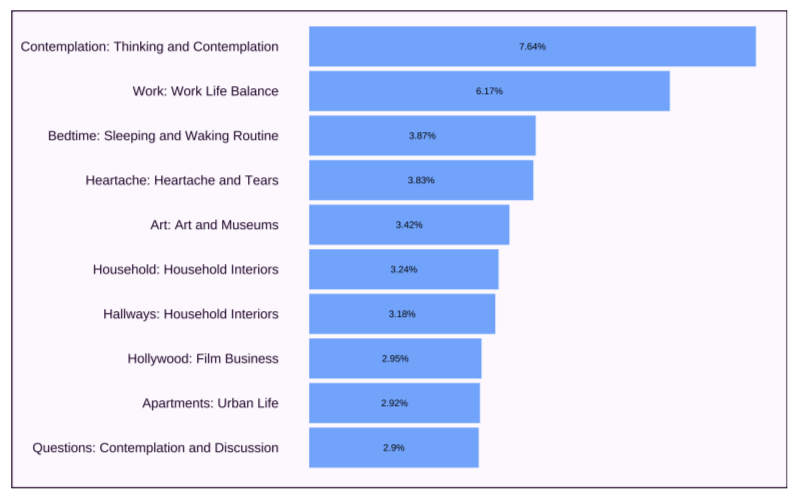
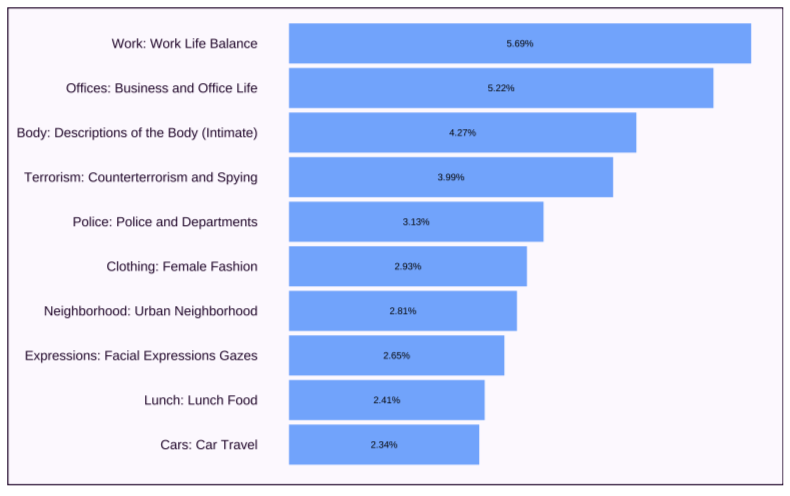
Major subjects graph: Marlowe identifies 10 primary topics in the narrative and estimates the percentage of the text that deals with each.
In response to the report, author Hallie Ephron—one of the co-authors behind G.H. Ephron—said it’s a little like hearing from the blind men describing an elephant, as in the famous parable. “You get a lot of data bands, but integrating it and figuring out what to do, where to focus your energies, what to fix first … not so much.” However, she thinks the report would be useful to a coach or editor as an additional way of looking at the manuscript.
Regardless, Ephron believes writers need to consistently work on issues that aren’t addressed in the report, such as viewpoint (is it under control, harnessed?), voice (is it compelling?), character goal (does the main character need something, and are the stakes sufficient to make the reader care?), and more—what she called “qualitative issues.”
Elizabeth Fyne has yet to succeed in finding an agent or publisher for her literary novel that Marlowe analyzed. In reviewing the report, she found the instructions on using the narrative arc data to be vague, and she thought that the result was possibly incorrect. “The start and end points of the arc line seem to suggest that the story ends in a darker place than where it started, which would be an incorrect conclusion.” However, as far as identifying the plot turns and narrative beats, she agreed with the data.
When looking at the subject identification, Fyne said, “The major themes of the book revolve around death and exploitation. I can understand how the AI would miss the exploitation subject since (at least in this case) it must be inferred. I did a search, and in my 110,000-word novel, the words exploit and exploitation only appear one time each, despite these topics being essential to the story. Other important subjects are ballet (maybe included in the topic arts? or are there subtopics for things like performing arts?), sexual harassment, and abuse. I would say the subjects of Household Interiors and Hallways are misleading, since these descriptions are relevant to home decor as interactive contemporary art and not as decor per se, although they are definitely present in the book.”
If you’re curious about the tool, any author can generate a free report that focuses on surface-level issues, such as clichés, dialogue percentage, use of explicit words, frequently used adverbs and adjectives, and possible misspellings.
Bottom line: We expect book publishers and literary agencies to eventually use AI to help analyze slush piles and do first-pass analysis of manuscripts. While Authors A.I. is specifically marketed to authors right now, it’s only a matter of time before industry players make use of it. Also, keep your eye on BingeBooks, a book discovery site that will partly compete with Goodreads by using the Marlowe AI to make book recommendations. We’ll have a separate report for you later this year.

Jane Friedman has spent her entire career working in the publishing industry, with a focus on business reporting and author education. Established in 2015, her newsletter The Bottom Line provides nuanced market intelligence to thousands of authors and industry professionals; in 2023, she was named Publishing Commentator of the Year by Digital Book World.
Jane’s expertise regularly features in major media outlets such as The New York Times, The Atlantic, NPR, The Today Show, Wired, The Guardian, Fox News, and BBC. Her book, The Business of Being a Writer, Second Edition (The University of Chicago Press), is used as a classroom text by many writing and publishing degree programs. She reaches thousands through speaking engagements and workshops at diverse venues worldwide, including NYU’s Advanced Publishing Institute, Frankfurt Book Fair, and numerous MFA programs.