
A new survey and report has been released that examines a large cross section of writers about their attitudes toward AI. Josh Bernoff and Gotham Ghostwriters, who have extensive experience with survey design and data analysis, ran the survey. They collected nearly 1,500 responses from working writers; of these, about 300 were fiction writers.
Before I get into results, I should note that earlier this year, BookBub conducted a similar survey that reached about 1,200 writers. Its results were much discussed on social media by writers, especially by those who take issue with AI and questioned the percentage of writers (45 percent) who admitted to using AI. I saw comments such as “I don’t believe it. Every author I know hates AI with a passion,” and “I unsubscribed from BookBub emails because of this.”
Well, for those who still doubt or disbelieve, this new survey should provide ample evidence that AI is being used by many writers across all sectors—BookBub’s survey was not a fluke. More than 60 percent of writers in this new survey use AI at least sometimes, and 25 percent use it daily. But the deep divide that BookBub uncovered among writers is also reflected in this new, more expansive and rigorous survey.
Here are the findings that I find most interesting.
- Fiction writers who don’t use AI hate it. Fiction writers were analyzed separately in the survey because their business model differs from that of other types of writers (e.g., speechwriters, technical writers, content marketers, and so on). Of the fiction group, 42 percent use AI at least sometimes, which more closely mirrors the BookBub survey results. But nonusers were nearly unanimous in their disgust for the technology. Fiction authors using AI shared some of the same concerns about the technology as nonusers, but to a much lesser extent.
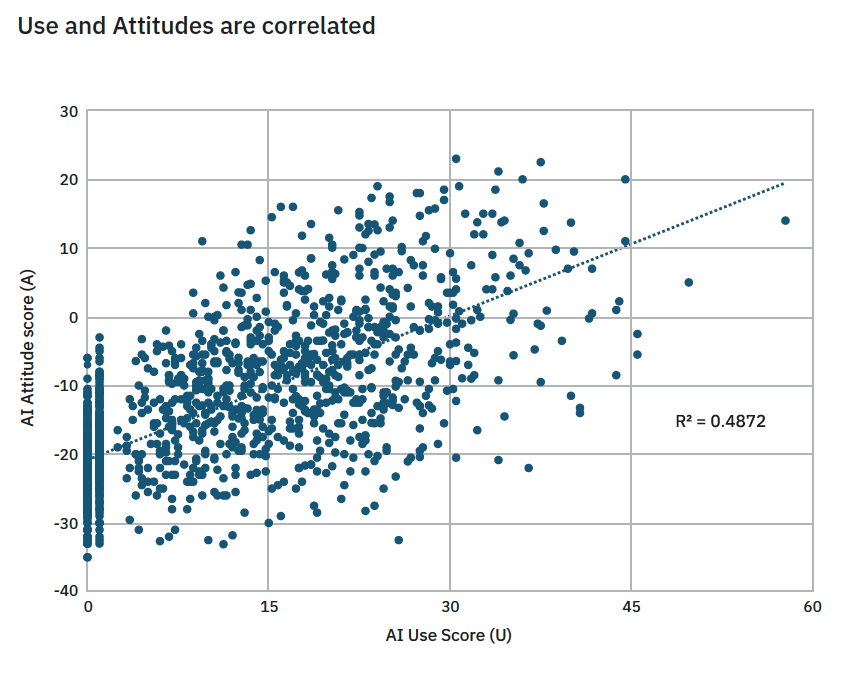
- How writers feel about AI depends almost entirely on how much they use it. More than half of advanced AI users think that AI is a positive force for the profession and that it has improved their career prospects, but only 3 percent of nonusers agree. See graph below on how use and attitudes are correlated.
- The most advanced AI users have higher incomes. The survey categorized writing professionals into four classes based on the diversity of tasks performed with AI each week. They all had similar profiles as far as age, gender, and hours spent on writing and editing. But advanced AI users have a median income of $120,000, 64 percent higher than nonusers.
Last week, I spoke with Bernoff via Zoom about some of these data points and how he interprets the findings. The following interview is edited and condensed for publication.
Jane Friedman: Before I ask about the data points I found interesting, what surprised you about these survey results?
Josh Bernoff: What I did not anticipate is the extreme anger and resentment of the people who don’t use AI and don’t think that it should be happening. Now, I come from an analyst background, which sort of gives you a bias toward trying out new technologies. But I knew that there would be people who used it and people who didn’t. And it was pretty interesting to see that 61 percent of the writers in our survey used it. And we went to great pains to make sure people knew: If you don’t use AI, we still want to hear your opinions. I wanted to get that. But … I was surprised by the amount of resentment and by people saying, “You know, I’m not even gonna try this. I’m not even gonna do it.”
It certainly wouldn’t surprise me to have people say, “Well, I’m nervous about it,” or, “I’m not sure if I can use this,” or “I’m worried about hallucinations.” But the number of people who are like, “You know, this is going to be the downfall of Western civilization.” And I’m not exaggerating. People said that. Okay, this is a pretty intense emotion that we’re dealing with here. And it seems that was predominant among fiction writers in particular—which, that didn’t surprise me.
Looking through the results, it appears that people’s opinions or attitudes, as I see it, haven’t changed since the technology came out in a widespread way a couple years ago, for the nonusers who responded.
So I want to actually start by talking about the AI users for a second. The fact that so few people are using [AI] to actually generate text that’s published was really encouraging to me. People were like, “Oh, this is the wrong way to use this. This is terrible. I’m not gonna use it for this.” Also, the fact that there’s almost a universal concern about hallucinations—people understand that there are problems.
Now, looking at the people who haven’t used it and aren’t knowledgeable about it—I spent 20 years as a technology analyst. I watched all these technologies come in. And this is always the way it is. People have all sorts of emotional reactions. When the web came in, and e-commerce came in, and mobile devices … We’ve heard this story over and over again.
The difference this time is that the speed of technology advance in AI is an order of magnitude faster than anything else I’ve ever seen. And it’s more universal. E-commerce only affected people buying things in retail. This affects everything. Every job and every activity. So of course people are afraid and ignorant, because, you know, the smartest people in the field of AI don’t understand all the implications, let alone some person who’s like, “Oh, yeah, I heard that it does this thing.”
It’s interesting to me that the people creating these tools—the Googles and the Microsofts and the OpenAIs—they’ve fallen down on the education front. It’s just like, okay, spread this AI thing all over everything that you’re creating, and it will all be better. Use Microsoft Copilot, and then you won’t have to think anymore.
There has to be an enormous amount of effort put into the smart ways, the right ways, to use this. We’ll get there, but it’s gonna be ugly. Especially for content organizations, for publishers, there’s evidence that they’re basically just throwing AI at the problem in hopes that it will make everything more efficient. And that’s a terrible idea. There has to be a real reckoning with what is the right way for creative people to use these tools.
The other standout finding for me was that the most advanced AI users have higher incomes than nonusers. Why do you think that is?
That’s a really hard question. You know, this is the classic example of correlation is not causation. I’m speculating here, because it’s difficult to tease this kind of information out of the survey data. But I think that if you are a freelance writer or a freelancer doing content marketing, or a business author, or anybody who is now making $120,000 or $150,000 or $180,000 as a writer, at that level, things that can make you more efficient are extremely valuable. So, yes, it’s not surprising to me that those people would look and say, “Oh, well, if I can get really good at this, I can save myself time and energy in the work that I’m doing.”
I am ghostwriting a book right now with an expert on a startup company, so he’s very forward-focused on technology. And when we have a task to do and I do not use AI, he gets upset about how wasteful I’m being of my time. He’s like, “You coulda just had ChatGPT or Claude give you the answer to that.”
So [laughs], you know, the expectation for these writers at a relatively high level is that you will be efficient, and efficiency turns into money. So that is one reason why I think the people who use AI are also the people with the higher incomes. A significant finding, though, is that the most intense users of AI are the most likely to say that it has increased their income. These people are certainly telling you that this tool has made it possible for them to make more money. For anybody who’s wondering if they should be trying this out, that’s a pretty important finding.
The people who are really good at the work that they do, as writers, can now be more efficient. And the people who weren’t that good and were doing work that was relatively rote work—well, you know, it’s not gonna be a really good time for those folks.
I was surprised that one in four writing professionals surveyed has considered giving up their work due to AI-driven changes. I have to wonder if these people were already considering giving up before AI.
That’s one of the few things that is almost the same among people who use AI a lot and people who don’t. Everybody’s scared. Everybody’s feeling intimidated. And that along with the pessimism about the industry in general is a big concern. But I don’t really know how to interpret that. They may be projecting their fears onto AI, or it may be accurate. But yeah, I think writers are pretty nervous. It’s not just writers. If I did a survey of software coders, I bet I’d see a lot of the same sort of trends.
This has been, and will probably continue to be, an emotional discussion for everybody. And I really urge people to look at the data and try and understand what’s really happening. I see all these people online expressing all these opinions, and I really want to say to people, would you stop talking for a second and look at the freaking data? … I’m very strongly looking forward to getting pilloried by people who love AI and people who hate AI equally. That will tell me that we actually did something useful.
Check out the report, free to all. Bernoff and Dan Gerstein at Gotham Ghostwriters are hosting a free discussion of the results on November 19. Register.

Jane Friedman has spent her entire career working in the publishing industry, with a focus on business reporting and author education. Established in 2015, her newsletter The Bottom Line provides nuanced market intelligence to thousands of authors and industry professionals; in 2023, she was named Publishing Commentator of the Year by Digital Book World.
Jane’s expertise regularly features in major media outlets such as The New York Times, The Atlantic, NPR, The Today Show, Wired, The Guardian, Fox News, and BBC. Her book, The Business of Being a Writer, Second Edition (The University of Chicago Press), is used as a classroom text by many writing and publishing degree programs. She reaches thousands through speaking engagements and workshops at diverse venues worldwide, including NYU’s Advanced Publishing Institute, Frankfurt Book Fair, and numerous MFA programs.



I’ll just say, thank you for this this. It is really useful to hear someone who understands a bit about the innovation cycle (see Diffusion of Innovations) – and who tech has been adopted in the past. There are so many echos of it. I get that AI is faster – and everything in the world today is more extreme. This seems to be another example of that extreme.
As someone who won’t use AI AND is knowledgeable about its history and technology, I wonder if my thoughts on the ecological and moral corruption of AI have a place. I also detest how we have let tech bros define “efficiency” as a signifier of good writing. I live for the inefficiency, the struggle, of good writing.