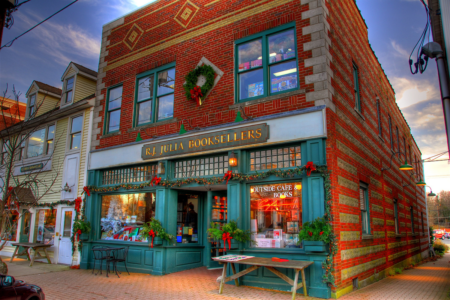
At this year’s ABA Winter Institute, as in the past, there was a session devoted to education for authors; a panel of booksellers discussed how authors can partner successfully with stores on events. This year’s panel included ER Anderson of Charis Books (Decatur, GA), Paul Hanson of Village Books (Bellingham, WA), Javier Ramirez of Exile in Bookville (Chicago), and Bunnie Hilliard of Brave + Kind (Decatur, GA).
The panel was divided into three parts, with one bookseller’s expertise per part: before the event (ER Anderson), during the event (Ramirez), and after the event (Hanson). Hilliard spoke specifically about children’s book events and school events.
When planning for bookstore events: Anderson advised that authors be proactive in starting the process; if you have a publisher, talk to your publicist as early as possible about your ideas or vision for bookstore visits. Anderson’s store, which does about 300 events every year (both in-person and virtual) is now booking events six months out. He advised being selective and focused in the bookstores you want to partner with: “Get rid of the ones you’re not excited about,” he said. Aside from geography, “Have a rationale for where you want to go and why.” Look for stores that focus on the kind of work you’re doing, that have good alignment with your book’s genre or themes. “That takes a little bit of research on your side,” he said. “It’s better to be good in one place than be spread thin at many places. Hone in: What is my brand? What is my good spot?” he advised.
When reaching out to bookstores: Anderson advises doing it over email first: “Don’t come in on a busy Saturday in person.” Make sure your website is what you want to be saying to the world already, since the bookseller will likely go there first to learn about you and your book. Whatever you do, never mention Amazon in your pitch to the store or send the bookstore to Amazon to look at your book. (It’s also a well-known rule that if you want to attract bookseller support, make sure your author website links to Bookshop or independent bookstores—or to a variety of retailers, not just Amazon.)
Bookstores are not fans of authors avidly sharing discount codes with friends and family or others who might be attending the bookstore event—that just hurts the bookstore’s sales. Anderson clarified during Q&A that these discount codes are often given by publishers to authors to spur their own direct-to-consumer orders, which bypass the bookstore’s role in selling the book and profiting from the event.
Ramirez offered encouragement for authors who get turned down by bookstores. “We’ve learned to do things that play to our strengths. If we turn something down, it’s not a personal thing. We don’t want to waste your time,” he said. “For us, we want that book to have legs year after year [in our store].” The panel’s moderator, Linda Kass of Gramercy Books (Bexley, OH), agreed. She added that whatever bookstores you visit, it should be “because they’re enthusiastic. That bookseller will care about your book, you as an author, and they’re going to promote it. That’s where your decisions should focus.”
To get turnout for an event: Part of your success here will depend on your research and ability to select the right venue. Do you have friends in the city of your event? Are you an alum of a nearby school? Part of a faith organization that has a presence in the region? Who are your collaborative people in that store’s city or region? If you have loose ties to the store’s city, then Anderson suggested finding a community organization that can be a good publicity co-sponsor of the event. (The bookstore may look for one regardless.) In such an arrangement, no money exchanges hands, but the community sponsor’s logo is part of the event’s marketing materials and social sharing images. A co-sponsor will mention the event in their newsletter if they have one, on their social media or website, etc. “We encourage you to spend as much time thinking about [potential co-sponsors] as we do,” Anderson said. You can share with the bookstore the top themes in your book that might help them identify a good partner.
Kass suggested that whenever you have a review or coverage of your book, send that to the bookseller, who then has content to put out on social media or in their newsletter.
During a bookstore event: “Do not treat your host like the hired help,” Ramirez said. “Be gracious to your hosts.” If you can see a way to make the event go smoother or easier or be more successful, do so. An example he offered was to take pictures at your event. Because stores can be short on time or staff, sometimes they can’t always take pictures—but they appreciate it when an author does, then posts them on social media, tagging the store. Also, “Take photos with your hosts afterward so they can be posted afterward.” These photos work well even for low turnout events; no one has to know that only a handful of people showed up.
If you’re not a good reader, don’t read. Instead, “Create an event that makes you shine.” A number of panelists mentioned that it’s popular now to structure author events as a conversation between the featured/visiting author and a local/regional author—which can lead to better turnout and a more dynamic presentation. (Also, if you have a conversation partner, they can read a portion of your book if desirable.) To close out the event, Ramirez suggested having a last question ready for good closure, whether you’re doing the event solo or with another author.
After a bookstore event, resist the temptation to ask, “Was this a good event?” Or, “How were the sales?” The why of an event is many-fold, and sales are a very small aspect, said Hanson. Other measures of success include the publicity around the event and the number of impressions made that will lead to sales before and afterward, as well as the connections you make with booksellers and readers.
For children’s book events: Authors might plan a storytime visit or a book launch visit, and possibly combine it with a school visit, which Hilliard’s store can help facilitate. “You have to be more interactive,” at a children’s event, said Hilliard. “If that’s not your strong suit, plan to get out of your comfort zone.” She recommended that authors send video book trailers, a quick intro video (calling out the name of the store or school), and/or character art in advance to get the children and parents excited about your visit. Finally, authors should bring non-book swag for children who are unable to purchase books during the event, a keepsake they can take home.
Bottom line: No matter what your event turnout is like, meaningfully connect with whomever attends. Ramirez emphasized the value of getting to know even that one person who shows up. Instead of sticking to your script during low turnout, he said, “Make a more intimate event. Forgo the standard setup.” And if no one attends, then spend your time connecting with your event hosts.

Jane Friedman has spent her entire career working in the publishing industry, with a focus on business reporting and author education. Established in 2015, her newsletter The Bottom Line provides nuanced market intelligence to thousands of authors and industry professionals; in 2023, she was named Publishing Commentator of the Year by Digital Book World.
Jane’s expertise regularly features in major media outlets such as The New York Times, The Atlantic, NPR, The Today Show, Wired, The Guardian, Fox News, and BBC. Her book, The Business of Being a Writer, Second Edition (The University of Chicago Press), is used as a classroom text by many writing and publishing degree programs. She reaches thousands through speaking engagements and workshops at diverse venues worldwide, including NYU’s Advanced Publishing Institute, Frankfurt Book Fair, and numerous MFA programs.