Publishers and authors’ organizations say that copyright law doesn’t allow for Audible’s new audiobook feature that shows the text as it’s read aloud—at least not without proper licensing or permission
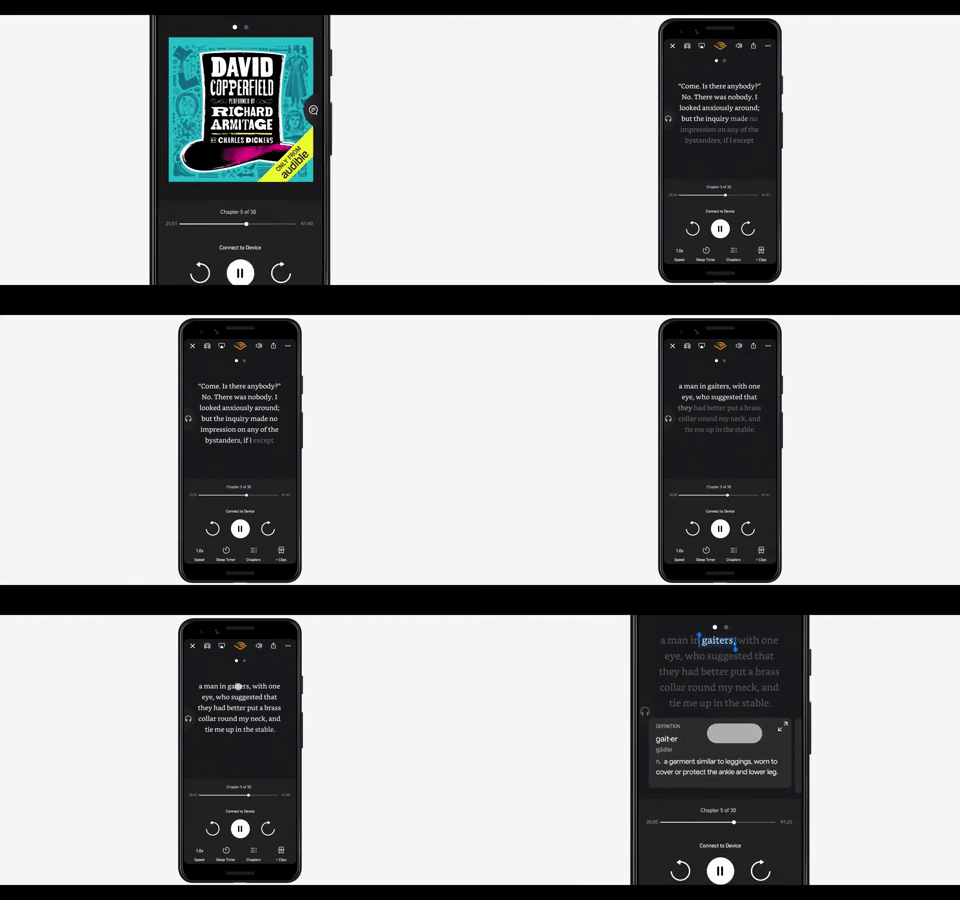
The only thing that may download faster than a new audiobook these days is industry reaction to Audible’s announcement that it will start offering captioned audiobooks. The company’s video (from which we generated the animated GIF below) makes it immediately clear why many authors, publishers, and even retailers may be worried. What you’ll see is a kind of ebook that scrolls along on your screen in sync to the audio, with some interactive features. The Authors Guild released a statement expressing alarm about what “appears to be outright, willful copyright infringement” that will “inevitably lead to fewer ebook sales and lower royalties for authors for both their traditionally published and self-published books.”
We contacted the Society of Authors in London, whose chief, Nicola Solomon, says they agree with the Authors Guild. “We haven’t seen this phenomenon in the UK yet and hope that Audible would not try it here as it would clearly be an infringement of our copyright law. This is another sign to us that the UK needs to be vigilant to maintain its gold standard copyright law post-Brexit. Obviously many of our authors may also be affected by their books being downloaded with captions in the US, and we would invite any members with concerns to contact us for individual advice.”
Solomon adds, “Obviously Audible might put this into contracts or terms and conditions with authors, who should read contracts carefully and be wary that they are not giving Audible rights that they have already granted to publishers or that prevent them from later licensing the rights to a print audiobook.”
As Andrew Liptak writes at The Verge, publishers are speaking out quickly, Penguin Random House telling him, “We have reached out to Audible to express our strong copyright concerns with their recently announced captions program, which is not authorized by our business terms.” And Michael Cader at Publishers Lunch (subscription required) quotes Simon & Schuster’s statement: “We have informed Audible that we consider its captions program to be an unauthorized and brazen infringement of the rights of authors and publishers and a clear violation of our terms of sale. We have therefore insisted that Audible not include in captions any titles for which Simon & Schuster holds audio or text rights.”
When the Hot Sheet contacted Audible to ask for a comment, Matthew Thornton, senior vice president for global corporate communications, indicated that the company believes rights holders will be less disturbed by the concept once they see it in action. “As you know,” Thornton tells us, “this feature is not yet available, so because people haven’t seen it, there’s some confusion as to how Audible Captions works and what listeners will experience. We’re reaching out to have discussions and provide demos to content providers to address this.”
At USA Today, Edward Baig wrote about how Audible’s captions feature has its origin in educational work in Newark, NJ, where tests with 11,000 students showed that the chance to see and hear text simultaneously proved beneficial. Audible has said the system can improve comprehension and vocabulary, word recognition, listening skills, and motivation—perhaps even leading more students to read.
However, copyright law may not be on Audible’s side. The Association of American Publishers quickly described this as a “surprising and deeply concerning” concept from the trade’s standpoint, writing: “Audible enjoys access to valuable literary properties only because publishers and authors have entrusted these works as part of explicitly licensed audio book agreements. … Nothing under US law permits a company that is a copyright licensee for one purpose to unilaterally extend the scope of the agreement to other uses, particularly for the purpose of enhancing one’s products for commercial gain.”
On a side note, longtime industry observers may recall the 2009 kerfuffle when Amazon Kindle first offered the text-to-speech feature. This is where a Kindle device reads your ebook to you using a generated voice (not the audiobook edition); today, that voice can come through your Alexa as well as your Kindle. Back then, the Authors Guild strongly opposed the feature, and eventually Amazon caved, allowing publishers to decide on a title-by-title basis whether to enable the feature. Still, Amazon maintained the use was legal, that they did not create a copy or a derivative work, and that text to speech did not constitute a performance. These days, it’s hard to buy an ebook from any retailer without text to speech available.
Bottom line: Not everyone in the writing and publishing community agrees on whether Audible’s captions are infringing. At his Passive Voice blog, attorney David Vandagriff wrote, “Absent a problem with the definition of ‘ebook’ in the contracts between Amazon and the publishers, [I think the captions’ appearance] is distinguishable from an ebook.” He goes on to worry aloud about punitive measures Amazon/Audible might take against publishers that don’t allow the captions. We’re less interested in arguments about Amazonian reprisals than in seeing if something might be done to make the captions available to students and/or others who need them while securing permission or compensating rights holders. It’s probably true that few committed ebook readers will be satisfied with the scrolling captions instead of an ebook, but whenever dealing with rights issues—as we pointed out with Scribd in our last issue—collaboration is often a better approach than forging ahead without permission.

Jane Friedman has spent her entire career working in the publishing industry, with a focus on business reporting and author education. Established in 2015, her newsletter The Bottom Line provides nuanced market intelligence to thousands of authors and industry professionals; in 2023, she was named Publishing Commentator of the Year by Digital Book World.
Jane’s expertise regularly features in major media outlets such as The New York Times, The Atlantic, NPR, The Today Show, Wired, The Guardian, Fox News, and BBC. Her book, The Business of Being a Writer, Second Edition (The University of Chicago Press), is used as a classroom text by many writing and publishing degree programs. She reaches thousands through speaking engagements and workshops at diverse venues worldwide, including NYU’s Advanced Publishing Institute, Frankfurt Book Fair, and numerous MFA programs.