“There are a lot of dead bodies on the field.”
That’s what Andy Hunter told us as we discussed his new effort to establish Bookshop, an online bookstore to compete against Amazon. He’s all too aware of the many players who’ve gone before him and failed, and he recognizes the enormity of the challenge ahead.
Because Amazon’s hold on the US retail market for books seems unassailable, one might quickly conclude Bookshop is doomed to failure before even laying eyes on it. However, if anyone can succeed, Andy Hunter—and the project’s partners and funders—may be among the best positioned to do so.
Hunter is a unique figure in literary publishing: he has created several long-standing print and digital publishing ventures, including Electric Literature, LitHub, and Catapult. Defying a common stereotype of a literary publisher, he embraces digital innovation and the opportunities of the online world. He’s known for using technology in smart ways to help literary culture flourish. (This interview in Publishing Perspectives by Erin L. Cox is a good primer on his values and mission.)
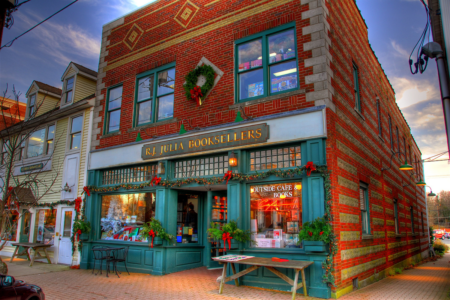
We asked Hunter why independent bookstores should worry about competing for online sales when one of their key value propositions is providing an experience—particularly a local, community experience. He tells us that, generally speaking, there are only about 150 bookstores out of ABA’s entire membership (roughly 2,000 stores) that enjoy a substantial amount of e-commerce revenue. Although enjoying a resurgence, all bookstores are endangered, given that Amazon has grown to more than half of all print book sales. The amount of book-buying activity going over to e-commerce has increased 15 percent year over year for the past decade. He says, “If you look at those two trends and follow them to their natural conclusion, will bookstores continue their resurgence if they don’t start participating in e-commerce?”
There is a central retail site for ABA members: IndieBound. In fact, the impetus for Bookshop arose when independent booksellers saw the need to improve the site. IndieBound hasn’t kept up with changes in online retail and has poor conversion when compared to Amazon. (Here, conversion refers to how many site visitors actually make a book purchase.)
Despite IndieBound being a poor means of selling books online, if authors want to stay on the good side of independent booksellers, they must link to IndieBound and not just Amazon when mentioning their books. Hunter says, “You give up sales when you link to IndieBound. You might sell five copies when sending [people] to IndieBound and 50 copies to Amazon. It’s not fair to put authors in this position where they have to choose. They have to have a virtuous alternative. This has frustrated me for a decade.”
Hunter hopes that Bookshop will become that “virtuous alternative.” It’s critical, he says, to make people feel like they’re not sacrificing something to take that virtuous action. “Amazon is so easy. It has to be as easy as Amazon,” he says. “If people are faced with a choice, they will choose the easy thing most of the time. If the virtuous thing is just as easy, they will choose a virtuous thing.”
Hunter admits up front that Bookshop’s conversion rate is not going to be as good as Amazon’s. However, to make up for that, Bookshop will have an affiliate marketing program that pays 10 percent. This way, as Bookshop affiliates, authors can conceivably earn just as much sending a reader to purchase at Bookshop as they would by sending a reader to Amazon. (Currently, Amazon pays 4 or 4.5 percent on affiliate sales for books.)
Perhaps most important, Bookshop will funnel 10 percent of a book’s list price directly to independent booksellers. This amount will go into a pool distributed to ABA member stores that opt in as Bookshop partners. But they stand to earn even more than that: bookstores that use the platform to sell books through links on their own websites, newsletters, and on social media will earn 25 percent of the list price of each book sold in addition to their share of the revenue pool. (Note that independent bookstores are not fulfilling orders; Bookshop is partnered with Ingram for inventory and customer fulfillment.)
While Bookshop is being built to benefit independent bookstores, Hunter says that if the effort is successful, the positive effects will ripple throughout the entire publishing ecosystem. “Bookstores constitute the literary fabric of the book world. If they were to blow away, the community would be deeply impoverished,” he says. “If one day Amazon delivers 100 percent of the books sold in the US and it’s all done online and there aren’t any bookstores left, the same amount of books won’t be sold and read. Books will be a much less important part of our culture.”
However, he emphasizes that Bookshop is not meant to beat Amazon. Rather, he says, he wants Bookshop to “snatch a crumb away from the giant’s mouth. A crumb is enough to support this ecosystem.” He says if Bookshop can sell to that 1 percent of conscious consumers, that would be massive (and sufficient) support for independent bookstores. Even though Bookshop is angling for just that 1 percent, Hunter says, “It’s an ambitious goal, and I don’t expect to get there in a year.” Working to his benefit, though, is the declining image of Amazon and Big Tech generally—not just in the publishing community, but among the general public. Now may be the perfect time to offer an alternative to people who feel conflicted about sending business to Amazon.
Bottom line: Bookshop is set to launch in January, and to start, it will sell only physical books. That’s not because Hunter or independent bookstores are against selling ebooks. Rather, Hunter says, he believes those aforementioned dead bodies on the field tried to do too much all at once. “We’re going to launch as simple as possible and let customer behavior dictate what we’re going to build next,” although digital audiobooks will be the next format they offer. He says anyone will be able to create their own storefront at Bookshop; it will be accessible to all people and not require technical knowledge. “I do have a vision that all the people who love books have lists on Bookshop. … So if you’re a vegan blogger and Instagrammer and you want to have your cookbook up there or all the cookbooks you recommend, … you can curate that page and you can link to that with your social media account. And bookstores get a cut of [sales] even though they’re not really involved.”

Jane Friedman has spent her entire career working in the publishing industry, with a focus on business reporting and author education. Established in 2015, her newsletter The Bottom Line provides nuanced market intelligence to thousands of authors and industry professionals; in 2023, she was named Publishing Commentator of the Year by Digital Book World.
Jane’s expertise regularly features in major media outlets such as The New York Times, The Atlantic, NPR, The Today Show, Wired, The Guardian, Fox News, and BBC. Her book, The Business of Being a Writer, Second Edition (The University of Chicago Press), is used as a classroom text by many writing and publishing degree programs. She reaches thousands through speaking engagements and workshops at diverse venues worldwide, including NYU’s Advanced Publishing Institute, Frankfurt Book Fair, and numerous MFA programs.