By now, I’m sure many of you have seen the New York Times article The New Fabio Is Claude (gift link), which reports on a romance novelist—presumably one of many—who has published hundreds of AI-generated works on Amazon. Every writer should read it if only to understand what’s possible and what’s happening in the Amazon marketplace.
The article has been met with outrage from the romance writing community for a range of reasons. Some don’t like that romance is the focus of this piece, as it suggests romance writing is of lesser quality. But as the article itself points out, romance is where technology shifts are felt first in publishing: It’s a market with voracious readers and big sales, and exactly the place to look for early signs of what the future may hold. Also, this is hardly the Times’ first foray into AI’s effect on literature. They frequently cover the intersection of AI and writing and publishing, and one of their earliest pieces focused on an upmarket novelist (gift link).
Some are angry at Bloom Books’ Christa Désir for telling the Times that AI detection tools will only work to a certain point. I guess some interpret this as a kind of endorsement or defense of AI, but all I see is someone stating a probability the technology will advance. Just as spam detection can’t keep up with spammers, AI detection will always be running a race with AI users who wish to escape detection. Bloom Books has zero interest in antagonizing authors or the romance community. So let’s not shoot the messenger, especially since Désir would have said much more to the Times that didn’t get quoted.
Most anger is directed at the authors who have revealed they’re doing this in the first place. I’m surprised and delighted that the journalist, Alexandra Alter, got such frank information on the record. The author featured, Coral Hart, is quoted, “If I can generate a book in a day, and you need six months to write a book, who’s going to win the race?” She says she’s earning six figures from more than 200 AI-generated works that have sold a combined 50,000 copies, which averages to 250 copies sold per title. It is not easy to get authors to talk about generative AI use because it means subjecting yourself to online fury and getting hunted down by people on Reddit who will do everything to figure out who you are. (Coral Hart is a pen name.) It makes sense to me that the person the Times got on the record is based in Cape Town, South Africa, an ocean away from the US community.
Hart will likely have pariah status indefinitely in romancelandia, but not necessarily with casual readers. As some have been brave enough to point out in comment threads, while fiction writers on the whole may be anti-AI, the general public may not care or realize that what they’re reading is AI generated. Of course, debate continues over exactly how much readers do or don’t care, both now and in the future. What’s darkly amusing about this article is how authors quoted in the piece say that sales aren’t affected if you use AI to generate the work, as long as you hide using it. They believe that readers will care less over time as the technology becomes more accepted or normalized. But I have no doubt some avid readers, regardless of what they read, will always be anti-AI and that no amount of normalization will bring them around. On the flip side, just as many (probably more) are not going to care. Both things can be true at once.
There’s considerable anger at the New York Times for bringing attention to such authors and books and giving them a bigger audience—or otherwise promoting them with this reporting. I wouldn’t exactly call the Times defenders or promoters of AI; one of the most important ongoing lawsuits against OpenAI for copyright infringement was brought by the Times. Fortunately, they continue to examine all sides of this issue while fighting for their interests in court. And in this case in particular, it is fortunate indeed, because the article offers evidence the market is being flooded with AI-generated material that earns money and causes market harm to human authors. Last year, the US Copyright Office warned about the danger of market dilution in one of their reports, and in the rulings handed down so far in AI copyright infringement cases, there are signs that judges might rule that AI model training is not fair use because of market harm. But it can be challenging to prove, not least because Amazon doesn’t label AI-generated books, the volume of this activity is hard to measure, and its market effects on human authors can be challenging to quantify. But lawyers are working hard to quantify it, and maybe the New York Times article will help them. So again, let’s not shoot the messenger. The article has done everyone a service by shining a light on an important topic.
Bottom line: For the last year, I’ve been trying like the lawyers to ascertain how much of a market threat AI-generated books pose to writers’ livelihoods. First, fiction and nonfiction markets will be affected in different ways. Nonfiction categories are already full of damaging and fraudulent AI-generated work, where you find books offering confident but harmful information (see the mushroom case) as well as all sorts of books trying to pass themselves off as something they’re not and/or directly infringing on actual works, especially in the case of memoir and autobiography. Fiction is a little different. It’s not a question of infringement or fraud yet, and most harm is done not to readers but to the market for human authors. When I asked Alex Newton at K-lytics what his data reveals about AI content in the Amazon marketplace, he said many fiction categories have seen dramatic growth in output, likely attributable to generative AI (see below). He believes many more people are writing who don’t typically have the stamina or craft to finish a book, but that does not mean their books sell. In fact, during one month last year, he found it striking that out of 700+ new titles in one fiction category, 72 percent showed zero reviews.
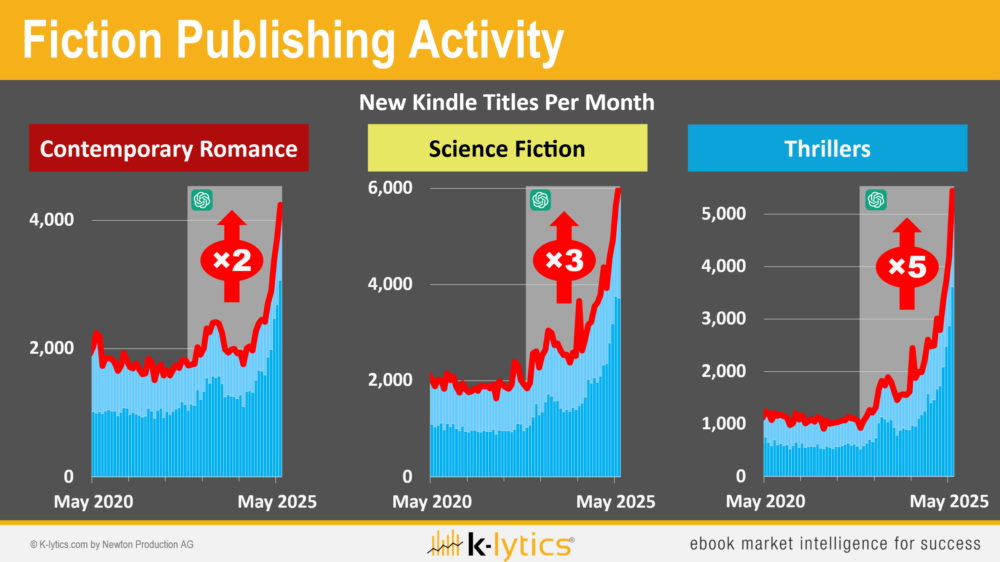
In a public Facebook comment, Novelists, Inc. president Kevin McLaughlin said of the situation, “Before folks panic, the important thing to remember is that at least for now, if someone is writing with AI, they have two choices. They can have the AI draft the book quickly and publish fast, in which case they’re not going to sell more than a handful of copies because the story is crap—or, they can spend about the same number of hours revising it that it would have taken an experienced novelist to write the book. … Writing a story book with these apps takes the same amount of time as writing a strong book the way the rest of us do. If someone is doing it faster, then they’re producing a poor quality experience that isn’t going to sell many if any copies, and they’re irrelevant to the industry, at that point. Kindle already has millions of low-quality books uploaded by unskilled human writers, so a couple million more bad books written by machines won’t have any impact at all.” We shall see.
Is Coral Hart really earning six figures from AI-generated work?
I don’t know, but some say she can’t be because her work has few reviews and low to average ratings (browse). Or, if she is earning that much, maybe it’s through Kindle Unlimited. Some have pointed out that Coral Hart’s work is not exactly trending on TikTok (at least not for the right reasons!) and earns limited word of mouth. One reason authors don’t like the New York Times reporting is that Hart discusses her classes teaching other writers to use AI to write books. This is a classic get-rich-quick model used across industries: Look at how much money I’m earning—you can earn this much money too if you pay for my class! So those classes can be where the most money is made. But I don’t blame the Times for bringing attention to Hart, because I think the flashing red light here is obvious regardless of her book sales. Or at least I hope it is.
Related: I interviewed Elizabeth Ann West in 2024 for this newsletter; she gets the closing quote in the Times piece, saying that eventually readers will come around to AI-generated fiction.
Readers respond
I heard from many readers about this article. The CTO of the Future Fiction Academy and Future Fiction Press, Steph Pajonas, wrote in. Not only does she work closely with Elizabeth Ann West, who was quoted in the Times piece, but she is a friend of author Coral Hart, the subject of the piece. Pajonas pointed specifically to where I discussed my gratitude to the Times for offering “evidence the market is being flooded with AI-generated material that earns money and causes market harm to human authors.”
She said, “I can assure you that Coral Hart is indeed a HUMAN author. She’s a real person who put her skills to use producing books quickly with the assistance of AI. That doesn’t make her any less human. I see this divide a lot, and I wish we all stopped trying to put labels on it like this. Some writers are using AI to help with small parts of their process. Others are using it to amplify their process and get more books out quicker, capitalizing on sheer volume. But that doesn’t make them any less human.”
I’m aware that some people in the writing community don’t think writers who use AI deserve the label writer or author, but of course they are still human, and I regret that I implied otherwise. We can of course continue to debate how AI-assisted or AI-generated works ought to be labeled and how “human” the resulting work is. The market impact of such work poses challenges that may not ever be fully answered or resolved, especially in the near term.
About Coral Hart’s six-figure sales: There has been considerable speculation about whether she is earning this much, including some people saying they looked up her sales on BookScan and could not find evidence that she’s succeeding at that level. Everyone should be aware that there is no way to look up sales figures inside Kindle Unlimited unless you are the author or publisher; BookScan has zero insight into that. On social media, many have pointed out that Coral Hart is but one pen name and that the author uses many other pen names, and that may be where the real sales are. I hope and assume the NY Times asked for and was provided proof of income or sales before taking her word for it.
Reader Karen Strippel wrote in with the following eye-opening experience with AI-generated romance apps: “Thank you for writing this. I started getting ads in my [social media] feed for personalized romance novels/experiences. Basically a choose-your-own-adventure, but with spice. You, theoretically, pick your preferences as to type of romance, setting, and spice level. Then the AI generates a story for you, where you can interact at key times to decide what your character does next. Highly personalized fantasies. I have no evidence, but I really think this type of model may be big competition. How many people would eschew buying a book that isn’t quite right for being the main character in their own plot?
“I tried out three different platforms to see for myself. One [RedQuill] I didn’t get through the selection process before the site got flagged by my Avast protection. With the second one [Sweet Secrets] I got through it, but the romance it generated did not at all fit the preferences I put in (I asked for fantasy or historic, and it gave me modern office). I believe that they have standard plots that they give people to start (I’m not sure if all the platforms do this), and I got flagged for one of those. I assume these pre-generated stories are higher-quality writing than those that are purely generated by AI, because I later got follow-up emails with snippets from the story to entice me to pay for the platform. I did not.
“The third one [Smut Finder] I got through and started up interacting with it. The writing was fairly flat and repetitive (one character was described as ‘calm’ probably 10 times over a few pages), but it wasn’t awful, either. What’s more, I could change the plot/happenings that the AI laid out to even further customize. You have the option to enter your own characters and then customize those to define what works for you and what doesn’t as you go along. There are tons of others. I imagine a few other genres will get into this too, probably fantasy, but it always starts with erotica!
“Knowing these can only get better was honestly fairly disheartening. Even myself, a writer, was tempted to just use this to create a story for myself rather than buy a book that may or may not fit my preferences. I could be wrong about this—and I do think that people crave surprise, originality, and good quality. It’s just very hard to see how this type of option wouldn’t siphon away a good portion of readers. Especially in romance.”

Jane Friedman has spent her entire career working in the publishing industry, with a focus on business reporting and author education. Established in 2015, her newsletter The Bottom Line provides nuanced market intelligence to thousands of authors and industry professionals; in 2023, she was named Publishing Commentator of the Year by Digital Book World.
Jane’s expertise regularly features in major media outlets such as The New York Times, The Atlantic, NPR, The Today Show, Wired, The Guardian, Fox News, and BBC. Her book, The Business of Being a Writer, Second Edition (The University of Chicago Press), is used as a classroom text by many writing and publishing degree programs. She reaches thousands through speaking engagements and workshops at diverse venues worldwide, including NYU’s Advanced Publishing Institute, Frankfurt Book Fair, and numerous MFA programs.