In case you didn’t hear: Taylor Swift is self-publishing Taylor Swift: The Eras Tour Book for $39.99, to be sold exclusively at Target while supplies last. Release date: November 29 (Black Friday). The book will include hundreds of images, including “never-before-seen performance photos from every era as well as exclusive rehearsal photos and behind-the-scenes images of instruments, costumes, set pieces, and designer sketches used throughout the tour.” It will also offer notes and reflections from Swift about the experience.
This decision has no material meaning for traditional publishing today or in the future. First of all, this is Taylor Swift, a savvy business woman and someone who pays attention to and understands her fans deeply. There is no publisher on the planet who knows her audience as well as she does, or how best to reach and serve them. Second, she is producing a piece of merchandise for those fans, as publishing vet Kathleen Schmidt has pointed out. It’s safe to assume Swift made a clear-eyed business decision about how to best execute and deliver this project to her fans. Her partner of choice in this? Target, a retailer that has served as an exclusive partner in the past. Michael Cader notes in Publishers Lunch (sub required), “Swift releases her own music and creates and sells her own merch, worldwide. And she has sold more than 10 ‘exclusive’ versions of albums through Target, so this is the latest natural step in a long commercial relationship.”
I can think of no good reason for Swift to involve a middleman-publisher, which would’ve added time and complication and also reduced her earnings, for no added value. This point bears repeating: She doesn’t need a publisher to understand her fans, to reach her fans, or to help her market to her fans, at least with this particular book. She may come to a very different conclusion for some other book in the future—namely, a book that would or could interest an audience beyond Swifties.
It sometimes feels like part of my job to question the group of people who love to look for any sign that traditional publishing is dead, dying, or irrelevant. I do look for those signs myself. But this is not one of them. Taylor Swift is an outlying case, and most famous individuals, I would argue, are not in her position. They don’t have an intimate understanding of their fans and may not even know how to reach them all that well. Remember how, a few years ago, the New York Times did a piece on social media failing to sell books? That was a very bad headline or bad conclusion, as I argued at the time, but the article did point out one useful thing: Just because you’re a celebrity (Billie Eilish or Justin Timberlake or Ilhan Omar, as cited in their article) doesn’t mean you’ll automatically write publish, market, and sell a book that your fans will buy. Publishers still have to do strategic work with the author to deliver a book their followers will want, to market and promote that book, and to collaborate with the author to reach fans (and to sell to fans) in a way that’s meaningful. There is no easy street here. But would Eilish or any of them done better self-publishing? No. They’re examples of authors needing a publisher—but the publisher failing to do their job on multiple levels.
That New York Times piece also helps underline that celebrities and other prominent individuals are not some financial saving grace of traditional publishers. Their titles can be important contributors to the bottom line (see the Obamas), but they require work to meaningfully craft and sell. There’s just less perceived risk involved, or publishers erroneously believe these books will be easier to sell. Peter Hildick-Smith, who does market research for publishers, has discussed how only 20 percent of the US population can be considered avid book buyers, and sometimes celebrities’ fanbases simply do not overlap that much with such buyers.
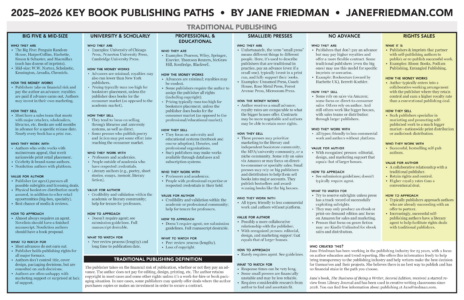
Bottom line: Swift’s self-published photo book is not an indicator that traditional publishers don’t matter any longer. A traditional publisher adds no value to this particular project; they would have been utterly superfluous. It will be interesting to see, however, if Swift licenses some kind of rights after she’s done with the initial release and partnership with Target. I mean, why not, unless there’s greater value to her in keeping this truly a limited-supply product. Only she knows her goals, and I’m not second-guessing her choices.

Jane Friedman has spent her entire career working in the publishing industry, with a focus on business reporting and author education. Established in 2015, her newsletter The Bottom Line provides nuanced market intelligence to thousands of authors and industry professionals; in 2023, she was named Publishing Commentator of the Year by Digital Book World.
Jane’s expertise regularly features in major media outlets such as The New York Times, The Atlantic, NPR, The Today Show, Wired, The Guardian, Fox News, and BBC. Her book, The Business of Being a Writer, Second Edition (The University of Chicago Press), is used as a classroom text by many writing and publishing degree programs. She reaches thousands through speaking engagements and workshops at diverse venues worldwide, including NYU’s Advanced Publishing Institute, Frankfurt Book Fair, and numerous MFA programs.