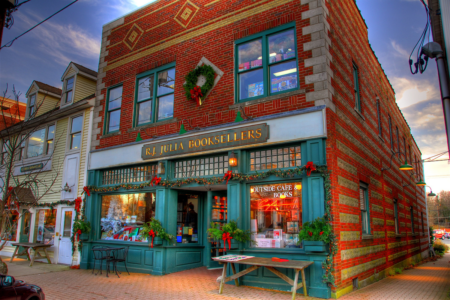
In 2020, bookstores were among the hardest hit by the pandemic; according to the US Census Bureau, sales declined on average by 28 percent. Stores quickly lost the foundation they had routinely counted on to drive sales: in-store browsing and events. So a quick pivot was made by many stores to digital events.
However, booksellers have discovered that monetizing digital events requires creative adaptation and offers a less linear payoff. After nearly a full year of experimentation, booksellers have begun to understand what works and what doesn’t.
First of all, literary events have become highly competitive, and hosting now comes with a slew of visibility issues. Readers are selective about events they attend, and the means of promoting an event has changed; bookstores must view the event relative to its ingredients. “For debut and lesser-known authors, the most important thing is to get their name out there and make people aware of their work, even if sales aren’t particularly high,” says Brittany Kerfoot, Director of Events at Politics and Prose in Washington, DC. “For big names and authors we’ve hosted time and again for years, we of course expect higher sales numbers with more exclusive, ticketed events.”
Accordingly, bookstores pay more attention to an author’s platform with digital events. “We never used to look much at an author’s social following when scheduling events in the ‘before’ times, but now that matters more than ever,” says Kerfoot. Obviously, the bigger the author’s platform, the more chances the event has to gain attendees and book sales. (It’s also why bookstores try to secure partner organizations or publications for events.) Kerfoot says the best paid virtual event combines a well-known author with a moderator people would also like to see. However, an author with a platform isn’t necessarily what matters most to Kerfoot. Even the emerging and exciting debut novelist can bring in viewers; what’s imperative is that the author, host, and other participants have great chemistry. Shane Mullen, event coordinator at the St. Louis–based Left Bank Books, agreed: “The absolute best way to ensure great attendance for an event is active social media from the author and conversation partner.”
However, digital events have less overhead, meaning stores can offer “event space” to new and different types of authors and publishers. “I can’t imagine returning to in-person only,” says Stephen Sparks, co-owner of Point Reyes Books. “Digital events have allowed us to promote books and writers that wouldn’t have travel or marketing budgets, connect with writers dispersed geographically.” (See our item in February about accessibility issues.)
One of the benefits of digital events is that, typically, everything is recorded. Mullen says they try to ensure that paid ticket holders enjoy the fullest experience possible; Left Bank Books offers recordings to ticket holders for later viewing. In some instances, the bookstore has edited event recordings and placed them online for free and/or on C-SPAN.org for a larger audience. For paid events, Politics and Prose keeps event recordings exclusive for the duration of the author’s tour before opening them up for public consumption. For Point Reyes, making recordings available has brought a longer lifespan of sales. “Events have a longer tail,” Sparks said. “We continue to get book orders for past events even months later.”
Both Left Bank and Politics and Prose have dabbled in coupon codes for some events. Mullen says that for some events they’ve offered $5 tickets that can then get the customer a $5 discount on the featured title. The store keeps sales stats to predict which events might benefit from additional sales enticements. Though coupon codes might be an interesting way to encourage sales, bookstores have discovered, once again, the power of the book. “Signed editions have been more of a rarity during the pandemic,” says Kerfoot. “It’s really special if we’re able to offer them.”
When bookstores monetize events, they try to do so in a community-sustaining manner. Sparks has moved away from a strict entry fee and toward donations. “All of our events are offered on a sliding scale from $0 to $100, so we have been able to capture at least some donations for every event we’ve hosted,” he said. Giving attendees the choice to pitch in whatever they can leaves the door open for financial recompense from the event while also building loyalty and charitability from customers. Sparks says about 5 to 10 percent of an audience tends to pay, and that every event usually earns out on a percentage of donations, which is encouraging. Even with a modest event series, the store brought in around $20,000 in ticket sales last year—pure profit, Sparks says.
Politics and Prose has also added an option for customers to donate. “We have been overwhelmed by the contributions in the past year,” Kerfoot says. Donation tickets start at $1 and have been, according to Kerfoot, a big reason they’ve been able to continue events throughout the pandemic.
Politics and Prose is also looking to earn money outside of book sales and donations. Kerfoot says they are building up classes programming, in addition to other models, and “constantly upping the game in events space, because we’re aware of how much ground we have to make up on book sales.” Classes have been popular and are accessible to people all over the country. “For example, Kate Reed Petty, author of True Story, did an event for us that was so interactive and fun that we asked her if she’d be willing to teach for us as well.” Another popular offering, the book club, has blossomed into its own offshoot due to the features Zoom offers for discussion—including the breakaway rooms, chat, and recording.
Bottom line: Broadly speaking, pairing book sales with event entry—wherein people attending are either required or encouraged to purchase the author’s book as part of the contribution to the event—has been the more consistently effective choice for bookstores looking to monetize events. But paid events have a role to play, too. Sparks says, “We now have a certain freedom to think outside the new release hype machine and can focus on backlist. Paid events help that.” What keeps people coming back to events online or in person, free or paid: creativity and excitement. “If the author is excited about the event, the audience will be, too,” Kerfoot says.

Jane Friedman has spent her entire career working in the publishing industry, with a focus on business reporting and author education. Established in 2015, her newsletter The Bottom Line provides nuanced market intelligence to thousands of authors and industry professionals; in 2023, she was named Publishing Commentator of the Year by Digital Book World.
Jane’s expertise regularly features in major media outlets such as The New York Times, The Atlantic, NPR, The Today Show, Wired, The Guardian, Fox News, and BBC. Her book, The Business of Being a Writer, Second Edition (The University of Chicago Press), is used as a classroom text by many writing and publishing degree programs. She reaches thousands through speaking engagements and workshops at diverse venues worldwide, including NYU’s Advanced Publishing Institute, Frankfurt Book Fair, and numerous MFA programs.