Alarmist articles in recent years have claimed that novelists, in order to land a traditional publishing deal, need to be online superstars. But an analysis of debut deals in Publishers Marketplace (PM) shows that’s outright false. While it is true that most authors who land deals—especially agented deals, the majority of those reported to PM—have some visibility within or connections to the traditional publishing community, it’s rarely online visibility.
The following analysis looks at the approximately 150 debut fiction deals reported to PM between April and August 2024. After excluding debuts from established nonfiction authors and established authors in other countries, plus deals for North America made by UK publishers, 131 deals remain for analysis. These deals fell into seven distinct categories. Here are the first six:
- Literary and university community (37.8 percent of deals): These are writers with MFA degrees, usually from notable creative writing programs; writing and literature professors; writers who have won fellowships, awards, and residencies for their work; writers who are actively publishing in literary magazines and journals (typically short stories and poetry); and/or writers who work at publications with ties to the literary community. While most of these writers produce what’s considered literary work, some do genre fiction as well, typically upmarket.
- Journalist and media community (16.5 percent of deals): This includes writers who have staff jobs at well-known publications or media outlets of any kind (e.g., public radio) as well as those who primarily work as freelancers for such publications.
- TV/film/stage/entertainment (11.8 percent): The bulk of this category includes screenwriters and people who work in the TV/film industry. It also includes actors, playwrights, comedians, etc.
- Publishing-industry types (8.7 percent): These are people who are employed in the book publishing industry, who once worked in the industry, or who freelance for the industry.
- Self-publishing authors (3.1 percent): It’s not always easy to tell which authors are also self-publishing because such work is often released under another name. So this category includes authors who are open about their self-pub work but traditionally publish as a separate effort under a different name. (Keep in mind we’re looking at debuts for this exercise, so they should use a different name to qualify.)
- Online creator or influencer (1.6 percent): Here’s the bogeyman, at 1.6 percent of the market (at least in the fiction realm) or two deals. One author is a hockey wife and influencer writing a hockey romance. The other has a successful Substack newsletter.
Belonging to any one of these categories does not mean it’s easier to get a book deal, but it can grease the wheels, help secure referrals, and lead to more consideration. And there’s the obvious point that most if not all people in these categories have spent years writing professionally and getting feedback on their work. Professional experience generally helps writers better pitch their work and network with savvy. For those in the literary and university community, winning awards or fellowships or regularly publishing short work is often a way to attract industry attention.
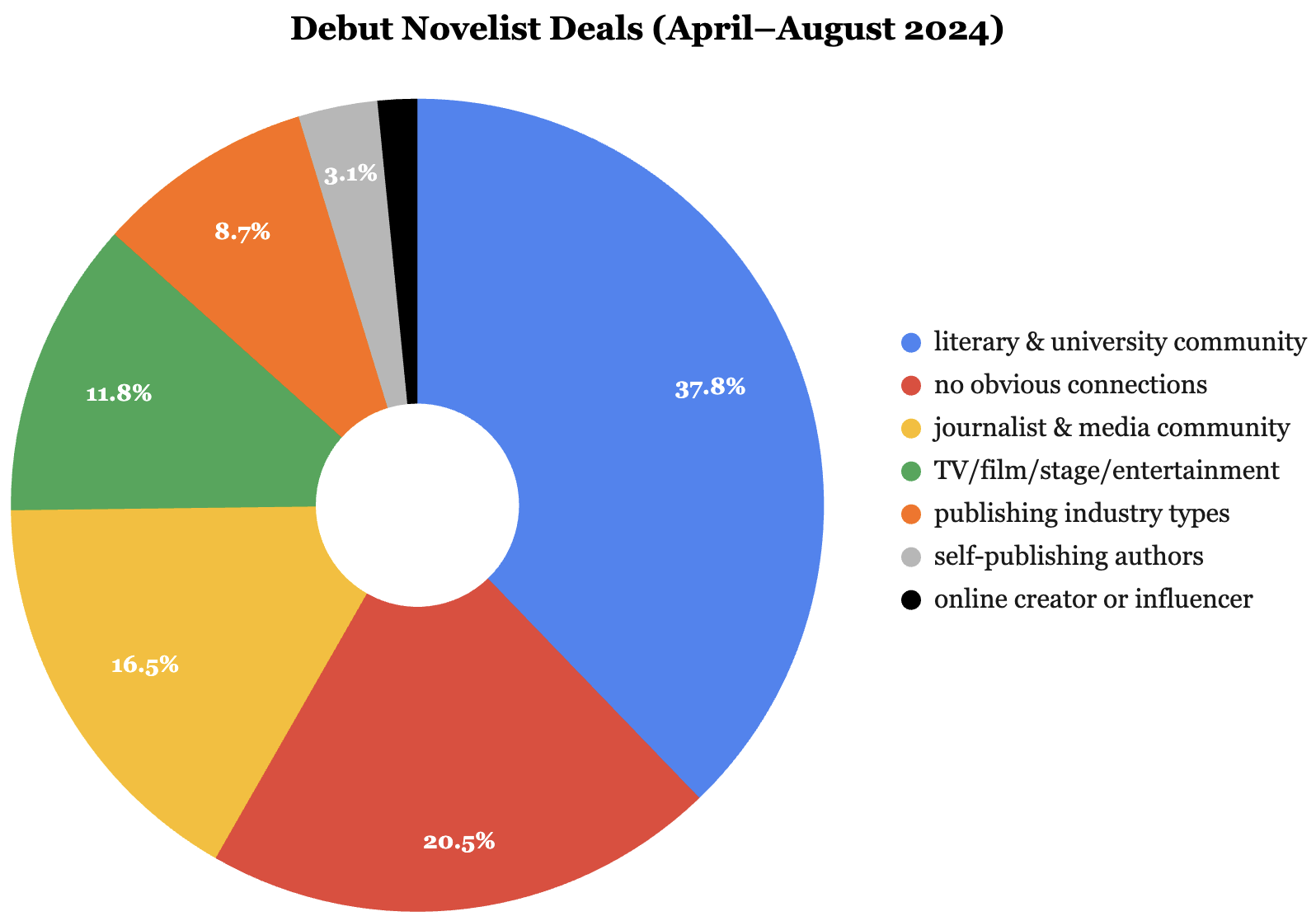
So that leaves the final category of “no obvious connections” (20.5 percent), which should come as reassurance. Sort of. It’s reassuring because it affirms that a writer can land a book deal if they have the right manuscript at the right time sent to the right agent/publisher, even if they lack industry connections or external validation or credibility in the form of awards or publishing credits. But the number here is small: 26 deals in a five-month period. (Keep in mind PM is not an exhaustive list of all publishing deals; it’s dominated by the Big Five, major publishers, and prestigious publishers.)
Out of all these categories, only a handful of authors had a meaningful online presence, except for the obvious category of online creator or influencer. Most writers, in fact, had thrown up a basic business card–type website, buttressed by a newly started Substack newsletter, not long after securing their deal. The website navigation was inevitably: BOOK | NEWSLETTER | CONTACT. As far as social media, Instagram was by far the most common type of account, with few TikTokkers to be found.
Many types of literary agencies represent debut novelists. However, some agencies did stand out for the number of debuts they logged during this brief window.
- Janklow & Nesbit logged an outstanding 10 deals. Their debuts came from all corners: a Vanity chief correspondent, a Substack writer (Rose Dommu of Mall Goth), a translator, multiple MFA graduates, and one with no clear visibility in the writing and publishing world.
- United Talent Agency logged eight deals, typically for clients working in journalism, media, or publishing, as well as literary community types. An example is Caro Claire Burke, whose career crosses over several of the defined categories: She has been published in major media outlets, has an ongoing short story project on social media (she writes short fiction based on popular music), and she’s an editor at Katie Couric Media.
- Trellis Literary Management logged six deals. Half of their debuts are from the literary & university community—Anna Kovatcheva, for example.
- Creative Artists Agency logged five deals, typically for established journalists or media figures. For example, they represented Robert P. Baird, who has contributed to countless publications, including the New Yorker.
The key publishers taking on debut fiction during this time period with at least four deals: Atria (Simon & Schuster), Berkeley (Penguin Random House), Bloomsbury (Macmillan), Crooked Lane (independent), Dutton (Penguin Random House), St. Martin’s (Macmillan), and Tin House (independent).
Bottom line: While nonfiction is a totally different ballgame, if you’re trying to establish a fiction career and desire a traditional deal, building an online platform is the least likely path to securing an agent or publisher. For writers on the literary end of the spectrum, it makes sense to seriously consider university writing programs paired with activity in the literary community (publishing shorter works, seeking out awards and fellowships, working at a publication). For writers in genre fiction categories, it helps to be working in publishing, publishing-adjacent industries, or entertainment. Still, there was no shortage of deals for authors who simply kept writing and revising and didn’t have meaningful literary publications or online activity prior to securing an agent or publishing deal.

Jane Friedman has spent her entire career working in the publishing industry, with a focus on business reporting and author education. Established in 2015, her newsletter The Bottom Line provides nuanced market intelligence to thousands of authors and industry professionals; in 2023, she was named Publishing Commentator of the Year by Digital Book World.
Jane’s expertise regularly features in major media outlets such as The New York Times, The Atlantic, NPR, The Today Show, Wired, The Guardian, Fox News, and BBC. Her book, The Business of Being a Writer, Second Edition (The University of Chicago Press), is used as a classroom text by many writing and publishing degree programs. She reaches thousands through speaking engagements and workshops at diverse venues worldwide, including NYU’s Advanced Publishing Institute, Frankfurt Book Fair, and numerous MFA programs.