Jane’s prefacing note: In late 2025, I was approached by a publishing and marketing professional with prior in-house experience at a major publisher. They wanted my take on their AI service, Request the Full. This service is for writers who want to gain a realistic sense of whether their work is ready to query without having to resort to community forums or more expensive paid guidance. However, they also did not want to be identified as the developer of this service, for obvious reasons. This person wrote to me, “The goal is to emulate an agent’s first pass as honestly as possible: clear verdicts, concrete notes, and a market-aware perspective on whether the material is likely to get serious consideration.”
The founder tells me this service does not train on your work or retain any data, and it has no marketing funnel whereby you’re sold anything else. I do believe them. AI is being used as a “force multiplier” (their term) on criteria they’ve defined from their own work.
Rather than review this service myself, I handed the task to an active writer and professional editor, Allison K Williams, who evaluates queries and first pages herself as part of her business but also runs into barriers in getting to yes for her own work.
Wouldn’t it be great to get immediate feedback that isn’t a form rejection?
Request the Full announces itself as “AI trained on agent and industry best practices” and offers AI-generated reports on queries and your first pages (15,000 words), assuring writers, “Your work stays private. Your rights remain yours.”
At $15.99 for query feedback and $39.99 for the first pages assessment, Request the Full is reasonably priced, if it can deliver. Literary agents who provide paid feedback on queries typically charge $50–$150; professional editors offer critiques of first 50 pages starting around $195–$350.
With a chance to try the service for free, I ran Request the Full through its analytical paces on an already-polished query for my own novel, on a deliberately bad query for an imaginary memoir, and on manuscript sample pages.
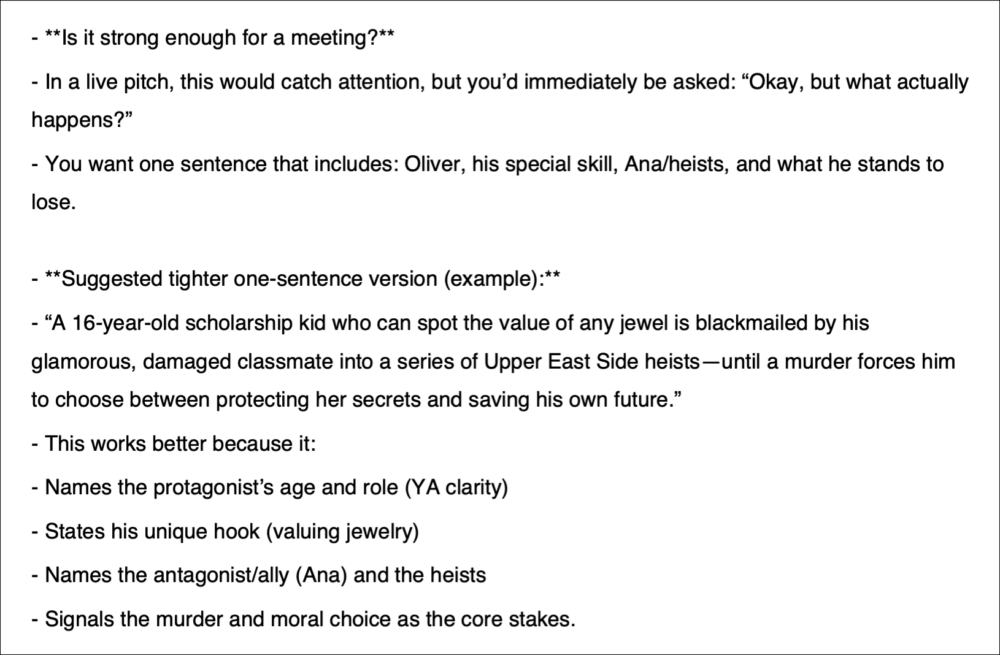
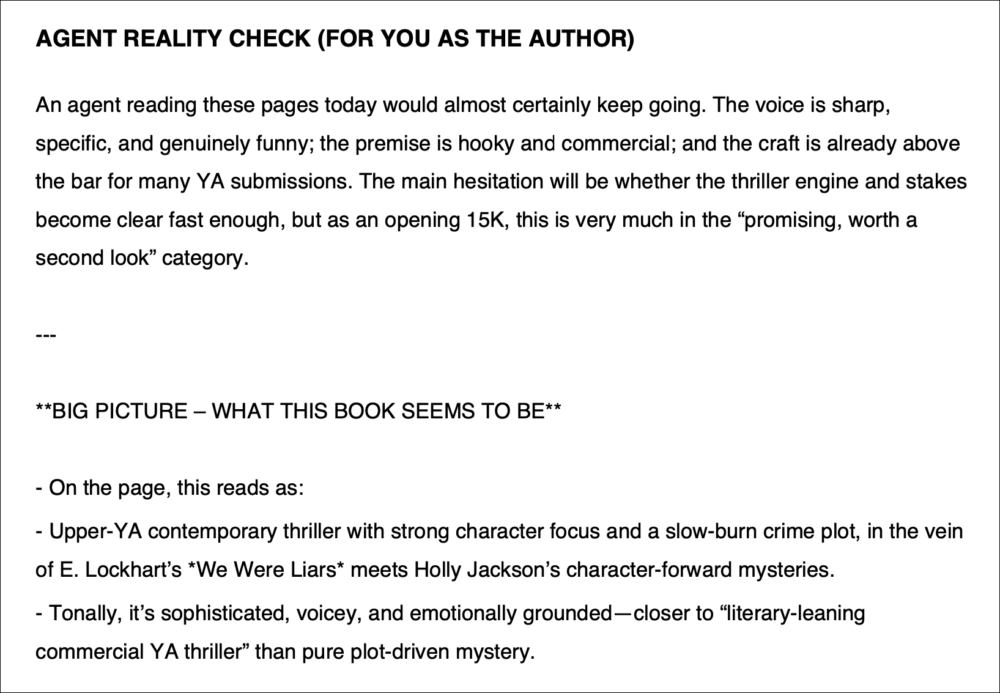
First, I tried an analysis of a polished novel query. Request the Full asks for your title, genre, the query, a one-sentence pitch/logline, and—to my surprise—also accepted up to 5,000 words of the manuscript. After a brisk 90 seconds, the system returned a six- to eight-page analysis with a downloadable PDF, opening with an overall “Agent Reality Check” summarizing the feedback and closing with whether this imaginary agent would request the manuscript. It agreed that my query was clear and focused but said I could make the stakes sharper in both query and pitch by naming the penalties the hero would face if he failed.
I resisted, clinging to my vibes-first pitch instead of spelling out the actual action of the book. But when I coach other authors on their pitches, I am indeed constantly asking But what happens? What is actually at stake?
I edited my query and tried twice more (which would have been another $15.99 each time). Both times, the engine proposed more specifics in the query. I did finally write a version of Request the Full’s suggested logline to use for future queries.
As an author, I’m struggling with whether my modern-day Oliver Twist retelling with a 16-year-old protagonist and sophisticated themes is YA or adult fiction. First, I included adult comparative titles and was told, “The package reads like YA in voice but is framed partly like adult upmarket. That can confuse agents about where to place it.”
I tried forcing the system toward literary fiction, comping to Ann Napolitano’s Little Women retelling, Hello Beautiful, and Barbara Kingsolver’s Dickensian Demon Copperhead (aspirational, I know!), but Request the Full was having none of that: “The pitch, comps, and ‘literary fiction’ label sit awkwardly between YA and adult,” and “the mismatch will give agents pause.”
Each time, the engine suggested additional comp titles to better align my manuscript with the market, and when I compared their suggestions to my actual pages, I had to concede: I’m writing YA.
Request the Full also noted that my opening pages were compelling but the second scene was slower, though the voice might keep readers going. I’m arrogant enough—and have received enough positive professional feedback—to think it will. A less-confident writer might just shorten the scene.
After three uploads of the same query with different comps and loglines, the feedback consistently identified the same strengths and weaknesses, similar to feedback I’ve had from literary agent friends and trusted fellow writers. Each report also included a suggested “single high-impact revision step” that boiled down to “make a choice about category and make it clearer; also, speed up the narrative.”
What about less-polished queries? I wondered what Request the Full would do with early-draft queries, like those I generally edit. Would this help an author without my publishing experience? I uploaded a query-that-wasn’t-a-query, an invented, rambling document with a bullet-point list of themes and the story lost in a voice-heavy paragraph about feelings. I added opening pages with a long scene about a character not mentioned in the query. Where Request the Full soared was in generating a list of steps to write a real query in accepted professional format. But the feedback felt overly kind, even laudatory, as it praised the voice and themes, and it seemed harder to pick out the criticism that would truly improve the pages. A human editor, on the other hand, would know that agent attention would flag on page two.
Next I tried the first-pages evaluation: Request the Full offers manuscript feedback on up to 15,000 words. I tested it with selections from two novels I’d written and one novel I’d edited, with permission from the author.
The six- to seven-page reports (my human editorial letters are between eight and 12 pages) identified overall strengths, character wants and stakes, pacing, sensitivity issues, and comp titles, and they provided a six-point “Revision Roadmap.” The reports included examples to illustrate revision suggestions and asked the type of questions about character motivation and plot points I’ve heard from agents in live pitching.
I found it accurately identified issues in the writing in all three books. Ironically, bringing me back to my original quandary about whether the book is YA or adult, one of the issues identified when I entered YA as the category was “agents will be checking: does this still feel like YA, not adult lit with teen characters?” Apparently, the pages could go either way. I’ll still need a conversation with a human agent or editor to solve this one.
Request the Full gives fairly high-level feedback, like “heavy exposition and ‘telling’ where scene and subtext would be more engaging,” with one example from the text. In my editorial letter for my client’s novel, I explained “show don’t tell” and how to use it; I also noted, among other specifics for the author’s revisions, sentences that summarized the details that followed and could be cut as well as overuse of elevated vocabulary.
Could standard AI tools do better? With a professional subscription to Claude, I asked for feedback in the same format:
Please analyze these opening pages of a manuscript. It’s [Genre] for fans of [Comp Authors]. You are an expert literary agent with experience in the [Genre] space and market trends.
I listed the same feedback categories from the Request the Full report, requesting a revision roadmap and a decision on whether this “agent” would request the full manuscript.
Claude reached similar conclusions on both books, and the revision roadmaps are complementary. Request the Full offered more on dramatic structure, market appropriateness, and suggested comps. Claude went deeper on specific character fixes and prose-level diagnosis. Of course, authors need to know how to frame their questions (or prompts) for general-purpose AI; the expertise of the person using the AI tool will affect the quality of response, the evaluation of that response (do you need to reprompt or redirect?), and the ability to revise based on the response.
Could a human publishing professional do better? I’ve had paid and free pitching opportunities and critiques, and I’ve hosted query bootcamps and pitch events where I’ve heard agent feedback for many authors. For pricing and speed, Request the Full wins, though you can book a live 10-minute consult with Manuscript Academy (among others) for as low as $49. While this engine is meant to help writers prepare submissions, not replace an agent, purchasing feedback from a person is one way to make a personal connection that can pay off later.
The AI engine is market-focused and morally neutral. My other novel included a school shooter, and years ago, I paid for a query critique. The agent responded angrily, having receiving my query at the time of a local-to-them tragedy. Understandable but not helpful. Request the Full pointed out content flags and listed thoughtful questions I should be sure to answer in both manuscript and query, including “Is the book ultimately condemning the act and interrogating the fantasy of revenge?” (Yes!) Claude also offered a “special note” on positioning this book carefully.
Bottom line: As with most AI engines, Request the Full includes plenty of praise. New authors may have trouble zeroing in on “you’ve got to fix this or your book won’t sell” buried under a heaping spoonful of sugar. Still, Request the Full’s feedback is specific, clear and immediate, and useful for an author refining their query, pitch, and pages. Authors who need feedback on a budget and want to know why their query or pages are getting rejections will find it a useful tool—as long as they dig for the critique beneath the praise.
Postscript from Jane: Meanwhile, agents plead with writers not to use AI for submissions
The Bookseller just published an article this week noting that more agents are adding stipulations to their submissions guidelines, asking writers not to use AI tools (or prohibiting its use entirely) because it makes query letters, proposals, and manuscripts worse, not better. One agent says, by using AI, “You may be missing an opportunity to secure representation by a reputable literary agency.” That is quite amusing, given the success rate of even the most polished, quality pitches. Other agents quoted in the article, who better grasp the situation writers are in, say they “recognise it’s not realistic to ban its use completely, particularly for writers who cannot access human feedback before submitting to agents.”
I too have seen AI’s flattening effect in my work with contributors and business partners, but I don’t think the solution is to make these proclamations and prohibitions. The solution is to simply reject anything that doesn’t meet editorial standards. If it’s bad, it’s bad. I can also imagine a future where those dealing with a high volume of submissions will use filters, powered by AI, to reject or set aside submissions that score high for AI-generated material—if such tools can keep up with the advancement of AI writing (a big if).
As part of these discussions, inevitably someone brings up copyright concerns as a reason for the prohibition: Purely AI-generated material cannot secure copyright protection under current copyright law in the US. That is becoming a red herring. If the industry is indeed serious about this concern, I’d like to see agents, editors, or publishers use best-in-class paid tools like Pangram to evaluate the probability of authors’ material having been generated by AI, then reject material or cancel books for AI use. Only then I will believe their copyright concerns. Even the biggest publishers have books on the market that have been AI assisted and received copyright protection. And let’s not forget the US Copyright Office did in fact say that AI-assisted material can be eligible for (limited) copyright protection, so this issue is complicated, and we shouldn’t pretend otherwise.
The biggest business reason for AI disclosure and transparency is this: The author, agent, editor, and publisher (and all other stakeholders) need to be on the same page about when and how AI is being used. But if disclosure leads to punishment or banishment, no one is going to disclose.
Readers respond
Author Fran Tabor responds: “So if you’re a beginner, AI is like your mom reading your ‘perfect’ manuscript that just needs ‘a few tweaks,’ but if you’re a skilled writer AI is more like a professor pointing out the details you should have caught but perhaps thought your manuscript and query were the exception—the voice of reason you’re better off listening to. It’s up to you to know which category you are in. Is abundant praise really an insult or a reward for a job well done? Tempted to try it.”

Allison K Williams has edited and coached writers to publication with many of the best-known outlets in media. As a memoirist, essayist, and travel journalist, Allison has written craft, culture and comedy for National Public Radio, CBC-Canada, the New York Times, and many more. She leads the Rebirth Your Book writing retreats series and, as Social Media Editor for Brevity, she inspires thousands of writers with weekly blogs on craft and the writing life. Allison holds an MFA in Creative Writing from Western Michigan University and spent 20 years as a circus aerialist and acrobat before writing and editing full-time. Her latest book is Seven Drafts: Self-Edit Like a Pro From Blank Page to Book (Woodhall Press, 2021). Learn more at her website.