

Just about every writer would love to have more readers—more readers of their books, their blog, their articles, or whatever creative work they’re producing.
But few writers have given much thought to having a call to action that’s associated with their work. “Call to action” is a marketing term that refers to the one thing you’d like someone to do if they’ve enjoyed or otherwise been affected by your work.
Writers are often the most guilty of magical thinking that goes something like this: My work speaks for itself, and if it’s good enough, then wonderful things will happen.
Well, sometimes your work does speak for itself, but it may not spur any action. Or, if it does spur action, people may not take the action you’d most prefer.
So with every piece you plan to write, it’s helpful to first think through: What would I like to see happen as a result of publishing this piece? What would I like to see the most engaged readers do?
Sometimes your goal is to generate interest in your books (especially around the time of a book launch), or maybe you’re hoping that people will follow you on social media or sign up for your email newsletter. The purpose of this post that you’re reading now is to bring awareness and visibility to my upcoming course on online writing.
The call to action for each piece you write may be different, and it tends to change depending on your current projects or initiatives. Don’t try to determine your call to action based on what other people are doing; it only makes sense when you base it on either your own short-term or long-term goals.
While online articles, interviews, and blog posts are very commonly associated with a call to action, they can appear in a lot of other places, including:
- The homepage of your website
- In your bio note on social media
- In your email signature
- At the beginning or end of your book
Here’s an example of a call to action that’s included in a bio note by Kirsten Oliphant:
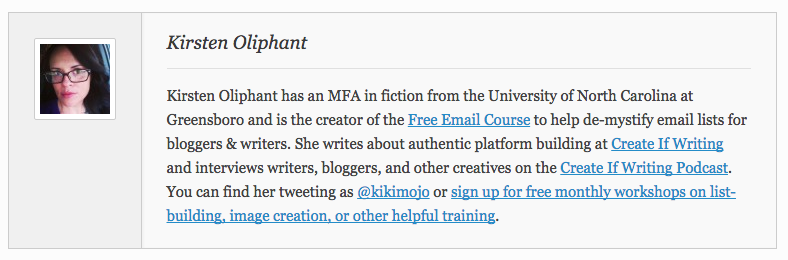
Here’s an example of a soft call to action in a Twitter bio—the link goes to a newsletter sign up.

Here’s an example of a call to action on a homepage at School of Book by David Moldawer:

Don’t be shy about including calls to action alongside or at the end of your work. They’re the most beneficial when you already have someone’s attention, and they’re most interested in either more great stuff from you, or staying up to date on your new stuff.

Jane Friedman has spent her entire career working in the publishing industry, with a focus on business reporting and author education. Established in 2015, her newsletter The Bottom Line provides nuanced market intelligence to thousands of authors and industry professionals; in 2023, she was named Publishing Commentator of the Year by Digital Book World.
Jane’s expertise regularly features in major media outlets such as The New York Times, The Atlantic, NPR, The Today Show, Wired, The Guardian, Fox News, and BBC. Her book, The Business of Being a Writer, Second Edition (The University of Chicago Press), is used as a classroom text by many writing and publishing degree programs. She reaches thousands through speaking engagements and workshops at diverse venues worldwide, including NYU’s Advanced Publishing Institute, Frankfurt Book Fair, and numerous MFA programs.




[…] view post at https://janefriedman.com/call-to-action/ […]