As exponential growth in audio inevitably slows, publishers will have to vie for market share with other content providers and services
While there’s no question that audiobooks remain an area of growth and opportunity for all publishers, the last two years have seen a slowdown in percentage growth, according to the latest figures from the US-based Audio Publishers Association.
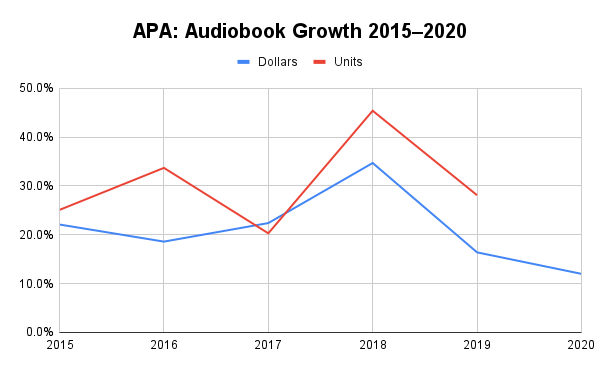
This is inevitable on some level: as the format grows from a small base, the percentage increases won’t be as impressive as before. However, it’s curious that—in the latest round of figures from the APA—much less information has been shared when compared to prior years. From 2015 to 2019, the APA released sales growth on an annual basis in both dollars and units, plus sales breakdowns across format and genre and sales by target age. When we asked APA’s executive director, Michele Cobb, for growth of sales in units in 2020 (to complete our chart above), she said the organization doesn’t have them for this year.
Regardless, the message from the APA (and others) is that we remain in a great business environment for audio. During a Book Industry Study Group presentation on June 1, Cobb discussed current trends and the latest figures that she can share.
- 2020 saw the largest increase since 2015 in audiobook titles published, with 71,502 audiobook titles released. Despite the pandemic, audiobook recording was not disrupted, as many narrators have a home studio or could find a way to continue work.
- The amount of adults in the US who are listening continues to inch higher. It now stands at 46 percent, up from 44 percent last year. But the biggest increase came among younger audiences. In 2021, nearly half of parents say their children (17 and younger) listen to audiobooks, up from 35 percent in 2020.
- Membership to audiobook services increased, with 38 percent of listeners subscribing to at least one service (e.g., Audible or Scribd in the US). You might recall that when audiobook distributor Findaway Voices released their annual figures, a big increase was seen in subscriptions as well. Cobb confirmed that more and more people are coming to subscriptions, whether on a credit model (like Audible), which is prevalent in the US, or unlimited (like Storytel). While she said it’s hard for publishers to go into an unlimited model, it’s a model that’s breaking into markets worldwide, and it’s hard not to envision more of it in the US. More on this in a bit.
Also in the great-news department: audiobook consumption grew more than podcasts during the pandemic. On May 20, Bookwire (a German-based digital book distributor that just launched in the US) held a one-day virtual conference, All About Audio, with multiple speakers and presentations on trends. Mark Mulligan of MIDiA Research said that during the second half of 2020, audiobooks had a 49 percent increase in consumer time spent, while podcasts saw a 35 percent increase. “This surprised me,” Mulligan said. “I sent [the report] back because I thought it was an error.” But it wasn’t. In addition, radio listeners have been adopting new spoken word formats at the expense of all other audio consumption. But 2020 was an unusual time. Won’t people go back to old habits eventually? Mulligan doesn’t think so. He believes people will spend time listening to an audiobook on a commute rather than a streaming music playlist.
There’s greater symbiosis now between audiobooks and podcasts. Cobb pointed to Spotify and Amazon Music bringing in podcasts and audiobooks to their services. (Note that Spotify, which started as a music streaming service, has in a short amount of time become the most widely used platform for podcasts, beating out Apple, said Mulligan.) Increasingly, the difference between audiobooks and podcasts is purely about the business model. Audiobooks are generally sold through a subscription or à la carte purchase, while most podcasts are ad supported. However, major changes have been transforming the podcast arena, where Spotify and Apple now offer paid subscriptions. Cobb said, “I think we’re going to see those models come together a bit more.” But if those models do come together, does that mean we’re all eventually moving toward an unlimited, paid subscription model?
Big houses like Penguin Random House continue to resist unlimited subscription models. And it’s easy to understand why: subscription models don’t pay as much as à la carte sales or credit systems such as Audible. For now, to the great fortune of publishers, audiobook sales have been additive: people who read books are listening to some to expand their reading capacity. The print market and audiobook market have continued to be robust; people buy both formats and go back and forth. Publishers are eager to keep this dynamic going for as long as possible.
During a Bookwire panel, Carmen Ospina, a marketing director at PRH, said, “We believe that the economics of unlimited access models are not good for the entire ecosystem because they reduce the overall revenue and the profitability for our authors and our agents.” She explained they made this decision based on studies and research across many territories, even looking at Nordic markets, where subscription services make up more than half of sales and revenue. At the end of the day, PRH concluded that staying out of sub models was the only way to preserve the value of their content.
In great contrast, Audible decided to launch in Spain in October 2020 using an unlimited subscription model. During that same Bookwire panel, Juan Baixeras, the country manager of Spain at Audible, was asked why Audible made that move when it works on the credit system elsewhere. Baixeras said, “This model is a success. We are one of many [services], and we think that offer is the correct offer for the Spanish audience.” So far they have 3 million hours of listening, with growth of 31 percent month by month since launch.
Current trends in audiobooks include:
- Mysteries, thrillers, and suspense continue to be the most popular genres. Thirty-one percent of audiobook consumers listen to these genres the most. Second most popular: history/biography/memoir (14 percent) and science fiction and fantasy (9 percent). Cobb pointed out that the top categories haven’t changed in years. People like SFF because such books tend to be long, and anyone using the credit model tends to prefer them for the value. This is why children’s titles tend to struggle in a credit system.
- There’s an increase in original works and adaptations in audio. These may or may not be based on a printed work. Cobb pointed to the example of Hey, Kiddo, first published as a graphic novel. “Twenty years ago, I don’t think anyone would’ve converted that into the audiobook format,” she said. The audiobook uses sound effects, music, and interstitial narration. “We’re seeing more and more of that,” Cobb said, where publishers will consider works such as original plays, musicals, or very short works—because audiobooks continue to grow as a format, with an increase in different business models.
- There’s growth in world language audiobooks. Spanish in particular is growing very quickly, with many audiobooks coming from US publishers who are publishing in Spanish. Cobb also mentioned Storytel as a driver of growth, as they’re opening audiobook markets all over the world. A critical piece of their success is having audiobooks that fit the local and regional market, with local authors and titles available in the local language.
The future may see increased use of AI recording. Cobb says companies that record books using AI have become members of the APA, although they’re not likely to displace human talent anytime soon. Publishers still find that a human actor gives the audiobook performance a touch of something they cannot get from a machine. Even so, Cobb says, “As with anything, you have to keep your eyes on technology.”
Google in particular has been working on a tool to help publishers grow their audiobook catalog with the push of a button using high-quality auto-narration. While it’s not meant to be a replacement for human narration, it could fit backlist titles that would not otherwise be cost-effective to produce. Google’s tool can generate auto-narration in one to two hours, and 70 percent of consumers who tried Google’s AI-narrated audiobooks were satisfied with the quality. (In fact, some didn’t realize they were listening to a synthesized voice. Listen yourself and decide.)
While Google’s tool is in beta, publishers can create an unlimited number of audiobooks for free and sell the auto-narrated audiobooks directly on Google Play and/or download the files to sell elsewhere. Right now, they support English-language only, and the ebook must be in EPUB format. (If you’re a publisher that wants access, fill out this form.)
Bottom line: For publishers, the biggest challenge is likely establishing a coherent yet flexible long-term strategy around the many different opportunities available to publish and expand further into audio. It’s no longer just about having an audiobook edition of a new print book. There are decisions to be made about how much to invest in that audiobook edition (one narrator or full cast?), whether it should be licensed out to another company, if it’s exclusive to a particular platform, and soon whether it merits human narration over AI narration. Some works might come out in audio first or launch as a podcast first as part of the marketing. There are more paths than ever before, with more platforms and experimentation on the way for monetizing audio. Publishers will likely have to broaden their horizons and experiment to remain competitive, especially as companies like Spotify, Apple, Amazon, and others aggressively invest in the market.

Jane Friedman has spent her entire career working in the publishing industry, with a focus on business reporting and author education. Established in 2015, her newsletter The Bottom Line provides nuanced market intelligence to thousands of authors and industry professionals; in 2023, she was named Publishing Commentator of the Year by Digital Book World.
Jane’s expertise regularly features in major media outlets such as The New York Times, The Atlantic, NPR, The Today Show, Wired, The Guardian, Fox News, and BBC. Her book, The Business of Being a Writer, Second Edition (The University of Chicago Press), is used as a classroom text by many writing and publishing degree programs. She reaches thousands through speaking engagements and workshops at diverse venues worldwide, including NYU’s Advanced Publishing Institute, Frankfurt Book Fair, and numerous MFA programs.