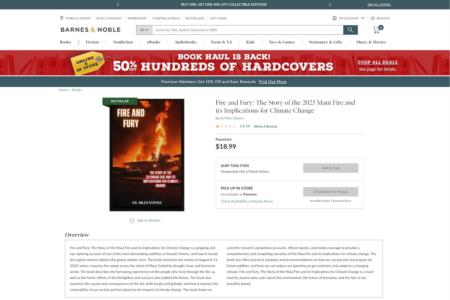
It’s a new rite of passage these days for nonfiction authors, especially memoirists, to find AI-generated copycats of their book on Amazon—sometimes even prior to publication date. Recently I was on News Nation with Leland Vittert to discuss the 15+ copycats of his memoir that were available on Amazon at the time we recorded the segment. (Those copycats have since been taken down, for the most part.)
So when I saw this new policy from Spotify about AI-generated content, I found myself hoping beyond all hope that Amazon would perhaps see the wisdom in following the same playbook.
Spotify is not anti-AI, but they see the harm caused by letting AI-generated content run rampant on their platform. In a statement, they said: “AI can be used by bad actors and content farms to confuse or deceive listeners, push ‘slop’ into the ecosystem, and interfere with authentic artists working to build their careers. That kind of harmful AI content degrades the user experience for listeners and often attempts to divert royalties to bad actors. The future of the music industry is being written, and we believe that aggressively protecting against the worst parts of Gen AI is essential to enabling its potential for artists and producers.”
Here’s what Spotify has done so far:
- They’ve deleted more than 75 million spammy tracks in the last year.
- They’ve introduced a new impersonation policy that prohibits unauthorized voice clones, deep fakes, and any form of impersonation. They’re also trying to prevent “content mismatches”—fraudsters trying to get their work to appear in another artist’s profile.
- They will combat accounts that engage in mass uploads, excessive duplication, manipulative metadata and SEO, and short tracks.
- They’re supporting a new industry standard for AI disclosures in music credits.
Like Spotify, Amazon could do something to prevent copycats and AI slop. Instead, it continues to demonstrate a profound lack of care.

Jane Friedman has spent her entire career working in the publishing industry, with a focus on business reporting and author education. Established in 2015, her newsletter The Bottom Line provides nuanced market intelligence to thousands of authors and industry professionals; in 2023, she was named Publishing Commentator of the Year by Digital Book World.
Jane’s expertise regularly features in major media outlets such as The New York Times, The Atlantic, NPR, The Today Show, Wired, The Guardian, Fox News, and BBC. Her book, The Business of Being a Writer, Second Edition (The University of Chicago Press), is used as a classroom text by many writing and publishing degree programs. She reaches thousands through speaking engagements and workshops at diverse venues worldwide, including NYU’s Advanced Publishing Institute, Frankfurt Book Fair, and numerous MFA programs.