The buy box has become prime real estate on the Amazon selling platform. Here’s when and how to wrest the territory back from a third-party seller.
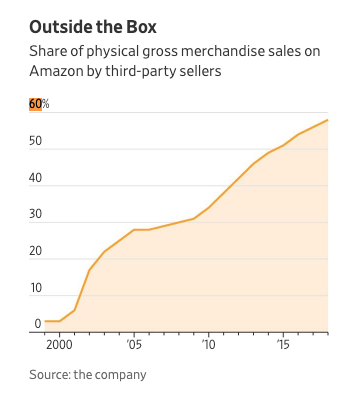
As most authors are only too aware, Amazon has long been open to competing third-party sellers (TPS), who sell through Amazon but ship independently. Collectively, the third-party selling space is known as the Amazon Marketplace, and its percentage of site sales has steadily increased in the last decade to 60 percent. The Wall Street Journal recently reported (subscription required) on this phenomenon, casting TPS in a negative light and claiming that Amazon “has ceded control” and is “unable or unwilling to effectively police” them.
Until recently, the default seller for new books—the so-called winner of the buy box—was always Amazon; the buy box could never be held by a TPS. All that changed in spring 2017, when Amazon decided to bring its policy for books in line with its existing policies for other merchandise and allow TPS to become the default seller for new and used books alike.
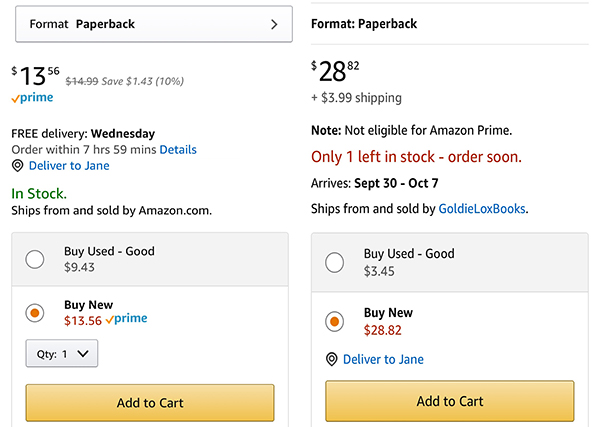
At the time, the new policy kicked up a firestorm of complaint in the publishing community but also led to a healthy tightening of publishers’ own sales policies—particularly as they relate to advance review copies, hurts, and remainders—and tighter controls on what books are sold as new on the Amazon platform. (We wrote about these changes in May 2017.)
Now, more than two years after the policy change, we’re starting to measure and observe the long-term effects of third-party sellers on the publishing industry. At Digital Book World, Joshua Tallent from Firebrand said that in their tracking of 40,000 titles from more than 50 publishers: (1) TPS won the Amazon buy box on 50 percent of those titles at least once, and (2) TPS win the buy box only about 15 percent of the time on average. Firebrand’s research also shows that the top 30 TPS make up half of the buy-box wins. The average sale price offered by Amazon is 26 percent off list; the average discount offered by TPS is 34 percent off list. However, based on Firebrand’s research, when a TPS takes the buy box, a product’s sales ranking drops regardless of what the sale price is.
We followed up with Tallent separately to ask him about how much this effect should concern authors and publishers. He told us, “You’ve got to watch, be careful, pay attention to who’s taking it, look carefully at who they are. In some cases, these are very large companies. In some cases it’s some guy who bought it used or got a free copy. There’s a lot of ways that people get these things.”
In a separate DBW presentation by LSC Communications (a commercial printer), the presenters relayed their finding that buy boxes could be lost as a result of easily corrected problems. In a study of 1,000 titles for which Amazon (i.e., the publisher) lost the buy box, LSC found that 125 had incorrect pricing in their metadata on Amazon (in other words, bad metadata had entered the system somehow), while the metadata for other books that lost the buy box indicated they were unavailable for sale.
Ian Lamont, who runs i30 Media, told us that his biggest problem is with third-party sellers who pass off used copies as new. “They are all third-party sellers concentrating on the book market, as opposed to libraries or individuals. They price aggressively and claim ‘new’ status to win the buy box. When I see [i30 Media books listed by third-party sellers as new], I order them to verify the condition and make sure they aren’t pirated. Invariably they are used, and obviously so—one seller even sent a shrink-wrapped book with a giant USED sticker on it. Others send books with damaged covers.”
At Digital Book World, we spoke to an industry insider about the effects of losing the buy box and if the negative repercussions are significant enough to invest in solutions. Unless it’s a case of a TPS who is a bad actor (e.g., selling used copies as new, producing counterfeits, or creating duplicate product pages to deliberately confuse customers), our insider said that buy-box changes can be mercurial and may not lead to meaningful lost sales for publishers. In fact, some TPS are independent booksellers who stay afloat through Amazon marketplace sales and acquire their stock legitimately through established sources like Ingram. (Third-party sellers, if selling new books through Amazon, can be asked to document how those new copies were acquired.) As a side note, we’ll add that companies like LSC and Firebrand sell publishers services focused on loss prevention—battling piracy, identifying counterfeit copies, analyzing third-party sellers and the buy box, and so on. These can be valuable services that provide useful insights and help publishers be proactive rather than reactive. Still, stats can be made to look overly concerning, especially if they’re offered without any sales context.
Publishers of educational and technical materials likely have the most cause for concern. Lamont said, “Publishers or sellers who have products that are easy or cheap to copy and have high list prices have the most to lose with the Amazon buy-box policy. … I can totally see why some publishers would pay for someone to monitor their listings, especially if they have experienced piracy. I pay an independent contractor to help me monitor my own listings, but I am more concerned with third-party sellers selling used books as new. … [It’s] against Amazon TOS. However, despite repeatedly reporting such third-party sellers to Amazon, I have not received any indication that Amazon took any action.” In fact, Lamont said, the offending TPS is still selling books—and racking up impressively high negative reviews.
Bottom line: Both authors and publishers must ask how much it’s worth micro-managing the buy box, especially in areas where a book’s price point is low (reducing risk) and where TPS activity appears legitimate. One’s time and effort may be most productively applied to best practices of marketing and promotion, including quality metadata. Updating books’ metadata and keeping it fresh and relevant can help a publisher or author maintain hold of the buy box. Either way, Lamont says that Amazon’s inaction in going after bad actors makes it “clear that publishers are on the losing end of this fight. Pirates and sellers know it, too. … Even if dozens of your customers are complaining, you can still stay in business on Amazon.” Adding insult to injury, brand or trademark owners who register with Amazon Brand Registry must pay Amazon if they want proactive counterfeit protection. In other words, Lamont pointed out, manufacturers (including authors and publishers) must pay for Amazon’s failure to police their own marketplace.

Jane Friedman has spent her entire career working in the publishing industry, with a focus on business reporting and author education. Established in 2015, her newsletter The Bottom Line provides nuanced market intelligence to thousands of authors and industry professionals; in 2023, she was named Publishing Commentator of the Year by Digital Book World.
Jane’s expertise regularly features in major media outlets such as The New York Times, The Atlantic, NPR, The Today Show, Wired, The Guardian, Fox News, and BBC. Her book, The Business of Being a Writer, Second Edition (The University of Chicago Press), is used as a classroom text by many writing and publishing degree programs. She reaches thousands through speaking engagements and workshops at diverse venues worldwide, including NYU’s Advanced Publishing Institute, Frankfurt Book Fair, and numerous MFA programs.