
Today’s guest post is by Lacy Phillips, Digital and Social Media Coordinator for P.S. Literary Agency.
More focus on e-commerce, less on linking
Expect continued expansion of on-platform conversion (that is, buying things on social media) with even more platforms implementing integrated e-commerce tools. External links are continuing to be less viable on social with some platforms beginning to implement pay-to-post fees.
I wish the publishing world would get more involved in the direct-to-consumer fulfillment opportunities presented by these platform-owned commerce tools (e.g., TikTok Shop), and update distribution models and tracking to the modern age.
User-tuned feeds
Expect expansion of user-tuned feeds with the rollout of interest categories on multiple platforms that allow users the ability to customize their algorithms.
This is both good and bad news for discoverability. For extremely niche creators, this is supposed to be good for long-term retention, but it’s a mixed blessing for cross-pollination of audiences and gaining new readers. My recommendation for authors and other niche professionals: post about all of your interests, as your holistic selves, to capture people who might not otherwise see into bookish and author spaces. Don’t just talk about your work; join conversations about your interests and hobbies. I personally know someone who only knows John Scalzi as the guy who posts about his insane burritos. Will they eventually read one of his books? Maybe!
Decreased use of hashtags
Instagram announced that hashtags will be limited to just 5 per post, down from a max of 30. Keywords are more than sufficient for today’s algorithms. If you’ve been relying on a hashtag strategy to expand your audience, now is the time to learn the value of loading your communications with keywords (spoken on video or in written posts or captions).
Here’s an easy hack to get you started: Always use alt text for image-based posts and load that alt text with keywords, like in the old days of metadata SEO hacking. For example, instead of your alt text reading “the image is of a book sitting on a tabletop next to a mug of coffee,” try something with a lot more specificity, like “the image shows the young adult dystopian novel The Hunger Games sitting on a tabletop next to a mug of coffee.”
Pinterest gains momentum
The platform recovered from its disastrous implementation of an AI-driven moderation bot to claim a top spot in growth metrics for brands with physical products to offer. In particular, it’s an external links juggernaut, rare in the landscape these days.
Do books sell on Pinterest? There are case studies that say yes! Loading album names with keywords seems to be a winning strategy. Uploading a pin gives you the opportunity to use the product link tools and fill in a keyword-heavy description that will help with discoverability while generating a pin from an external link will use the metadata from the linked publisher’s or bookseller’s page.
For a deep dive, see Jane’s recent free class on Pinterest with author Melissa Bourbon.
More longform video
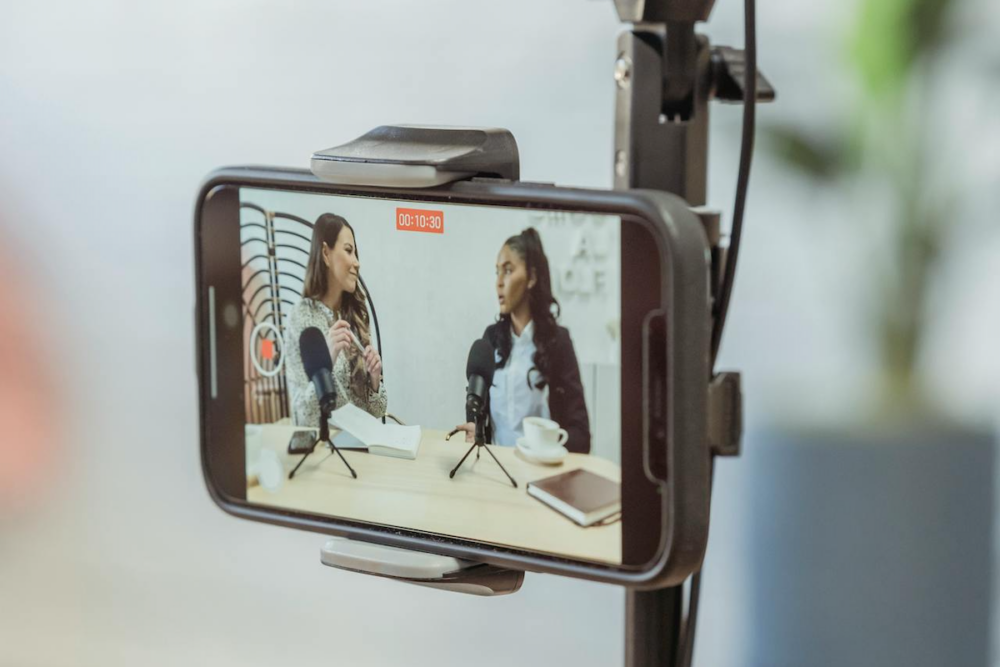
TikTok has already rolled out 10-minute videos and there’s a pilot program that allows some creators to upload 60-minute videos.
While short-form video is still king, this is a direction that the infinite scroll vertical video platforms are leveraging to combat “scroll fatigue” and keep their creators from expanding onto YouTube. If you’re a yapper, this is your time to shine!
YouTube picks up speed
I don’t have a stat to point to specifically, but my instincts are telling me that the decline of streaming platforms due to increased fees and the amount of competition in that sector is driving some of the expansion of long-form video and YouTube in particular. Storytellers are poised to be big winners here. Also notable: YouTube’s CEO was named Time’s CEO of the Year.
Digital avatars decline
Bad news for Vtubers, GIFtubers, and voiceover creators, but real faces are in high demand. Also of note, the Metaverse is no more after Meta pulled the plug on the entire project, taking an astronomical loss on the investment they’d put in to make it happen.
The Metaverse was an example of a solution looking for a problem to solve. Nobody wanted it, and now it’s gone. Let’s hope this also happens with the AI tools being shoehorned into every online space. Also, anecdotally, I saw one creator’s audience abandon them after they invested in a set of really obvious veneers that affected their ability to clearly annunciate. When all your audience knows about you is your authentic face and voice, then both of those things change suddenly to become more artificial, it can be very off-putting.
Declining popularity of LinkedIn
LinkedIn was out front on the integration of AI LLM tools, and it has suffered. Turns out nobody wants to read an infinite scroll of copy-paste, LLM-generated hustle culture screeds. Also, the rollout of LinkedIn Video was one of the biggest duds I’ve seen from a major feature implementation. Nobody used it because the user base they’d been cultivating was highly dependent on being spoon fed LLM output text-based posts, and those users either couldn’t (because they were bots to begin with) or wouldn’t (because video takes more effort) pivot to video.
More polls and carousels
Polls and carousels are over-performing on multiple platforms. It’s hard to know what to make of this. Perhaps algorithms have become more savvy about rewarding time spent parked on a post passively taking in information over the “engagement is king” reach drivers of the recent past.
Quality over quantity (always)
Audiences reward creators who go deeper than surface level. Prioritize depth over frequency. The days of posting just anything 10 times a day to gain traction are in the past. Get with the “only speak when you have something to say” program.
Stronger regulations on social media use
There will be fallout from Australia’s ban of under-16s on all social media. This could herald a new wave of governments having the will and popular support to impose stronger regulations on social media platforms. There could very well be more huge changes like forced sales or industry-disrupting regulations; the era of allowing social media platforms to conduct unchecked social experiments may be coming to an end in some regions of the world. I wouldn’t be surprised to see proposals that treat social media platforms more like public utilities, and increased protections for minors going into effect in countries with functional regulatory bodies. What does this all mean for authors and publishers? Volatility that could reduce reach and conversions for any social media strategy. Don’t become over-reliant on any one platform, and focus on owned media as much as possible.
Search on social expands
Searching for things on social media is not just for Gen Z anymore.
Google is less useful now than ever before, so when people are looking for answers, they’re using the search features on social media platforms instead of browsers. I had a hit tweet back in the day that I could use to predict rises in COVID cases because it would start getting traction cyclically when people were using Twitter search instead of Googling their symptoms.
If you have good keywords in a post, expect it to be indexed and pushed by the algorithm when users search that keyword. Pay attention to search sources in your insights or look up what’s trending (SEMrush, TikTok Business Insights, the Explore or Discover pages on different platforms) and create content geared toward those popular searches.
Influencer economy downturn
The influencer economy is crashing. Even the chronically online are fatigued by disingenuous sales pitches, but this is becoming an opportunity for experts with personal brands.
There’s an obvious avenue of growth for nonfiction authors here, but there are ways that fiction writers can leverage the popularity of experts with dedicated audiences online. Write a book where one of the characters is a nurse? Find a nurse micro-influencer and ask them to tell you what you got wrong and what you got right about the realities of their job. They’ve already captured an audience interested in nursing and a portion of them could already be readers. What’s more exciting, though, is the potential to reach non-readers and get them to pick up a book that includes one of their interests.

Lacy Phillips is a brand manager and content creator with 25 years of experience working in publishing, print marketing, and new media. She has partnered with more than 40 nonprofits and mission-driven organizations to help them grow engaged communities and amplify work that matters. She currently serves as the Digital and Social Media Coordinator for P.S. Literary Agency.
Lacy has shared her expertise in social media strategy and brand voice development with Scribophile and Writing Day Workshops, and has served as a guest moderator and panelist for WriteHive. She is also an organizer and regular contributor to Virtual JaneCon, an online celebration of Jane Austen, her work, and her readers.



SO useful. Thank you!!
Three things I wholeheartedly agree with: 1) digital avatar decline (I just advised a fellow author the same thing – “stop with the AI-generated sales videos” on Facebook, 2) declining popularity of LinkedIn: I’ve been on there for years and have noticed this in the past year. I’ve stopped spending time there because I’m so tired of the obsession with AI articles and nothing else of substance, 3) “only post when you have something to say.” OMG, thank you for this. How many Substack experts tell us to “post Notes two, three times a day or you’ll never gain any traction here.” First, do these people have a life? Who has time to do this, and who has something meaningful to say that often? I want to be successful here and build an audience, but if I’m putting out forced drivel to do it…
Great article, thank you. I’m not on some of the other platforms you mentioned so I can’t comment on Instagram, TikTok, YouTube…although thinking about that last one.
Hi Gail, your point 3 above really hit home for me also. I’ve just started on Substack and cannot believe the endless streams of cutesy Notes people produce. I suppose they are just trying to be noticed in the swarming ocean. But I’m more interested — much more interested — in what they actually write. And I rarely get to see that for all these pithy little quotes and so on. I’m just serializing my actual books there and limiting notes to a few that point to the episode posts. Successful or not, that’s a workable approach for me.
This is a useful overview of industry trends and I appreciate that you have given tips that are actionable. Thank you.
Great post – thank you!
What a great post. So much useful info. But I still find myself feeling like I just can’t keep up with the changes. so I keep doing what I’m doing to the best of my ability and hoping for the best.
Great post! A lot resonated with me. Thank you. I might have to log back into my Pinterest account and start posting again.
Always such great information to mull over and implement into my efforts. Thank you. Cheers to all of us as we continue into this Wild West that is modern-day publishing.
I love to play the games on LinkedIn and my posts over there get better engagement than what I put out on IG or FB combined! So I think I’ll stick with it for now. 😀
Very interesting and useful!
Fantastic article with so much practical knowledge I can use, both as an author and a fiction book coach. Thank you!