These services aim to enhance discoverability among industry insiders, but they aren’t a one-stop shop for independent authors seeking exposure
Editors and marketers at traditional publishers—or those performing gatekeeping roles as bookseller, librarian, or reviewer—are intimately familiar with NetGalley and Edelweiss+. Both services offer early looks at books about to release, with NetGalley focused on providing and distributing advance review copies in digital form. Yet the use and value of either service can be somewhat opaque to the average author, especially one who self-publishes. Authors interested in marketing to industry insiders should know how these tools get used—and they’re also worth a look for anyone wishing to stay on top of new releases.
NetGalley is familiar to most authors, since the service actively markets and sells subscription packages to both publishers and authors. In a nutshell, authors pay to make their books available for review and distribution to reviewers and industry insiders—people the site calls “professional readers.” According to the site’s media kit, the NetGalley community consists of about 450,000 members: 65 percent reviewers, 13 percent educators, 9 percent media, 9 percent librarians, and 4 percent booksellers. It is free to become a member.
Just about every publisher of size uses NetGalley in some way to facilitate digital review copy release. However, publishers don’t make every title available, and publishers can be selective in whom they approve to receive an ARC. Furthermore, titles marked as private aren’t visible to NetGalley members unless they’re invited to read it. Finally, most ARCs can be requested only for a select period of time.
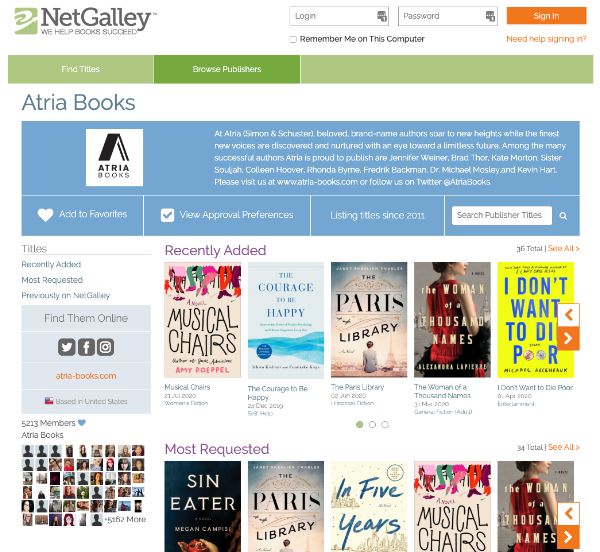
If independent authors want to participate, NetGalley’s cost is $450 for one title for six months. For about double that price, you can get a mention of your title in the NetGalley newsletter. (There is also a subscription option, but it makes sense only for authors and small publishers releasing at least eight or 10 titles per year.) While NetGalley does have a large membership, keep in mind that simply listing a title there doesn’t result in reviews. The listing must be complemented with other promotional activities to drive traffic to the title on NetGalley; NetGalley also offers paid marketing programs. Finally, successful use is mostly tied to pre-release marketing campaigns. While it’s possible to list a title on NetGalley after publication, that’s not why most publishers or reviewers use the site.
NetGalley was recently in industry headlines for adding audio excerpts to its site. Members can browse excerpts online and stream them through an on-site player. NetGalley plans to introduce full audiobook files by summer 2020. Also note: NetGalley owns Bookish, the book recommendation website started by New York publishers. Consider Bookish the consumer-facing part of NetGalley, the sort of website where you can find a great book club pick. NetGalley appears to be edging more into direct-to-reader marketing.Launched in 2009, Edelweiss+ is a bit trickier to understand, since it serves multiple purposes with a goal of helping independent booksellers efficiently order and sell books. For the purposes of this item, we’ll focus on just one aspect: how Edelweiss+ helps booksellers discover not-yet-published titles. So far Edelweiss+ has 145,000 users, with 20,000 booksellers (2,700 “verified Barnes & Noble employees”); 18,000 librarians; 16,000 publishers, distributors and sales reps; 9,000 academics; 6,000 media or agency professionals; and 50,000 reviewers and book lovers. (Accounts for readers are free; anyone can sign up.)
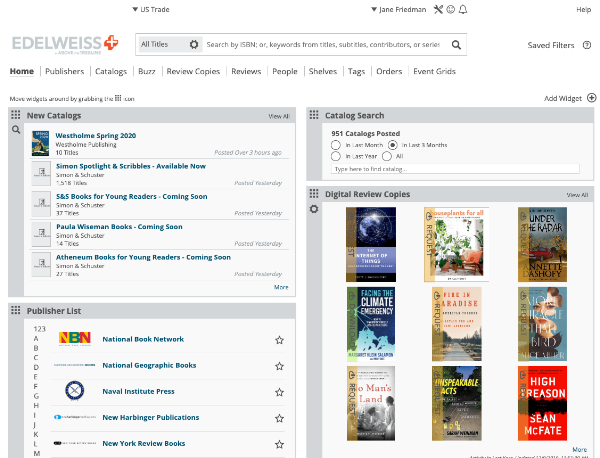
Edelweiss+ is rather like having all traditional publishers’ catalogs available in one place, through one interface, with a consistent and standard presentation, and all information up to date. (Publishers are responsible for uploading and maintaining their titles.) Booksellers can order through Edelweiss+ and communicate with publishers through the system rather than peruse a print catalogue.
Titles cannot be added to Edelweiss+ unless you are an approved publisher. That means self-published authors can’t add their titles to the system, although we know of one workaround: IndieReader, a paid book-review service, offers six months of placement on Edelweiss+ if you want to promote your digital review copy to that audience. It does require getting a paid review from IndieReader. As with NetGalley reviews, though, simply listing a title on Edelweiss+ doesn’t guarantee attention; it must be complemented with other pre-release marketing.
Edelweiss+ just announced a new tool for booksellers: direct-to-consumer email marketing. Those who pay for the Edelweiss+ suite of services can create a store-branded, personalized email to customers based on purchase behavior. So if you start receiving more direct marketing messages from your local bookseller in 2020, you can thank Edelweiss.Bottom line: Marketing through NetGalley and Edelweiss+ is mainly the province of traditional publishers and authors who don’t have to ask who should receive advance review copies. They make the most sense if you already have a list of media contacts, book reviewers, booksellers, librarians, or influencers. However, Edelweiss+ and NetGalley remain helpful resources for anyone researching the market and what titles are on the horizon. Marketing applications aside, it’s interesting to see how both services are offering more tools and opportunities to market and advertise directly to readers.

Jane Friedman has spent her entire career working in the publishing industry, with a focus on business reporting and author education. Established in 2015, her newsletter The Bottom Line provides nuanced market intelligence to thousands of authors and industry professionals; in 2023, she was named Publishing Commentator of the Year by Digital Book World.
Jane’s expertise regularly features in major media outlets such as The New York Times, The Atlantic, NPR, The Today Show, Wired, The Guardian, Fox News, and BBC. Her book, The Business of Being a Writer, Second Edition (The University of Chicago Press), is used as a classroom text by many writing and publishing degree programs. She reaches thousands through speaking engagements and workshops at diverse venues worldwide, including NYU’s Advanced Publishing Institute, Frankfurt Book Fair, and numerous MFA programs.