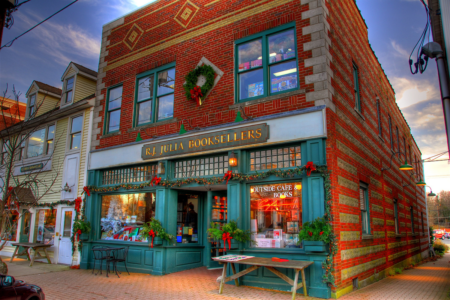
Over the last few years, one of the feel-good publishing stories has been the rise of the independent bookstore, in tandem with the staying power of print book sales. (This story remains somewhat unique to the United States, as this piece from the New York Times demonstrates.)
As well as independent stores have been doing—with memberships at the American Bookseller Association (ABA) up for seven straight years—they still face issues of long-term sustainability. Shelf Awareness, the email newsletter that serves the independent bookselling community, is running a series about the struggles some stores face with minimum wage increases happening across the country.
At a recent publishing conference, ABA CEO Oren Teicher said that the average profit margin of an independent bookstore is 2.4 percent. Therefore, even small changes in costs—such as wage or rent increases—can quickly make a store unprofitable.
To survive minimum wage increases, Shelf Awareness reported that booksellers in California are looking to add products with a better profit margin than books: “Books Inc. [in San Francisco] has increased its sales mix from about 2 percent in gifts to around 15 percent currently. [They] would highly recommend that any bookstore not selling gifts do so.”
Additionally, booksellers are hoping for better terms from publishers, which isn’t necessarily wishful thinking; earlier this year, HarperCollins launched the New Bookstore Development Program to support the opening of new independent bookstores or those expanding to new locations.
Bradley Graham, the co-owner of Politics & Prose, indicated to Shelf Awareness that, despite the recent optimism surrounding independent bookstores, they still face serious challenges, and “the industry is not necessarily on firm financial footing for the foreseeable future.” Bookstores must scrutinize every single expense; one store in New York figured out that by purchasing narrower ribbon, they could halve their gift-wrapping costs.
Bottom line: For ABA bookstores reporting to Nielsen, unit sales increases in 2016 have so far been 5 percent, compared to a 6.4 percent increase in all US print book sales. It’s not a great sign for the indie stores when their sales don’t keep pace with industry-wide increases, since this potentially indicates more market share for their biggest competitor, Amazon—which has already opened one physical bookstore location and plans to open several more. While independent bookstores have benefited from the “shop local” movement, better tech for store management and sales, and better terms from publishers, one has to be extremely optimistic to envision them growing in the face of a competitor like Amazon.

Jane Friedman has spent her entire career working in the publishing industry, with a focus on business reporting and author education. Established in 2015, her newsletter The Bottom Line provides nuanced market intelligence to thousands of authors and industry professionals; in 2023, she was named Publishing Commentator of the Year by Digital Book World.
Jane’s expertise regularly features in major media outlets such as The New York Times, The Atlantic, NPR, The Today Show, Wired, The Guardian, Fox News, and BBC. Her book, The Business of Being a Writer, Second Edition (The University of Chicago Press), is used as a classroom text by many writing and publishing degree programs. She reaches thousands through speaking engagements and workshops at diverse venues worldwide, including NYU’s Advanced Publishing Institute, Frankfurt Book Fair, and numerous MFA programs.