If I had to encapsulate the conflicting message at the heart of the All about Blockchain conference, it’s this: “NFTs just make sense! But we have to lower the barriers because customers are confused.”
Maybe it is true that NFTs are an inevitable part of our future in some metaverse where we live, work, and play (and are apparently obsessed with signaling our status). But that doesn’t negate the fact that your average internet user—and that includes anyone who considers themselves an early adopter—doesn’t own crypto and remains confused about NFTs. The most common Google searches for NFTs relate to the definition and meaning of NFTs, or how to create or buy one.

Conference speakers repeatedly emphasized the necessity of making it easier for the average person to purchase NFTs with fiat money (e.g., US dollars), since so few people own crypto or want to own crypto. (Currently, most NFTs are purchased with cryptocurrency.) The crypto market is volatile and doesn’t have the best reputation, not to mention the entire web 3.0 / crypto space has been subject to speculation and hype, with sites dedicated to ridiculing it. During the Q&A period, in response to a question about whether the market is overhyped, Dr. Teo Pham said, “It might turn out to be the biggest bubble ever. And maybe in 12 months nobody is going to talk about it anymore. But it might just be the new internet.”
What I see from authors is a great deal of hope—perhaps wishful thinking—that NFTs will solve intractable problems of the digital age. Indie author Joanna Penn said during her presentation that a better business model for writers is needed, as author incomes have eroded over time. She pointed specifically to (1) advertising costs, since visibility on Amazon can depend on paid ads and (2) general inflation, which is not helped by Amazon cutting royalties in half when self-publishing authors price an ebook above $9.99.
Penn argued that what’s great about NFTs is that they make it possible for people to “truly own assets” (ebook or audiobook files) and also resell them. “When the penny drops on resale, you’re going to be delighted,” she said. That does sound tempting. Today’s authors don’t see a dime from used book sales (although there is a limited scheme in the UK for print editions). And there is no mechanism at all for legally re-selling a digital book, much less a profit share for the author.
But as mentioned in the previous item, selling NFTs as a form of content (as a means of selling or granting access to an ebook or audiobook file) is poor use of the technology. Conference host Videl Bar-Kar of Bookwire said, “Content is not enough on its own to create all the value.” The fact that authors like the idea of earning a profit every time their ebook or audiobook is resold isn’t sufficient motivation for people to start buying their books in NFT form. As for Penn, she used generative AI to create art based on her books for her first NFT offerings, and that artwork comes with digital book files.
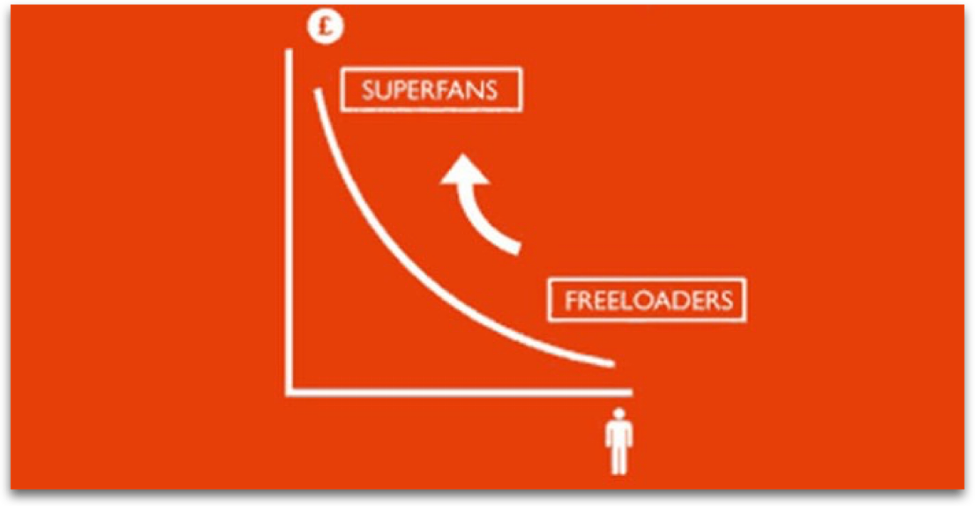
NFTs could be an attractive way for authors to cater to their most ardent fans. Penn’s larger point was that authors should think about NFTs as an opportunity to diversify their business model and add new revenue streams. I consider this filling out one’s demand curve (see below). On the far right of the curve are the free and cheap offerings that might initially attract readers. On the far left of the curve are the expensive offerings for super fans. NFTs, at least as discussed during the conference, were primarily seen as desirable for fans—people already invested in an author’s work.
This talk of diversification makes sense for authors who have well-established careers and spend time on business strategy. Pham noted optimistically that, in the future of NFTs and the metaverse, “Everyone can be an entrepreneur.” In my experience, this is not what authors enjoy hearing. If they’re honest, most authors prefer to earn a living, if they can, from their core activity of writing books, thank you very much—not from running communities, being on social, becoming an influencer, creating Patreon levels, or selling NFT special editions. How many of the “unlockables” that authors create will be meaningful or desirable to a fan? You can only know that by having a big enough readership, engaging with them, and asking them. It’s hard enough to get authors excited about social media or email newsletters for reader engagement—not even new technologies—which makes me wonder why so many appear excited by NFTs. Maybe because NFTs seem like salvation, a road to riches leading away from Amazon? If something seems too good to be true, it probably is. Either way, it’s clear that some authors misunderstand what NFTs are and what they represent. As of today, NFTs might play a role in your career if you have an established readership and you’re willing to invest in crypto. But so many authors I meet struggle to find their readers and have limited means of reaching them directly.
Finally, NFTs are experiencing a serious backlash, especially in the video game industry. There are legitimate concerns surrounding crypto and NFTs, such as gas fees (the fees involved in each and every transaction, which can be significant), the environmental cost of these technologies, and shifting crypto regulations. All speakers agreed that we are talking about a future that isn’t going to arrive for five, 10, or even 20 years. We won’t be getting rid of web 2.0 anytime soon, and every author needs to carry on with their usual publishing work.
Bottom line: Penn said authors stand to lose young book lovers by not giving them book NFTs to “flex.” The trend I see, though, is young book lovers flocking to physical bookstores to read and buy print books—to experience, if only for a moment, a pre-digital era. I see young people reading and recommending books to each other on BookTok, with print editions lovingly annotated. I see them reading and writing on mobile-first platforms like Webtoon, Wattpad, and Tapas. Of course these activities do not exclude a desire for NFTs, and by all means authors should experiment if they wish. But you won’t become irrelevant and your career won’t end if you ignore NFTs. I’m happy to let others see if a market exists and learn from their failures. Holtzbrinck’s Nastaly said, “You have to make sure that our current target group, which is not necessarily tech savvy, somehow is able to enter this space. Because if they don’t, we have to come up with more compelling use cases than just fandom. Because if these two spaces [crypto enthusiasts and book/reading enthusiasts] do not overlap, then fandom is not a solution.”

Jane Friedman has spent her entire career working in the publishing industry, with a focus on business reporting and author education. Established in 2015, her newsletter The Bottom Line provides nuanced market intelligence to thousands of authors and industry professionals; in 2023, she was named Publishing Commentator of the Year by Digital Book World.
Jane’s expertise regularly features in major media outlets such as The New York Times, The Atlantic, NPR, The Today Show, Wired, The Guardian, Fox News, and BBC. Her book, The Business of Being a Writer, Second Edition (The University of Chicago Press), is used as a classroom text by many writing and publishing degree programs. She reaches thousands through speaking engagements and workshops at diverse venues worldwide, including NYU’s Advanced Publishing Institute, Frankfurt Book Fair, and numerous MFA programs.