On a regular basis, the Authors Guild surveys its membership to ask incredibly detailed questions about writing and money. The results of these surveys seem preordained to deliver unfortunate news about the inconsequential and declining sums that writers earn. That’s not to say the findings are wrong, but the situation for anyone trying to make money from their creative work is complicated and nuanced. What constitutes full-time authorship? Should we expect authors with full-time jobs (such as professors) to spend much or any time on stoking their own book sales? What does one do with median income averages that lump together every genre and type of writer?
However you regard these surveys, organizations like the Authors Guild often seek evidence and ammunition they can use for lobbying and legislation, fundraising, and other efforts to help support members. And this latest study is the most comprehensive of its kind to date in the US. It was conducted in collaboration with 36 other organizations, including Penguin Random House, Hachette, Ingram, Draft2Digital/Smashwords, the Alliance of Independent Authors, PEN America, African American Literature Book Club, and many others.
The 2022 survey includes data and insights that haven’t been part of previous studies. That said, the 2018 report in PDF form has been removed from the Authors Guild website, making comparisons difficult. So far, the full scope of the 2022 results has not been made publicly available, only key takeaways. For what I’m sharing in this article, I spoke for two hours with Peter Hildick-Smith, who the Guild hired to help conduct the survey. He took me through about 170 pages of results, so there is a lot to consider, with many insights waiting to be unearthed.
Side note: It is hard to collect good data for these surveys. I’ve taken the income survey before and have sometimes completed it and sometimes bailed—it is overwhelming in its detail, even for someone who likes knowing their numbers. For this latest survey, invites were sent to 280,000 (!) people; that resulted in about 5,700 survey participants total. Hildick-Smith described getting even that response as “brutally hard.”
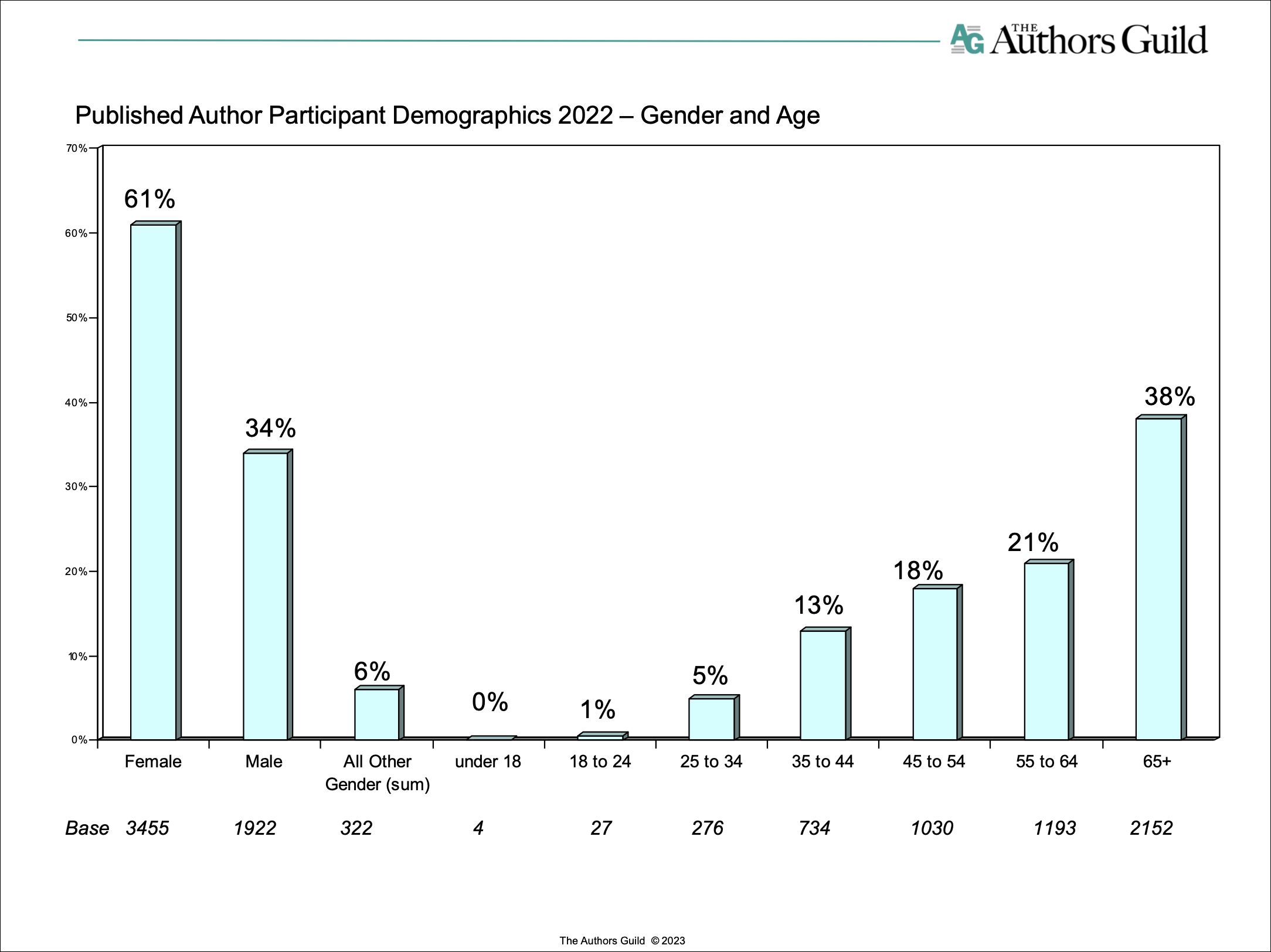
And this touches on the problematic nature of this research: You’re only getting the people willing to give you this information, and that group skews older. Authors 65 and over make up 38 percent of the overall sample—an important consideration in these results, as we’ll see.
However, this new survey segments authors in ways that help bring meaning and clarity. The data can be sliced and diced to look at traditionally published or self-published authors, full-time or part-time authors, year of first publication (2018 or prior, versus 2019–2022), book-related income and non-book-related income, genre/category, and race. Overall, about half of the survey respondents are traditionally published and half are self-published. In my discussion with Hildick-Smith, we discussed how this study highlights interesting opportunities for authors and perhaps bigger sea changes in the industry. I personally think that’s far more meaningful than the raw income data.
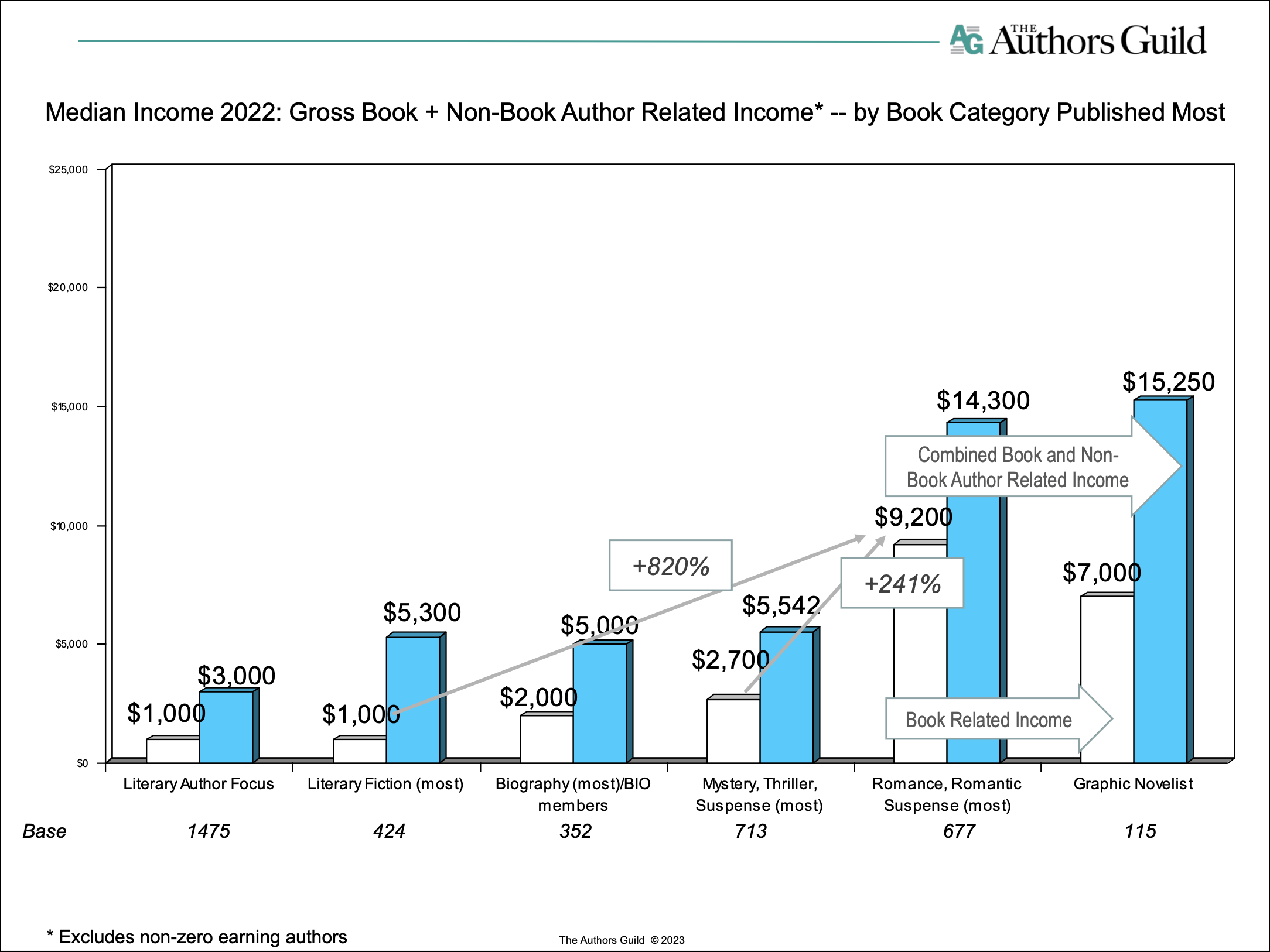
But let’s look at income to start. For me, the survey underlines what most people know after being in the business of publishing for two seconds: The genre or category you write in directly affects your potential earnings in addition to how prolific you are as an author. Romance has long been the most widely read and published genre, and it has seen considerable sales growth in the last year. Other types of commercial fiction—like mystery/thriller—are also dependable for income. This fact comes through plainly in the following graph, where romance authors report outearning everyone except graphic novelists. And who earns the least? Literary authors. No surprise there.
Where things get even more interesting is when you look at the same chart but focus only on the people who consider themselves full-time authors. In other words, anyone part-time (who may have a day job or who isn’t otherwise committed to full-time authorship) has been excluded. Here, romance authors come out on top. Moreover, they earn more from book sales alone than from other types of income, which makes sense, given that romance novelists tend to focus on publishing and marketing their books—not on speaking, teaching, or selling services. (More on this later, when we get to the marketing portion of the survey.)
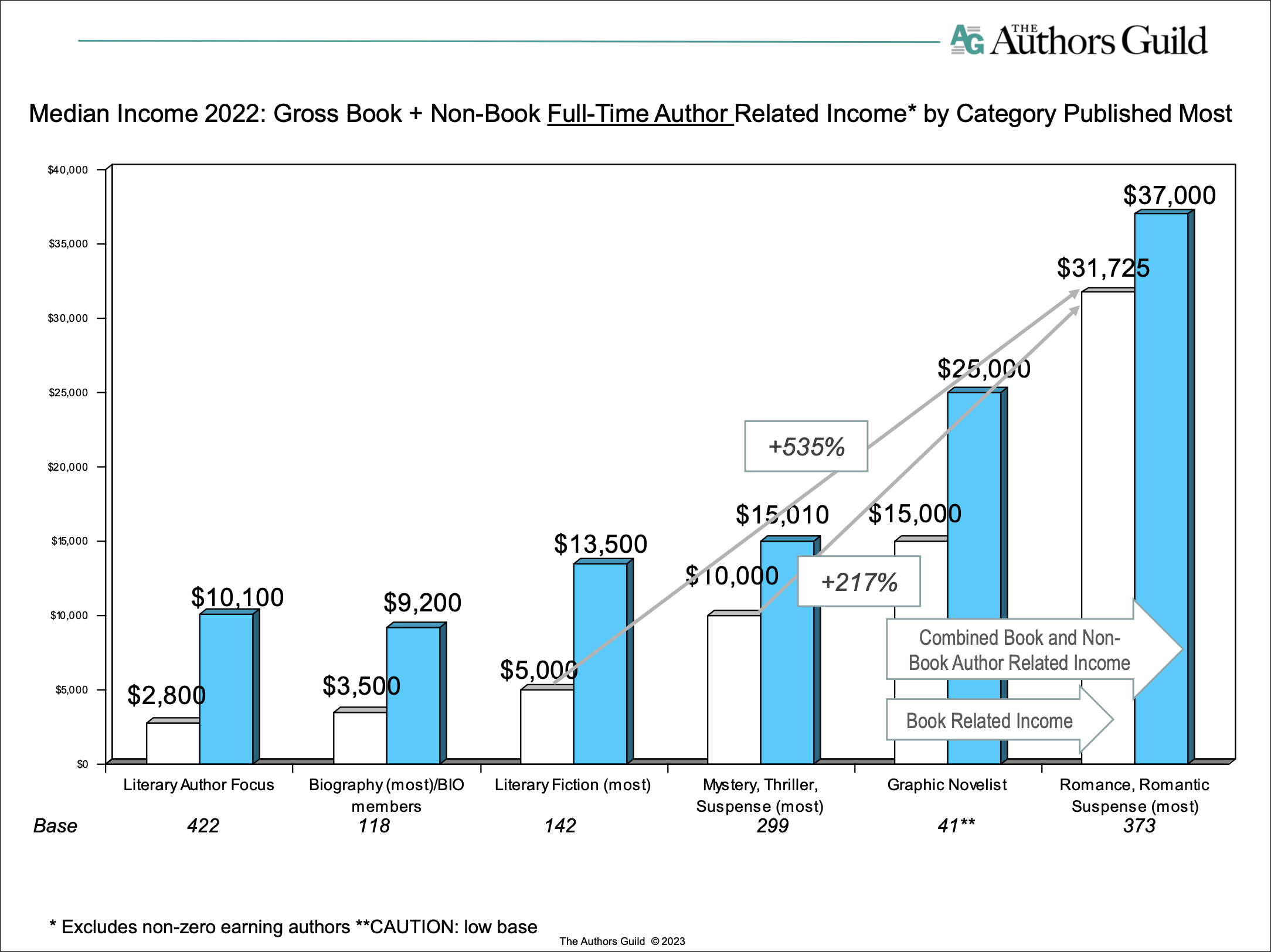
Again, note how the literary authors are bringing up the rear: because their books don’t sell in sufficient quantities, they really need that non-book author income from speaking, teaching, journalism, editing, and related activities. In case there’s any doubt: Commercial work consistently sells more than literary work, just as the name indicates. Throughout history, poets and literary writers have either worried or complained that readers are more likely to buy and read “lighter” entertainment; a continuing divide remains between so-called genre fiction writers and so-called literary writers. (I admit to greatly simplifying a complex issue; there is always overlap between the two.)
Authors most likely to report their income decreasing over the last five years? Traditionally published authors and those age 65 and up. I don’t find that a surprising result, especially given how dramatically book discoverability has changed (it’s more online-driven), and how self-published authors have taken away market share in certain genre fiction categories. But just as important, survey data shows that younger authors are spending more time on marketing than older authors on average. Also, as far as money invested, author marketing spend peaks among authors ages 45–54 and is lowest at 65 and up. Authors who invest less in marketing should expect author-related income to decrease.
Who is mostly likely to report their income is increasing? Authors publishing serializations and authors 25–44 years old. Overall, self-published authors were slightly more likely to report increased rather than decreased earnings; they were also far more likely to have published a book in the last year. A couple different details to highlight here:
- Last year, ALLi surveyed more than 2,000 authors and found that the median annual income for self-published authors was $12,749. This year’s Authors Guild survey finding is nearly identical for that segment: $12,800. For traditionally published commercial authors who are full-time? $15,000.
- Traditionally published commercial authors appear to hold a significant advantage in securing non-book income related to their career—there’s more upside in teaching, speaking, editing, and so on, with a median author income of $25,000 when combining book sales with everything else. For self-pub, it’s $15,000 all in.
One of the most important income findings I saw: When self-pub authors start out, they tend to earn exceptionally little compared to those getting traditional deals (or advances), which makes sense. But if the self-published author keeps going and becomes established (if they can hit the five-year mark as far as this survey), they are likely to outearn their traditional counterparts. Hildick-Smith wonders what this situation might look like in another five years: Will self-publishing authors continue to get smarter and savvier? Will authors publishing traditionally figure things out or fall further behind?
The survey reveals genres or categories in which authors are more likely to self-publish today. These include romance (by a very wide margin) as well as science fiction and fantasy. Traditional publishing still has a dramatic hold on children’s publishing and YA (where librarians and educators tend to rely on vetted material from publishers) and a moderate hold on mystery-thriller-suspense. On the nonfiction side, self-publishing predominates among self-improvement, religion/spirituality, relationships, fitness and diet, and Christian works. Traditional publishing predominates for history, current events, and investigative reporting, where authors likely need funds to support their research and time to write, in addition to a publisher willing to stand behind the value and veracity of the work.
Kindle Unlimited can be critical to self-publishing author earnings. The KU effect is so important, in fact, that full-time self-published authors can expect to earn the same amount as full-time traditionally published authors, on average, if they use KU. And self-published authors outperform—by a whopping 67 percent—traditionally published authors when you look at book-only earnings. That probably won’t come as a surprise to authors in KU, but it may come as a surprise to those in traditional publishing who don’t have experience with the platform. Nearly half of self-publishing author respondents distribute through KU, and 12 percent say it’s a major source of sales for their most recent self-published book.
A big area of opportunity for all authors? The audiobook format.Audiobooks are not being exploited that well by self-publishing authors, likely due to the expense and lack of experience in that format. But there’s also a considerable missed opportunity for traditionally published authors as well. Only 22 percent of traditionally published authors have over half of their books in audiobook format. AI narration might, over time, help close this gap, and if Spotify’s entry into the market increases audiobook discoverability and consumption, we might see more authors and agents taking action to exploit unused audiobook rights.
What marketing works to sell books? In an optional survey for those who published a book in 2022, authors were asked what marketing and promotion was most effective in increasing book sales. The highest-ranked efforts were Kindle Unlimited (or other subscription programs, like Scribd), ebook discounts or promotions (e.g., BookBub), and the author’s email newsletter. Marketing that was reported least effective: social media of all kinds and blogging. Some authors did not consider TikTok all that helpful, but it really depended on the genre of the author. TikTok was considered very effective by romance and romantic suspense authors as well as those writing African-American fiction, poetry, YA fiction, and new adult and erotic fiction.
And here’s the final kicker: Romance authors outwork, outspend, and out-hustle most authors, and their investment bears out in the increased income we saw earlier. Romance authors spent an average of two full days a week on marketing and promotion of their work, tying with authors of African-American fiction for most marketing hours spent per week. That’s 45 percent more than the mystery/thriller authors who were surveyed. Hildick-Smith commented, “Looks like dedication and hustle are the ‘magic bullet.’ Would other authors’ overall income performance similarly benefit with additional effort? Very likely, if at the same time they challenge the long-standing publishing tradition of relying on marketing intuition.” That means: Test and measure your results, then learn from and act on those measured results to further improve performance.
Bottom line: Some of the most memorable takeaways from this survey involve the differences between traditionally published and self-published authors. Other data points I saw showed evidence of how well self-published authors are able to market, promote, and sell their books to earn a living—if they’re able to keep writing and publishing over a sufficient period of time in a genre where there is market demand. I don’t envy traditionally published genre fiction authors, especially debuts, who must have a hard time competing against their self-published peers when trying to build a readership from scratch. They rarely have the advantage of competitive pricing, nor are they able to make use of KU in many cases (because large publishers won’t put their books in it).
Younger authors seem to be observing and grasping how the industry is changing. According to the survey, the younger the author, the more likely they are to prefer self-publishing for their next book. In fact, less than half of authors under 45 years old would prefer to have their next book traditionally published. For authors 25–34, 2 percent indicated they prefer to serially publish (e.g., Vella, Wattpad, Radish). I suspect that number would be much larger with a different author sample.
Finally, the survey results look sobering for anyone with a Big Five house: Earnings have declined for those authors over the last five years at the rate of inflation. The biggest selling authors are seeing their sales soften, which indicates to Hildick-Smith that the big traditional publishers need to think of some new approaches for marketing and promotion. For the top 10 percent of traditionally published authors, he said, “There are a lot of folks out there nipping at your heels, and you’re having to share the winnings a lot more.”
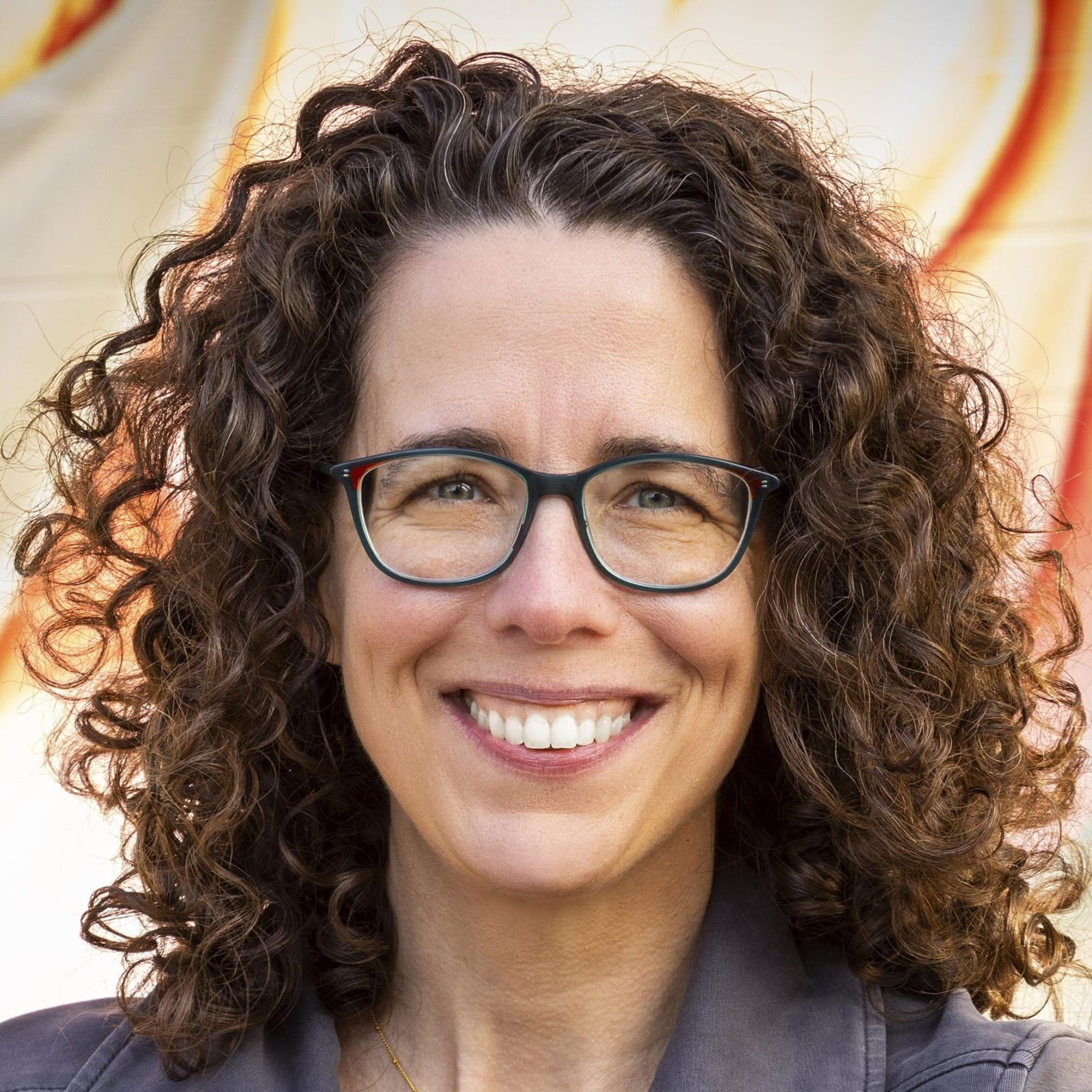
Jane Friedman has spent her entire career working in the publishing industry, with a focus on business reporting and author education. Established in 2015, her newsletter The Bottom Line provides nuanced market intelligence to thousands of authors and industry professionals; in 2023, she was named Publishing Commentator of the Year by Digital Book World.
Jane’s expertise regularly features in major media outlets such as The New York Times, The Atlantic, NPR, The Today Show, Wired, The Guardian, Fox News, and BBC. Her book, The Business of Being a Writer, Second Edition (The University of Chicago Press), is used as a classroom text by many writing and publishing degree programs. She reaches thousands through speaking engagements and workshops at diverse venues worldwide, including NYU’s Advanced Publishing Institute, Frankfurt Book Fair, and numerous MFA programs.