Social media listening services and advertising analytics help publishers customize book marketing and improve reach
For years now, the game plan for any book launch looked roughly the same across all traditional publishers: invest in advance reader copies, do bookseller and library marketing and mailings, give away copies for early reviews at Goodreads, run print ads, and conduct some partnership marketing where possible. Largely, publishers don’t track and measure these efforts, or it’s often impossible with something like print advertising.
Perhaps more important, the traditional book launch model has rarely been an efficient process and typically gets built from scratch with each title. With publishers’ limited staff and resources, that means a lot of books never get the support they need and don’t live up to their potential. To change outcomes, book marketers need to find a way to spend their budgets more wisely, preferably on channels they can measure, on campaigns they can gain knowledge from, and on tactics they can repeat.
Traditional publishers have been moving toward data-informed marketing campaigns in which success can be measured and audience data carries over from one book to the next. In a presentation last month at Digital Book World, Andrea DeWerd, a senior marketing director at HarperCollins, described the shift that’s occurring in broad terms and also offered a case study showing how the company uses data and measurement to better market and sell books. (Note that DeWerd used the term data-driven throughout her presentation, although we believe it accurate to say her team uses a data-informed approach. More on the differences here.)
A data-informed book marketing campaign starts with identifying the audience, media, and messaging. DeWerd’s team no longer has to start from the ground up on this because HarperCollins has created audiences and insights for specific categories and genres that can be used from one campaign to the next. To that foundation they add bespoke marketing elements for each book. Not only does this lead to better results, it allows the team to work on more interesting and fun elements of a campaign.
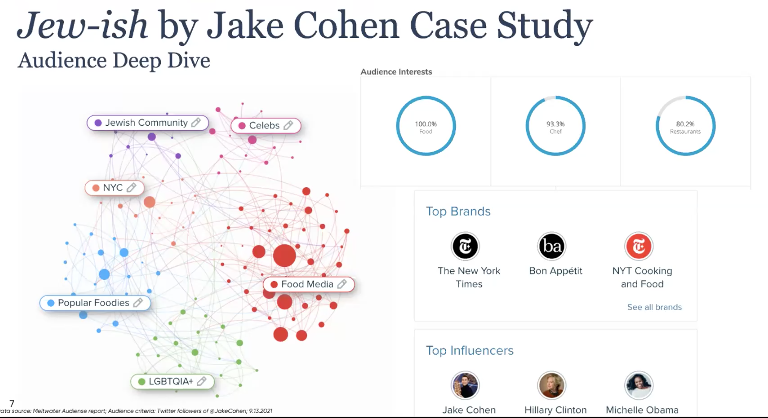
DeWerd’s case study focused on Jew-ish, an illustrated cookbook by Jake Cohen that hit the New York Times bestseller list. Going into the campaign, DeWerd’s team wasn’t sure if the book’s audience knew Cohen’s name or if they were more familiar with Feedfeed, where he’s a test-kitchen director. By using social listening and analytics tools Meltwater and Klear, they were able to quickly pull together insights on Cohen’s existing audience based on his social media presence: they were more female than expected, with a strong LGBTQ and New York City component. While the marketers knew some of this already, it confirmed their assumptions.
DeWerd said that they don’t have an in-house analytics team, so they need to use audience insight tools that the in-house marketers can understand even without a data background. That’s why they use Meltwater and Klear for this purpose; they are very user friendly. They can also export the data and share it with authors and agents to facilitate discussion and collaboration on the campaign. While individual authors typically can’t buy or afford enterprise tools like Meltwater, there are alternatives that can offer similar information at a more reasonable cost, such as SproutSocial, Mention, and SparkToro.
Study into Cohen’s online audience led to an important and early insight: amplifying his TikTok use would likely produce the best reach to his audience. So DeWerd’s team asked him to double-down on that activity. Then, the publisher placed TikTok ads for the book—but critically, these ads were identical to Cohen’s usual TikTok content except for the inclusion of a brief flash of the book cover. (Here’s an example: black-and-white cookie recipe.) The campaign was so successful that it now serves as a case study for a digital advertising agency, and DeWerd’s team shifted their ad budget away from simple banner ads over to TikTok. When running a digital ad campaign, weekly monitoring and optimization is important, DeWerd said. “Someone needs to be looking at this every week and making these decisions with human eyes.”
But what about fiction—or debut authors, or those with little to no platform? We asked DeWerd about this via email after her presentation, and she generously responded with an in-depth look at how she handles such campaigns:
- The first step is market research. What are the comp titles? Comps may include similar reads but also similar time periods, topics, or feelings. Do any of the comp authors have large social followings? (DeWerd defines large as more than 10,000 followers on Instagram, TikTok, or Twitter, which have the best public data.) Are there particular people or influencers talking about those comps? What hashtags are used in posts about the comps? On Goodreads, what keywords are used in reviews for those comps? What Goodreads shelves are used (the surprising ones, not general ones like mystery)?Do the Goodreads reviews mention other titles that did not come up in the initial round of comps?
- The second step is to run reports with tools like Klear and Meltwater using the comp authors and influencers who talked about the comp titles. Who is talking about these comp authors and titles and where? Who is talking about specific topics and keywords related to the book? This requires specificity, e.g., “fiction about the Black experience in America.” DeWerd also runs more general reports on overall genres one or two times per year: What does a general contemporary romance reader in the US on TikTok look like these days? What does a mystery lover look like?
- Finally, DeWerd and her team synthesize their learnings from all the reports. What audiences are similar and where is there overlap? Where is more information needed? If her team needs more data, they will get more reads by conducting another a Goodreads giveaway, NetGalley promo, or Instagram giveaway. That ultimately seeds more online activity around the book and surfaces more marketing data. Sometimes new comps will come up as a result of reader reviews.
DeWerd adds, “That last step is important—fiction takes a lot of ‘send books out, get reviews, wait, and measure,’ to be successful. It takes time to do that.” And, “On top of building buzz, it gives us time to get to know our audience, what they’re responding to, and the best way to engage them!”
Bottom line: DeWerd said of their old campaigns, “We would spend all of our money on a print ad, blow all our budget in one shot, and if it doesn’t work, we’ll say maybe it was the cover. [But] we didn’t know why it didn’t work.” Now, her team engages in message testing and can optimize the campaign in real time. In essence, DeWerd said, it gives them a second chance (or third or fourth) to make a book.

Jane Friedman has spent her entire career working in the publishing industry, with a focus on business reporting and author education. Established in 2015, her newsletter The Bottom Line provides nuanced market intelligence to thousands of authors and industry professionals; in 2023, she was named Publishing Commentator of the Year by Digital Book World.
Jane’s expertise regularly features in major media outlets such as The New York Times, The Atlantic, NPR, The Today Show, Wired, The Guardian, Fox News, and BBC. Her book, The Business of Being a Writer, Second Edition (The University of Chicago Press), is used as a classroom text by many writing and publishing degree programs. She reaches thousands through speaking engagements and workshops at diverse venues worldwide, including NYU’s Advanced Publishing Institute, Frankfurt Book Fair, and numerous MFA programs.