I had not heard of wholesaler Faire until recently, when publisher Anne Trubek of Belt shared with me a rather fascinating story of how, at a recent meeting of independent publishers, she asked what others thought of Faire and if they were using it. The response she received was uniformly and vehemently negative—that Faire cuts out publishers’ sales reps and is impersonal, among other issues.
Faire is a tech wholesale business-to-business marketplace that launched in 2017, built for the gift, jewelry, and home goods market. In 2022, Publishers Weekly reported on the growing use of Faire by publishers and bookstores alike. By that point, Faire had 600,000 independent retail accounts and 85,000 brands, and book publishers were starting to get onboard, largely to sell books directly to gift and specialty stores (although bookstores use Faire, too). Just as in other areas of publishing, wholesaler and distributor consolidation has left few players, creating a wholesale gap to fill.
I reached out to nearly a dozen mid-size, small, or independent publishers, asking if they would discuss Faire. Only two would speak on the record (Trubek and Joe Biel of Microcosm), but I was able to glean enough insights from other conversations, as well as my own exploration of the Faire website, to understand why retailers like Faire and why it is growing.
Faire has seen a 43 percent year-on-year sales increase in the books category in the first quarter of this year, according to a company spokesperson. The number of active publishers has grown 32 percent year on year, and the average number of products per publisher has increased 226 percent in the last year. The total product catalog for the Books category on Faire increased fourfold in that time. During the prior year, that same metric only doubled, so this year’s pace of growth is faster. As of today, all of the Big Five publishers maintain an active Faire storefront, most with a Top Shop designation and hundreds of ratings. They aren’t putting their entire catalogs on Faire, but their curation still includes thousands of items. For some books, the minimum quantity required is one copy, priced roughly at 50 percent MSRP. Typically there is a minimum order amount; for example, at Penguin Random House, it’s $100.
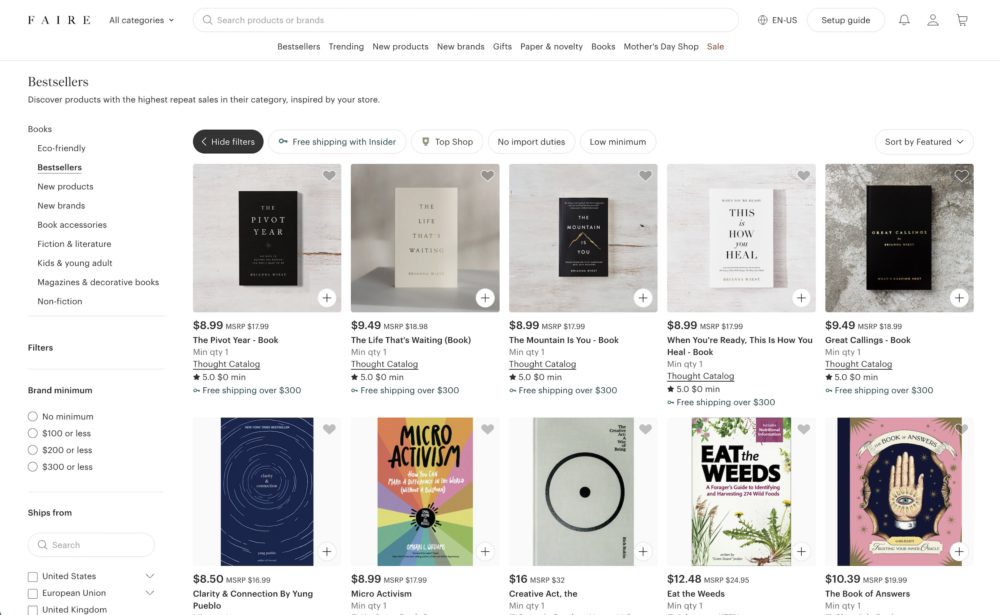
Books are ancillary to how Faire retailers shop and remain a small product category. Publishers whose titles have natural gift, lifestyle, or specialty appeal—illustrated books, regional interest, cookbooks, mind/body/spirit—are most likely to benefit, rather than publishers with large, general-interest lists. In 2022, Red Wheel/Weiser, which publishes titles for the gift market and is known for mind/body/spirit titles, told PW they had shipped to more than 300 accounts during their first months on Faire, and the majority were new customers. Faire’s latest numbers suggest that trajectory has continued. However, books are unlikely to become a major component of Faire’s business. Biel told me that when Microcosm asks for platform features, Faire tells them to wait until publishing reaches 5 percent of their sales.
A gift store buyer who shops for books on Faire is likely looking to round out a display, not put books front and center. For example, if you browse the Chronicle Books shop, you’ll find collections right now focused on Gourmet + Wine Retailers, Toy Stores, Game Stores, Baby Shower Gifts, and Graduation.
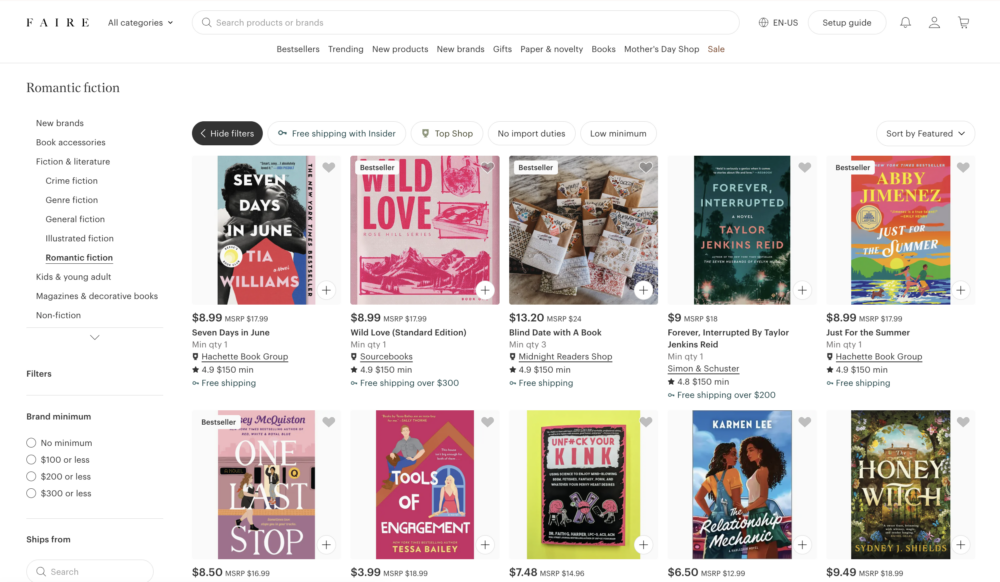
Still, more general-interest books now get listed on Faire than before. In 2022, Sourcebooks told PW they weren’t making fiction available for sale on Faire—only gift titles—but that dynamic has changed. Today all kinds of books are available, with specific categories listed for browsing: genre fiction, crime fiction, and romantic fiction, in addition to kids and young adult categories. You can also find distributors like IPG and Stable Book Group listing on Faire.
So why aren’t more publishers talking about Faire, and why can Faire spark a negative reaction? Mainly the tension relates to publishers who use commissioned sales reps focused on geographic territories and relationships with retailers. If retailers place an order through Faire, the sales rep may not get a commission for it. However, Faire does have a mechanism for publishers to designate existing accounts and protect rep commissions; it requires documentation, such as prior invoicing, outreach records, or rep relationship history. However, some publishers simply let Faire orders process without flagging existing rep relationships. Or, publishers may find they don’t need or want to pay sales reps any longer. Biel said that Microcosm severed its gift reps on the West Coast because “Faire actually was a better way of reaching the West Coast.”
Publishers may use Faire as a complement to rep relationships, not a replacement; they may encourage reps to deepen relationships with accounts that are already buying through Faire. And publishers are not necessarily hiding the fact their titles are on Faire; Chronicle makes it plain, as does Thought Catalog and Red Wheel/Weiser. Publishers I spoke with more often report a good experience when combining Faire with in-house sales reps rather than commission reps.
Publishers pay a $10 new-customer fee plus a commission to Faire when it drives new relationships or sales. In 2022, PW reported the standard commission on such orders as 15 percent. If the retailer uses Faire because of the publishers’ direct link (and/or a pre-existing relationship), Faire charges zero commission, only payment processing fees. But drop-shipping readiness, a prerequisite to working with Faire, can increase costs and is a different operational burden than shipping cartons to wholesalers. This can potentially push small Faire orders into loss territory. However, Faire guarantees payment to sellers regardless of when retailers pay.
Typically, bookstores are not supposed to order books through Faire. In practice, some do, classifying purchases as sidelines or using the platform for convenience. Biel offered the example of Main Street Books in Minot, North Dakota. The store has been in business 40 years but has never been visited by a rep group. Faire succeeds in reaching the nooks and crannies of the market that road reps can’t efficiently cover. Biel said, “The stores find you; Faire makes sure you get paid. You’re not left hanging if a customer has an unpaid bill. … This is how we reach middle America.” He says the number-one thing he hears from bookstore Faire buyers is that this is how publishing should have been operating for decades, yet it’s this outsider tech company that’s stepped in with the solution.
Faire does come with significant customer service requirements, especially when there’s no sales rep in the mix. Just like other platforms, Faire rewards responsiveness from vendors and penalizes neglect through its rating and discoverability systems. Any publisher selling meaningfully on the platform must have an employee assigned to dealing with Faire every day. Biel noted that serving retailers who use Faire can sometimes present unique problems. Many have never ordered books before and don’t know publishing conventions—that books arrive in multiple shipments, that trim sizes vary, that a hinge score on a binding is not a defect. This is where Biel continues to find sales reps valuable. They keep things more streamlined, and the rep provides “the social labor” of preparing customers, explaining what to expect from the publisher, how shipments arrive, and so on, which reduces the customer-service burden on the publisher’s end.
Bottom line: Today, the largest publisher in the world, Penguin Random House, has a Top Shop designation on a platform where candles sell in bulk quantities. That’s because Faire fills a distribution gap that publishing has in part created for itself: through territorial rep structures that can leave some states neglected, plus wholesale relationships that require too much paperwork or too many phone calls. Publishers need diverse methods of reaching retailers, and whether they admit to it or not, they’re increasing sales through Faire—so much so that Biel told me that it’s now very late in the game for a publisher to begin selling there. Instead, he suggested publishers find a sales group who understands their line, or “look for the next Juniper or Abound platform.”
Correction
This article mistakenly reported that Microcosm replaced their West Coast reps. They replaced their gift reps, but not their trade reps. Also, Biel said he wouldn’t recommend NuOrder to other publishers instead of Faire, but he does suggest publishers find a sales group who understands their line or “the next Juniper or Abound platform.” We regret the error.

Jane Friedman has spent her entire career working in the publishing industry, with a focus on business reporting and author education. Established in 2015, her newsletter The Bottom Line provides nuanced market intelligence to thousands of authors and industry professionals; in 2023, she was named Publishing Commentator of the Year by Digital Book World.
Jane’s expertise regularly features in major media outlets such as The New York Times, The Atlantic, NPR, The Today Show, Wired, The Guardian, Fox News, and BBC. Her book, The Business of Being a Writer, Second Edition (The University of Chicago Press), is used as a classroom text by many writing and publishing degree programs. She reaches thousands through speaking engagements and workshops at diverse venues worldwide, including NYU’s Advanced Publishing Institute, Frankfurt Book Fair, and numerous MFA programs.