
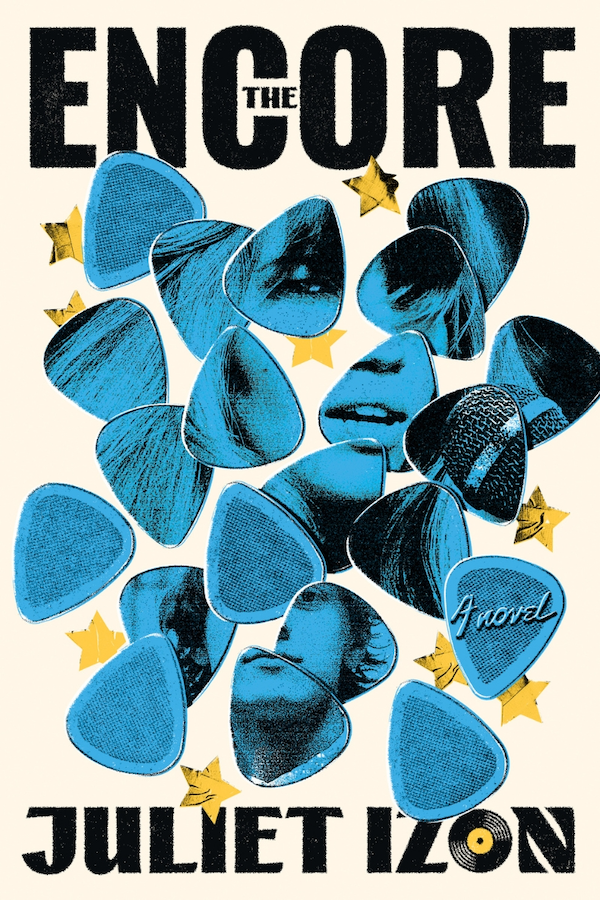
Today’s guest post is by journalist and author Juliet Izon. Her debut novel is Encore.
When I made the decision, nearly a decade ago, to leave the (relative) stability of an on-staff editor position to pursue the (again, relative) freedom of freelance writing, it was with one goal in mind, foremost: autonomy. After so many years of being assigned stories, oftentimes on topics I had little interest in (golf and watches, I’m looking at you), I was hungry for the chance to write more in-depth on subjects that excited and intrigued me—the kind of pieces that don’t feel like work because you’re enjoying the process so much.
Since then, and with a lot of hard work, I’ve been fortunate to build up a pretty awesome stable of clips, from outlets—Vogue! Conde Nast Traveler!—that high-school me could have only dreamed of nabbing bylines in. But what I didn’t fully understand when I went from writing primarily short, listicle-type articles to longer, more narrative-based feature pieces, is that the role of your editor significantly increases. Let’s be honest: there was only so much I could screw up in a piece about new veggie burgers to try in New York City. Penning a piece, say, on the significance of the first Filipino cardinal to have a shot at the papacy is a little more nuanced.
But when you’ve toiled over a story for days or weeks, and you truly feel like it’s the best representation of your skill as a writer, and then you get a Google Doc that’s a sea of blue from in-line corrections from your editor? Yeah, that hurts. Because even when you’ve been writing for as many years as I have, your first thought is often: “Wasn’t this nearly perfect as it was?”
Reader, I’m holding your hand as I say this: it wasn’t.
Writing, as we know, is a solitary sport. And the longer your story is, the more hours you’ll spend alone while you craft it. But unless you’re penning a magnum opus for your eyes only, the reading of your work will reach hundreds—thousands if you’re lucky (and more if you write about hockey players). And even if you’ve read and edited your story yourself so many times you see it imprinted on your eyeballs, that’s not the same as it being the best version of itself. For that, you need a second pair of eyeballs, one that’s approaching your work with expertise and a lived experience that’s different from your own. In other words … an editor.
I’ve had no choice but to develop a thicker skin when it comes to critiques of my writing because if I wanted to stay in journalism, that’s par for the course. But writers don’t need—nor do they often have—years of being edited in order to approach the process in a healthy way. You just need a few emotional shortcuts, which I’m happy to give you from my own, hard-earned experience. (And I can double-vouch for this advice: I put it all into practice during the multi-round editing process for my debut novel, The Encore, published by Union Square & Co.)
Do not tackle edits right away
Instead, sleep on them. No, really: your brain, quite literally (look this up!), needs time to absorb the information while you sleep. So, sure, read the edit letter or the in-line notes right away, but then … don’t act on them. Allow yourself the mental and chronological space to metabolize it all. I guarantee in a day or two, suggestions that your editor made that you, at first, felt were outlandish will seem less so, and probably really smart. And a large volume of edits, promise, will seem easier to tackle when you begin to do so after a pause.
My editor, for example, wrote an offhand suggestion for the latter third of the book while we were in dev edits which, on first read, I had already made up my mind to disregard. But I woke up the next morning and knew she was right. Adding in this plot twist meant rewriting a substantial bit of my last chapters, but that final act of my book is so much stronger for it.
Your editor is on your team
If there is one lesson I’ve learned through partnering (see that word? partnering) with editors over the years on all types of stories it is this: they are on your side. Yes, your knee-jerk reaction to edits may be defensive: “Didn’t they see that point was made in this paragraph? No, that character’s motivations are absolutely clear!” But remember that your editor’s job is not to antagonize you, it’s to make your work better. If they’re flagging that a sentence is unclear, it’s not because they hate you. It’s because the sentence … was unclear.
You both want the same thing, after all: for your work to be the best version of itself and to succeed. An editor with a lot of notes is just trying that much harder to make that hypothetical a reality. Be more wary, instead, of the editor who leaves you next to nothing.
Edits are not personal
The longer the manuscript, the more emotionally entangled you probably are with it; this is just gospel writer psychology. But you are not your manuscript. And critiques of your work are not critiques of you as a person. Your editor doesn’t dislike you just because they think your pacing is off in that one chapter, or even if they don’t love your main character as written. Don’t let your self-worth get dinged for a reason that’s unrelated to it.
There have been so many times when I’ve received a document back from an editor that is covered in blue suggested changes and I’ve thought to myself: “They’re never going to want to work with me again!” And then I run into that same editor at a cocktail party a few weeks later and at no point do they ever tell me that we can’t hang out because I mistakenly hyphenated adverbs.
Don’t be afraid to ask for help
True story: I had not written in Microsoft Word in over a decade when I found out that all of my major edits for my novel would need to be tackled in the software. My editor sent out her first round of edits and left instructions for how to address her comments, and I immediately wrote back and said something super peppy like, “You got it!” Obviously, I did not have it. And rather than just futilely Googling “wtf is a track change?” I took a deep breath and sent an email with all my granular, follow-up questions on the editing process. She wasn’t mad! Instead, like a normal person, she explained what I didn’t understand, and then I was able to add track changes of my own without worrying I had just messed up an entire 100,000-word document. Progress!
Turn in your work on time
Publishing deadlines, as opposed to journalism ones, generally have a bit more leeway. When you ask for an extension on the former, you might be granted weeks, if not months. If I asked one of my digital editors for the same length of time? They’d be laughing so hard I’m not sure they’d even be able to send a reply email. So yes, I am in the habit of turning in my work on time, because otherwise, that story will never run.
But punctuality isn’t some innate skill that only journalists possess: barring major emergencies, you, too, can be on time. You just have to make it a priority. And not only do writers who turn in their work on time receive a special place in literary heaven, they make their editors that much more likely to want to work with them again. And if there’s one lesson I hope you’ve learned from this essay, it’s that there is literally no one you want on your side more than your editor.
Now, all of this being said, am I delighted when I get a new batch of edits and it seems like there’s more wrong on the page than right? Of course not. But the above mantras help me move forward from any panic or despair much faster. And moving on means my work is that much closer to being out in the world—exactly where it belongs.

Juliet Izon is a journalist and author who has written for publications including the New York Times, the Wall Street Journal, Condé Nast Traveler, Food & Wine, and Architectural Digest. She lives with her husband, daughter, and two Ragdoll cats, splitting her time between New York City and the Hudson Valley. When she’s not writing, you can usually find her at a show: Broadway, ballet, art, or (naturally) a concert. The Encore is her debut novel.




Brava–great column filled with useful advice. Sometimes I think writing is like a rarified form of horseshoes in that you’re continually trying to get something as close to a finished product as you can. The process never seems to end, and you have to accept that. Otherwise, good editors are priceless. My daughter edits my manuscripts. She’s brilliant at it.
I sooo relate to this piece. On both sides. As a writer, I’ve had those moments where I absolutely disagreed with an editor’s comment before bed and absolutely agreed the next morning. And as a editor, I’ve had writer-clients get very upset with edits I’d made to a manuscript and I’ve had to (gently!) explain that we’re all on the same team and want the work to be the best it can be. I always say that journalism made me a better writer. But I also think it made me a better business professional, which is just as important. Wishing you much success with your debut novel!
As someone who has spent 40 years (and counting) in newspapers, I cannot endorse this column enough. I’ve been on both sides of the table, as a reporter/writer and an editor, and I know exactly the mindsets addressed here. EVERYONE needs an editor, even editors! Thanks for taking on this important topic.
In my four decades working as a journalist (over five hundred articles written for eight magazines), I’ve learned that some lesser editors you’ll inevitably work with over the course of your career will feel compelled to unnecessarily edit clean copy because they feel their job title requires it. Sometimes an edit is annoying but something you can live with: for example, the unnecessary insertion of punctuation that slows your pacing or blunts a punchline. But I can’t count all the times conjunctions have been swapped (“and” replacing “or”) to wrongly imply equivalence, determiners were substituted (“the” replacing “a”) to incorrectly change a noun’s reference, or a conditional clause was deleted to tighten up a sentence but resulted in a potential attribution becoming absolute. Still, the editor is your boss and you must preserve the relationship. What I’ve learned to do is politely point out any edits that are technically or factually incorrect (your editor will appreciate this!) but not sweat the small stuff.
I love how this guidance on the writing process is also sound wisdom for living and working with others. Thank you, Juliet, and good luck with your book.
Great article.