Probably the number-one disappointment authors have with their traditional publishers: lack of book marketing and publicity support, both real and perceived. Why real? Publishers have stretched staff, limited time, and too many books to adequately support. Why perceived? Publishers do a lot of work behind the scenes that can go unrecognized by authors, not least because publishers can be poor communicators about in-house efforts.
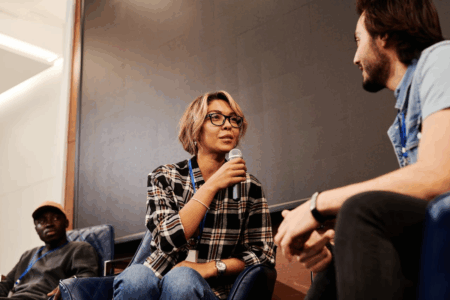
At the US Book Show last month, a panel of experts gathered to discuss how authors can best launch their book in collaboration with their publisher and/or with outside help. Panelists included Michelle Aielli, who oversees publicity and marketing for Hachette; Brianna Yamashita, executive director of marketing at Simon & Schuster; Alison Rich, senior vice president of author development at Penguin Random House; and Nathalie Ramirez, director of marketing at Zando. Moderating the panel: Audra Boltion-Ortiz, president and CEO of Boltion Group Public Relations.
Knowing the publisher’s anticipated marketing and publicity timeline is a starting priority for any author. As a general rule, publishers start working directly with authors on marketing and publicity about four to seven months prior to pub date. But that doesn’t mean internal work doesn’t begin earlier—most publishers are laying the groundwork about 18 months ahead of time, and some titles need a longer runway to succeed. For example, if a book might be right for a celebrity book club, then titles are typically sent for consideration eight to nine months before the pub date. Aielli said that Hachette had their first marketing meeting with an author of a May 2024 release in December 2022. “That’s very unusual. But this is an individual that has a lot going on in a lot of different areas,” so there needed to be early discussion of launch focus to get everyone moving in the same direction. “This was not a meeting for us to say, ‘Okay, we’re going to start reaching out to Fresh Air.’” Very early in the process it’s also helpful for authors to be up front with the agent or publisher about any bad media experiences or relationships that could affect planning, as well as any unique opportunities or advantages the author has in hand.
For some titles, the publisher is not eager for the author to start marketing and promoting early; this is often the case with celebrity books. Yamashita said that’s something where “we can wait until that five- to six-month period, because frankly you might lose attention if you start crowing about it too early. It really does depend on the book.” Aielli told authors and agents alike to have a conversation with the publisher if you believe the title needs a longer runway to succeed. “I don’t think any publisher is going to be like, ‘No, we cannot speak to this person until six months before publication,’” Aielli said. “But on a realistic note, eight to nine months ahead of publication is when metadata gets uploaded to online retailers. So I don’t think any of us on this panel would want an author actively promoting anything until someone could actually pre-order the book. So that’s a marker.”
Publishers are still interested in generating pre-orders when possible. As far as knowing for sure what will move the needle for a book, Aielli says pre-orders are the surest bet out there. “The more pre-orders an author can accrue, the more copies we get out, the more we print, the wider the distribution, and the more visible that book is in terms of retailers,” she said. “I encounter authors a lot of the time—you’d be surprised—who are like, ‘Oh, I can’t ask that person to do that.’ But that’s the time. This time in the lead-in to your publication is the time to ask all of your favors, call your famous friends, call your influencer friends, call the people that run the massive organizations that have supported your work. Call them all. And do everything you can to amass pre-orders.” The earlier this happens in the process, the more it affects the publisher’s campaign and the book’s distribution.
Before the pre-order campaign, authors should engage with readers or target communities in the year or two (or more) leading up to launch.Rich said, “There’s still a lot of organic work an author can do to build community, strategize what platforms [to use] and how and where they want to show up.” That takes time to do authentically so that when the author does turn around and ask their community to buy the book when it’s available, those people care and they’re invested. Rich admitted that the publisher’s machinery is not “super designed” for that organic, community-building period, which—let’s be honest—falls almost entirely on the author to initiate and sustain. Ramirez said that, while she’s not saying every author needs to have a huge online following, “They do need to be observing and understanding and seeing what’s working on social media, just so they can take part in that authentically when their book is ready.” (For authors who aren’t sure where their readers are, see our 2022 piece Find Your Readers for Free.)
Do authors have to be on social media for their book launch? Not necessarily, but the bulk of many examples and suggestions from the panel centered on social media because it’s seen as the easiest and most immediate way for authors to be visible, make connections, and build community. The same principles can be applied to whatever goal the author might have, like getting on the Today Show. Rich said, “If you think you belong on the Today Show, then go watch the Today Showand understand what they’re talking about.” In brief: observe and engage in the channels where you think your readers are or where authors and creators you respect are showing up. See what’s resonating, see how it’s resonating, connect with people who are in a similar space to you. Ramirez said authors can take a local or regional approach by building relationships with booksellers and understanding what’s working for them. “The more people you know, the more chances there are of opportunity,” she said.
More than ever, authors wonder if they need to be on TikTok. While the panelists agreed that TikTok and the BookTok community have been important for book sales (and Ramirez was confident in predicting that it’s here to stay), no one thinks it’s appropriate for all authors. “It’s about going where you think your readers are and engaging and listening and taking part,” Yamashita said. “I’ve authors who want to get on TikTok, and I’m like yeah, but you’re a stodgy professor of history books and hate being on camera, and you can’t do a video [to save] your life—you can barely text me—so, like, no, don’t go on TikTok, that’s not your audience. … If you are not a video person, then that’s not the outlet for you.” She continued later with her example, “Maybe you should be on Substack instead, because you can’t write an email that’s fewer than three pages.” (Side note: If you’re sending your marketer or publicist three-page emails, time to stop.)
The unsexy truth is that there’s no “best use” of every author’s time or marketing and publicity dollars. Everything depends on the book. Fiction and nonfiction work differently. Debuts and established authors work differently. And so on. If advising an author who has a minimal budget for book promotion on how to best allocate their limited resources, Aielli said, “I’m sure many [agents] in this room have been faced with a no from a publisher on spending $2,000 or $2,500 to send their author to the LA Times book festival or spend money on online advertising. With that amount of money, I’d say that the author may want to consider supplemental support [to their publisher] if they feel like their publisher is really working with them.” Yamashita agreed. “A lot of it does depend on what your publisher has gotten [marketing and publicity wise] and is able to do. I would always say do this in consultation with your publisher. They will actually tell you where they think you should spend your money.”
What if, despite everyone’s best efforts, the book isn’t selling? Ramirez said, “Open communication is the best route. So there’s full transparency, nobody’s tip-toeing, and you can really be collaborative. … Figure out what stone has been left unturned, and try that.” Aielli added that if the agent and author have been involved and included in the marketing and promotion from the start, it makes these hard conversations more productive. “The agent will already have a sense early on where the pain points are,” she said. “If you are in the loop early, I feel like the approach can be one of more collaboration and brainstorming as opposed to accusational.”
Bottom line: Rich said it’s hard for publishers and authors to cut through all the noise today, so if you plan to cut through, you have to spend a lot of time on laying your marketing and promotion foundation as early as possible. The panel’s moderator, Boltion-Ortiz, said, “It’s like training for a marathon. You do all of the healthy things before, and they all really do matter.” Later on, authors need to be honest and get on the same page as the publisher about what’s working, what hasn’t yet been tried, and how to invest any available resources.

Jane Friedman has spent her entire career working in the publishing industry, with a focus on business reporting and author education. Established in 2015, her newsletter The Bottom Line provides nuanced market intelligence to thousands of authors and industry professionals; in 2023, she was named Publishing Commentator of the Year by Digital Book World.
Jane’s expertise regularly features in major media outlets such as The New York Times, The Atlantic, NPR, The Today Show, Wired, The Guardian, Fox News, and BBC. Her book, The Business of Being a Writer, Second Edition (The University of Chicago Press), is used as a classroom text by many writing and publishing degree programs. She reaches thousands through speaking engagements and workshops at diverse venues worldwide, including NYU’s Advanced Publishing Institute, Frankfurt Book Fair, and numerous MFA programs.