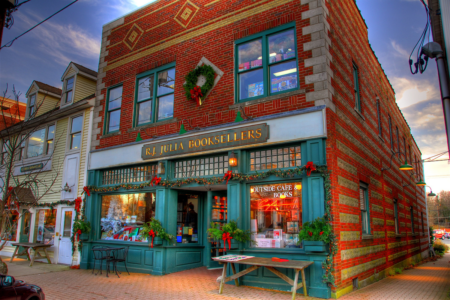
While authors may see little effect from the sale of the small Foyles chain to the UK’s big company, the important point for most seems to be “anything but Amazon”
Initial reports of the sale of Foyles bookstores in the UK for an undisclosed figure featured headlines proclaiming “Shock and Mixed Reactions,” but after those first moments of surprise, The Bookseller’s editor Philip Jones wrote, “the trade was calm, the media untroubled; even the two once opposing Twitter accounts (@Waterstones and @Foyles) came together in fidelity.”
As it turns out, this is probably the friendliest possible takeover for Foyles. Waterstones chief James Daunt drove the point home, saying, “Together we will be stronger and better positioned to protect and champion the pleasures of real bookshops in the face of Amazon’s siren call.” The common-enemy appeal works every time.
Foyles is a 115-year-old family business that has seven stores. Most are in London, with one each in Bristol, Birmingham, and Chelmsford. And the company is 80 years older than Waterstones, which operates 283 shops, mostly in the UK (with a few in Europe). In the UK, the big chain is comparable in market dominance to Barnes & Noble in the States, but Waterstones is much more stable and profitable. It employs 3,500 people.
Foyles had struggled with business rates, as non-residential property taxes are called. Jones makes the point that “despite being 1 percent its size, Foyles pays almost as much in rates as Amazon UK does in corporation tax,” adding that rent for its various locations came to close to £2 million (US$2.6 million) annually.
A few years ago, Porter went to London for one of Foyles’ sessions on redesigning its flagship site at Charing Cross Road and saw a remarkable process in action: publishers, editors, agents, and salespeople sectioned off at tables, busily haggling over what features they felt the “new Foyles” should have. The result was the bright, white-and-blond-wood space now at Charing Cross—something like one of MoMA’s airiest galleries.
While there has been some hand-wringing among fellow booksellers that Foyles might be made into “another Waterstones,” Waterstones’ James Daunt has determinedly maintained a certain autonomy in his own chain’s locations and will likely do the same for Foyles (after, as Jones says, a few inevitable management changes).
Bottom line: Authors, while far happier seeing a small independent chain like Foyles saved rather than scuttled, should watch with literary agent Lizzy Kremer’s cautions in mind (paywall): “My concern in a books industry dominated by big companies is that … we need to ensure that authors’ economic needs are met,” she told The Bookseller. “Authors can’t club together into bigger, more powerful entities to protect their profitability in the way other parts of the business” can. At this point, little change for writers can be expected unless, down the road, publishers significantly renegotiate their sales agreements with Foyles-owned-by-Waterstones.

Jane Friedman has spent her entire career working in the publishing industry, with a focus on business reporting and author education. Established in 2015, her newsletter The Bottom Line provides nuanced market intelligence to thousands of authors and industry professionals; in 2023, she was named Publishing Commentator of the Year by Digital Book World.
Jane’s expertise regularly features in major media outlets such as The New York Times, The Atlantic, NPR, The Today Show, Wired, The Guardian, Fox News, and BBC. Her book, The Business of Being a Writer, Second Edition (The University of Chicago Press), is used as a classroom text by many writing and publishing degree programs. She reaches thousands through speaking engagements and workshops at diverse venues worldwide, including NYU’s Advanced Publishing Institute, Frankfurt Book Fair, and numerous MFA programs.